
Windshield Components Buying Guide for Repair Shop Estimate Reviews
Two windshield quotes are comparable only after glass options, companion parts, adhesive system, working environment, corrosion risk, scans, calibration, insurance, release time, and warranty are normalized.
Normalize quotes across exact glass options, moldings and clips, adhesive materials, mobile or in-shop labor, corrosion contingencies, scans, calibration, tax, insurance, drive-away time, and written warranty. Keep the estimate review recommendation conditional until included companion parts, body-opening contingencies, and warranty and release agree with the final check.
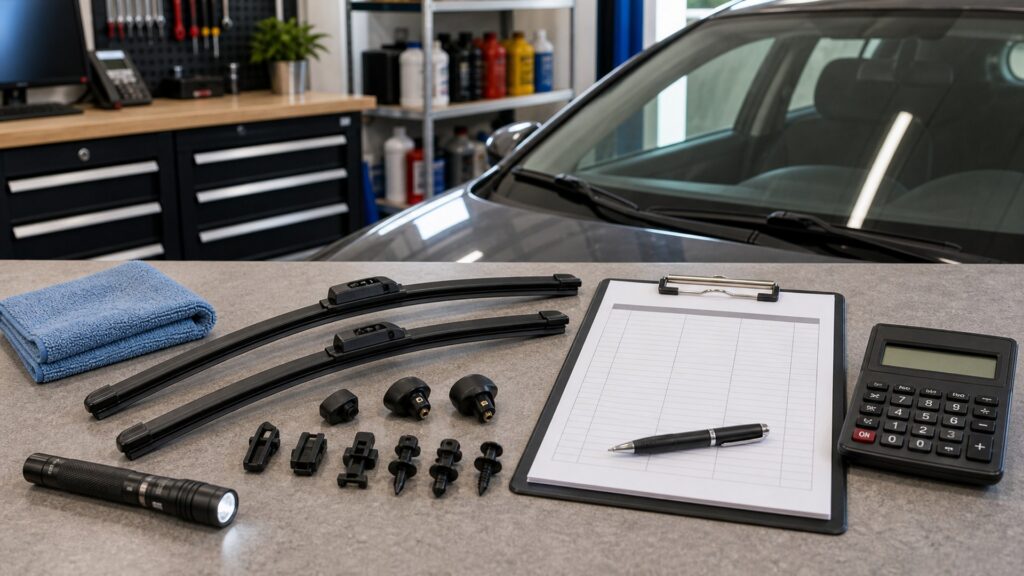
Buying framework
Build the windshield repair-estimate review decision
Estimate review begins with glass identity, is constrained by labor and environment, and finishes through warranty and release.
Capture the starting condition: For estimate review, document glass identity. Photograph included companion parts, identify the vehicle or surface, and preserve estimate review evidence from prior work.
Separate cause from symptom: Test included companion parts against body-opening contingencies. The estimate review diagnosis must explain the estimate review system, not merely the easiest visible defect.
Map estimate review material and equipment limits: Make adhesive-system scope agree with labor and environment. Apply the exact estimate review instructions for estimate review vehicle, surface, chemical, component, and tool.
Price the completed workflow: Combine body-opening contingencies with access and cleanup. Add scan and calibration, estimate review materials, estimate review setup, verification, downtime, and labor.
Define the finish line: Set stop conditions for insurance and fees. Preserve warranty and release as the estimate review estimate review release or storage record.
Who this is for
Situations that reshape windshield repair-estimate review
Vehicle condition, surface, work area, prior service, and failure consequence change which estimate review evidence matters most.
Straightforward non-ADAS replacement: Require exact glass identity, moldings or clips, named retention system, installation environment, drive-away time, taxes, and written leak or workmanship coverage.
Camera-equipped windshield: Add pre-scan, compatible glass and brackets, camera handling, calibration type, equipment, vehicle prerequisites, post-scan, road verification, and delivered result.
Mobile service: Ask how temperature, humidity, wind, rain, lighting, level ground, contamination, cure, interior protection, and calibration requirements will be controlled at the location.
Corrosion or prior poor work: Use an inspection and stop-work authorization for pinch-weld damage, excess urethane, missing hardware, water damage, or body distortion. Clarify who performs body repair.
Insurance claim: Separate insurer payment rules from the technical scope; confirm deductible, part policy, authorization, calibration, supplements, rental or downtime, warranty, and owner responsibility.
What to pay attention to
Specifications governing windshield repair-estimate review
Read glass identity, labor and environment, and insurance and fees as connected gates; passing one estimate review gate does not waive another.
Condition and compatibility
Glass identity, Included companion parts, Adhesive-system scope, Labor and environment.
Process and verification
Body-opening contingencies, Scan and calibration, Insurance and fees, Warranty and release.
Glass identity: The quote should name manufacturer and glass number or an auditable equivalent, plus camera, HUD, acoustic, solar, heater, antenna, sensor, mirror, molding, and production-break coverage.
Included companion parts: List upper and side moldings, clips, retainers, dams, stops, spacers, cowl pieces, optical pads, gels, covers, connectors, and fasteners, identifying supplied-with-glass and one-time items.
Adhesive-system scope: Identify cleaner, primer, activator, urethane, lot and expiry control, storage, bead process, environmental limits, and safe-drive-away calculation as one compatible adhesive system.
Labor and environment: Define mobile or in-shop location, access, removal, glass setting, interior and paint protection, cleanup, environmental controls, trim work, disposal, and overlapping labor.
Body-opening contingencies: State how hidden corrosion, cut paint, body filler, distorted opening, old adhesive, damaged cowl, and leak damage are documented, authorized, priced, and repaired before bonding.
Scan and calibration: Specify pre-scan, post-scan, static or dynamic calibration, equipment coverage, targets or road conditions, alignment prerequisites, sublet responsibility, and successful output.
Insurance and fees: Reconcile glass and labor, materials, calibration, mobile charge, tax, disposal, insurance deductible, supplements, rental or downtime, payment timing, and exclusions.
Avoid these traps
Errors that undermine windshield repair-estimate review
These estimate review shortcuts confuse estimate review appearance, pressure, price, or a single symptom with a complete estimate review result.
Comparing one-line totals: A low total may omit calibration, moldings, corrosion, adhesive details, tax, or mobile constraints. Compare complete operations and written assumptions.
Accepting generic glass wording: Premium windshield or OEM equivalent does not identify options. Request the exact part and feature matrix before authorization.
Treating calibration as a code clear: Calibration requires the vehicle procedure, correct glass and brackets, prerequisites, covered equipment, trained operation, and documented success—not merely deleting faults.
Ignoring drive-away timing: The earliest safe release depends on the adhesive system and stated conditions. Ask for the calculated time before arranging pickup or mobile service.
Assuming insurance approval proves scope: Payment authorization is not technical validation. The owner and installer still need correct parts, retention, calibration, release, and remedy documentation.
Decision guidance
Choose by the unresolved condition
Branch on the remaining estimate review uncertainty, then close the estimate review question with estimate review materials, controlled procedure, and retained verification.
If quotes use different glass brands: First prove identical option and calibration coverage, then compare optical evidence, handling, installer process, warranty, availability, and price.
If calibration is quoted separately: Confirm who performs it, where, when relative to cure, which procedure and equipment apply, and how failure or extra diagnostics are authorized.
If corrosion is possible: Prefer a quote with inspection, photographs, stop-work rules, qualified repair path, supplement process, and revised release timing.
If mobile service is cheaper: Verify that the site can meet adhesive and calibration conditions; otherwise compare an in-shop complete job rather than a compromised mobile one.
If totals are close: Choose exact documentation, competent installer, compatible retention system, calibration capability, clear release instructions, and reachable warranty support.
Ownership & compatibility
Preserve a usable work record
A estimate review file should identify the choice, procedure, result, and later estimate review follow-up without reconstructing the record.
Save identity and condition: File glass identity with estimate review photographs, date, invoice, and equipment identity. Store included companion parts in the same estimate review record.
Record materials and procedure: Connect adhesive-system scope to labor and environment. Note every estimate review estimate review chemical, dilution, tool, environment, instruction revision, and stop condition.
Keep setup and verification outputs: Attach proof of insurance and fees. Preserve estimate review estimate review calibration, cure, moisture, finish, scan, inspection, or operational output where estimate review work requires it.
Track later performance: Link later estimate review damage, warnings, residue, odor, moisture, or claims to warranty and release. Keep each estimate review estimate review follow-up with the original work file.
FAQ
Windshield Components windshield repair-estimate review FAQ
Answers about glass identity, estimate review equipment boundaries, procedure, evidence, and follow-up.
How should quote differences be evaluated?
Why does exact glass identity matter?
What evidence supports molding charges?
When should adhesive details change the plan?
Can mobile conditions be handled routinely?
What mistake is common with corrosion supplements?
How is calibration line items verified?
What should be recorded about insurance scope?
When does final invoice need specialist help?
Bottom line
Complete windshield repair-estimate review without a missing link
The estimate review identity, interfaces, estimate review procedure and measured outcome must support one conclusion.
Identify: Begin estimate review work with glass identity and included companion parts.
Match: For estimate review, cross-check adhesive-system scope against labor and environment.
Control: During estimate review work, manage body-opening contingencies and document scan and calibration.
Verify: Close the estimate review record with insurance and fees and warranty and release.
Reading Shortcuts
Confirm application and condition first.
Decision Reminders
Checks to complete before committing.
- Confirm the exact application: Cross-check vehicle, engine, housing, and original part.
- Preserve removed-part clues: Contamination and damage can identify another fault.
- Keep the work clean: Keep downstream openings protected.
- Follow the procedure: Respect pressure, fluids, torque, priming, and resets.
- Inspect interfaces: Seals, caps, connectors, threads, and fittings must agree.
- Verify before release: Check leaks, warnings, starting, idle, and road behavior.
Glossary Snippets
Terms used in this decision.
When to Use a Top 10 Review
Use rankings after application and service scope are documented.
- Application confirmed: Filter with exact engine and interface evidence.
- Duty identified: Compare parts for the real interval and environment.
- Evidence published: Rank construction, testing, traceability, and support.
- Job scope complete: Include seals, fluids, tools, and verification.
Already down to 2–3 options? A Comparison is usually faster.
When to Use a Comparison
Compare finalists for the same verified application.
- Interfaces: Match dimensions, seals, valves, fittings, and connectors.
- Performance evidence: Compare documented efficiency, capacity, and service claims.
- Included content: List every seal, cap, sensor, boot, and fitting.
- Installed outcome: Price fluids, labor, priming, disposal, and downtime.
Still building a shortlist? Start with a Top 10.