
Cordless Drills Buying Guide for Woodworking
Woodworking puts a different kind of pressure on a cordless drill than rough construction. The tool needs enough strength for hardwood and larger bits, but clean starts, low-speed control, comfortable balance, and a chuck that holds bits consistently often matter more than headline torque.
This guide helps you match a drill to furniture building, cabinets, shop fixtures, joinery, and general wood projects. It explains which specifications change accuracy and feel, when a second drill or impact driver helps, and how batteries, bits, and accessories affect the cost of the complete setup.
Buying framework
How to think about buying a cordless drill for woodworking
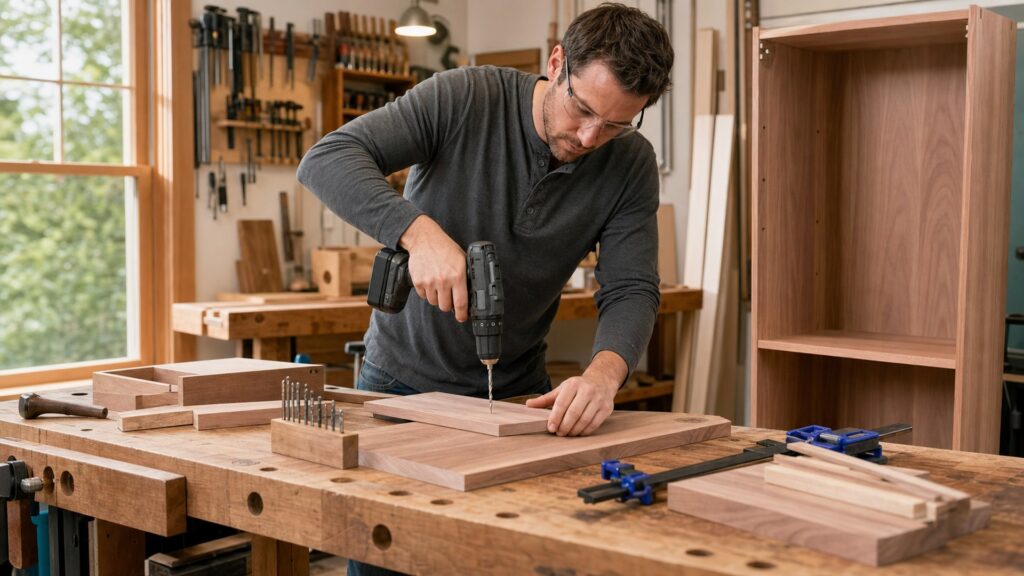
Start with the operations you repeat at the bench, not the largest number on the box. A woodworking drill should start holes where you mark them, control screws near finished edges, and stay comfortable through layout, drilling, assembly, and hardware installation.
Separate precision from brute force: Pilot holes, countersinks, hinge hardware, and pocket-hole assembly reward smooth control. Large Forstner bits and hole saws need more torque, but they should not dictate the entire purchase if they are rare.
Choose the size you will actually reach for: A compact drill is easier inside cabinets, drawers, and casework. A larger drill can manage demanding bits, yet extra nose length and battery weight can make careful assembly less pleasant.
Treat the chuck as part of the accuracy system: Reliable bit grip and low visible wobble help pilot bits, countersinks, and small twist bits track cleanly. A metal chuck is useful, but consistent clamping matters more than material alone.
Plan the drill-and-drive workflow: Many woodworkers use a drill for pilot holes and a second drill or impact driver for screws. This avoids repeated bit changes and lets each tool stay set for its task.
Buy for the wood and hardware you use: Dense hardwood, long structural screws, large holes, and cabinet hardware place different demands on the tool. Match the drill to the hardest common operation rather than an unlikely future project.
Who this is for
Match the drill to the woodworking you do most
The right drill changes with project scale, material, and how much time you spend fitting parts versus making large holes.
Furniture and small-project builders: Prioritize a compact body, gentle trigger response, useful clutch settings, and low weight for pilot holes, assembly, drawer slides, and hardware.
Cabinet and built-in makers: Look for short head length, a bright work light, dependable chuck grip, and batteries that fit into cases without making the tool tail-heavy.
Hardwood and thick-stock users: Choose stronger low-speed performance and a secure 1/2-inch chuck if you regularly use larger brad-point, Forstner, or hole-saw bits.
Shop-fixture and renovation builders: A versatile brushless drill with two speeds can cover jigs, benches, shelving, installation work, and occasional construction-style fastening.
New woodworkers building a first kit: A balanced drill/driver kit with two batteries is usually more useful than a maximum-output bare tool. Leave room in the budget for sharp bits, countersinks, and clamps.
What to pay attention to
Which cordless drill specs matter for woodworking
Woodworking performance is a blend of tactile control and usable capacity. Compare both groups instead of letting voltage or torque claims make the decision alone.
Specs that affect feel
Trigger progression, clutch repeatability, balance, grip size, head length, work-light placement, and low-speed smoothness shape accuracy during assembly.
Specs that affect capability
Chuck capacity, gearing, sustained low-speed torque, battery output, supported bit diameter, and thermal protection affect larger holes and dense material.
Trigger and brake behavior: A trigger that starts gradually makes it easier to center a bit on a mark. A predictable brake helps stop before a screw head sinks below the surface.
Clutch range: Useful clutch steps help with repeated hardware and small screws, but testable consistency matters more than a high number of settings.
Chuck grip and runout: Bits should seat securely and spin without obvious wobble. Excess runout can enlarge pilot holes, make countersinks uneven, and shorten bit life.
Two-speed gearing: Low gear supports larger boring bits and tougher screws; high gear speeds small pilot holes. A clear, positive selector is preferable to a vague switch.
Battery size and balance: Compact packs keep the tool nimble at the bench. Larger packs add runtime and output for boring, but can interfere inside cabinets or increase wrist fatigue.
Often overvalued: Peak torque and maximum RPM do not describe finesse, chuck accuracy, or how the drill behaves at the start of a hole. Those qualities are central to woodworking.
Avoid these traps
Common mistakes when choosing a woodworking drill
A drill can be powerful and still be frustrating at the bench. These buying errors usually show up as damaged work, awkward access, or money spent on capacity that rarely helps.
Buying the heaviest drill for future-proofing: Extra output brings extra size. If most work is pilot drilling and assembly, a bulky tool can reduce control on every project while its maximum capacity sits unused.
Ignoring chuck behavior: A slipping or visibly wobbling bit undermines accurate layout. Check user feedback and warranty support for the chuck, not only the motor specification.
Using an impact driver for every screw: Impact drivers are fast, but their pulsing action can be abrupt near delicate hardware and finished surfaces. A drill clutch often gives finer control.
Running dull general-purpose bits: Poor bits create heat, wandering holes, and tear-out that buyers may blame on the drill. Sharp brad-point, countersink, and boring bits are part of the system.
Forgetting cabinet clearance: Measure the drill with the intended battery and bit installed. Bare-tool dimensions can hide the space required to work squarely inside a case.
Decision guidance
Which cordless drill is right for your woodworking
Choose the lightest, most controllable tool that can handle your hardest routine operation without repeated stalling or overheating.
Choose a compact 12-volt drill if: Your work centers on small furniture, hardware, pilot holes, light assembly, and tight cabinet spaces. Confirm that the chuck accepts your common bits.
Choose a compact 18- or 20-volt drill if: You want one broadly capable shop drill for furniture, cabinets, jigs, and occasional larger holes without moving to a full-size high-output model.
Choose a full-size drill if: Large Forstner bits, hole saws, thick hardwood, long screws, or installation work are regular parts of your projects and you can accept more weight.
Add a second tool if: You frequently alternate between drilling and fastening. A second compact drill or a carefully controlled impact driver can make assembly faster and preserve setup.
Use a drill press instead if: The operation demands repeatable perpendicular holes, depth control, or large bits in work that can be brought to a stationary machine.
Ownership & compatibility
The long-term woodworking setup around the drill
The useful purchase includes batteries, bits, storage, and service support. A modest drill paired with accurate, sharp accessories can outperform a premium tool with a neglected bit set.
Battery platform: Consider whether the platform also supports sanders, saws, lights, and vacuums you may use. Compact and high-output battery options give the drill different handling characteristics.
Wood-specific bits: Budget for brad-point bits, countersinks, driver bits, Forstner bits, and quality hole-saw arbors that match your projects and chuck capacity.
Dust and chuck care: Brush dust from vents and chuck jaws, store bits dry, and avoid closing the chuck on debris. Fine shop dust can interfere with grip and cooling over time.
Cases and bench storage: A stable charging location and accessible bit organization reduce setup friction. Oversized molded cases may be less useful than compact shelf or drawer storage.
Service and replacement: Check warranty terms, local service options, battery availability, and whether a worn chuck can be replaced economically.
FAQ
Cordless drill buying guide FAQ for woodworkers
Quick answers about drill size, clutches, impacts, bits, and batteries for woodworking projects.
Is a 12-volt drill enough for woodworking?
Do woodworkers need an impact driver?
Does a metal chuck guarantee better accuracy?
What drill bits are best for clean holes in wood?
Should I buy a kit or a bare tool?
Bottom line
The simplest way to choose a woodworking drill
Prioritize controlled starts, dependable bit holding, comfortable balance, and enough low-speed capacity for the bits you use regularly.
For detailed bench work: Choose a light compact drill with a smooth trigger and useful clutch.
For an all-purpose shop tool: Choose a compact brushless two-speed drill in a battery platform that supports the rest of your likely tools.
For repeated large holes: Choose more low-speed capacity and a secure 1/2-inch chuck, or move the most exacting operations to a drill press.
Final check: Fit your common bit, install the battery size you expect to use, and judge the complete tool by control and clearance, not the bare drill alone.
Reading Shortcuts
Jump to the decisions that shape a woodworking drill purchase.
Decision Reminders
A short bench-side checklist before you buy.
- Start slowly: Smooth low-speed response protects layout and finished surfaces.
- Check the chuck: Secure, straight bit holding matters for clean pilot holes.
- Fit the whole tool: Battery size changes balance and cabinet clearance.
Glossary Snippets
Useful terms for comparing woodworking drills.
When to Use a Top 10 Review
Use a ranked list when you want a shortlist organized around shop size, value, and capability.
- You need a starting field: A Top 10 can surface compact, value, and higher-capacity choices.
- You know your project class: Rankings are easier to use after deciding whether precision or larger-hole capacity leads.
Already down to 2-3 drills? A Comparison can expose differences in size, chuck, batteries, and control.
When to Use a Comparison
Use a direct comparison once two or three drills appear suitable for your woodworking.
- The tools look similar: Side-by-side details reveal head length, kit contents, gearing, and battery tradeoffs.
- You are choosing a platform: Compare the wider tool range and battery costs, not only the drill.
Still exploring? Start with the Top 10 cordless drills to create a practical shortlist.