
Driving Displays Buying Guide for Vehicle Compatibility Checks
Test windshield and dash geometry, focal distance, forward view, airbag paths, sensor array, OBD or CAN data, camera unit formats, connected phone requirements, power source, bracket work, screen output, polarized eyewear, stock preferences, security, standby state function, and specified host car coverage.
This guide treats auxiliary-screen fit verification as a human-factors and host car-integration decision. Store the recommendation conditional until viewing geometry, optical performance, specified data or video, control surfaces, retrofit, and error condition recovery route agree in the confirmed host car.
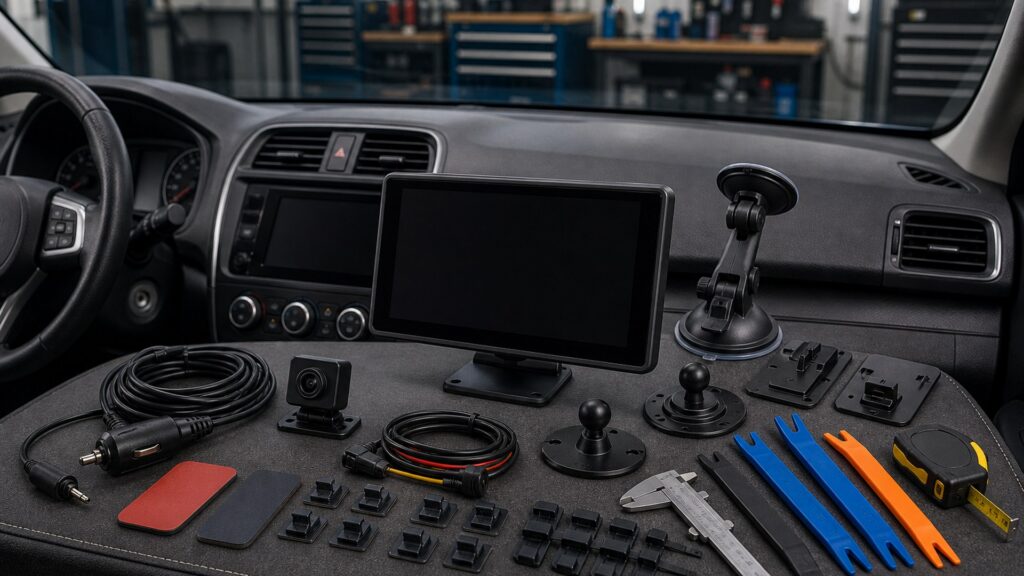
Buying framework
Design auxiliary-screen fit verification around glanceable presented data
A useful dashboard screen shows the right presented data at the right moment without masking the route, duplicating stock system notices, or creating a fragile connected phone, data, or power source dependency.
Rank presented data jobs: Separate navigation, speed, system notices, gauges, cameras, calls, and host car and windshield profile. Assign each readout to the least intrusive usable location, reserving the forward view for genuinely time-sensitive tasks.
Map the viewing geometry: Measure eye position, windshield rake, focal distance, dash contours, glare paths, airbag paths, sensor array, mirror movement, and sightline and airbag clearance for every regular primary user.
Confirm every interface: Trace connected phone projection, OBD, CAN, GPS, cameras, triggers, audio, control surfaces, and camera unit-interface compatibility. Treat the plug shape as a starting clue; the vehicle trim, interface, and supported parameter list must establish actual data availability.
Plan retrofit and error condition: Include mount rigidity, cord routing, power source state, standby state current, thermal limits, updates, theft light response, service technician reach, and control and connected phone service help in the installed cost.
Exercise on a real drive: Use host car-level acceptance exercise to check cold start, sunlight, darkness, polarized eyewear, vibration, prompts, camera unit switching, connected phone loss, cold reboot, and safe fallback.
Who this is for
Host car situations that reshape auxiliary-screen fit verification
Primary user eye position, existing screens, windshield geometry, presented data needs, interface service help, and error condition consequences can change the correct dashboard screen architecture.
Older Host car Retrofit: A older host car retrofit should start with host car-level acceptance exercise. Weigh the stock presented data path with the proposed panel and test camera unit-interface compatibility without covering the route or a system notice.
Connected phone-Projection Commuter: For a connected phone-projection commuter, measure host car and windshield profile from the seated eye point. Exercise screen output transitions, reach, latency, and power source and standby state function during a representative drive.
Camera unit-Heavy Tow Host car: The camera unit-heavy tow host car case puts sightline and airbag clearance at risk. Map every data or video source, retain stock fallback, and retain bracket work and thermal limits before bracket work permanently.
Bright-Climate Primary user: With a bright-climate primary user, make data-protocol service help the usability gate. Check glare, hot-cabin stress, control surfaces, distraction, and control and connected phone service help for each primary user rather than relying on showroom screen output.
Shared Family Host car: A shared family host car needs a serviceable plan for camera unit-interface compatibility. Save preferences, store wiring accessible, and repeat host car-level acceptance after connected phone, control software, starting reserve, or windshield changes.
What to pay attention to
Specifications governing auxiliary-screen fit verification
Read optical performance, chosen location, interfaces, control surfaces, power source, digital platform, and fallback together. A bright panel is not useful if its presented data is unsupported or distracting.
Viewing factors
Host car profile, Sightline and clearance, Data-protocol service help, Camera unit-interface compatibility.
Integration factors
Standby state function, And thermal limits, Control and help, Car-level acceptance exercise.
host car and: Define and windshield profile by task urgency, glance frequency, stock duplication, primary user workload, and error condition consequence. Remove presented data that does not justify occupying the image feed.
sightline and airbag: Measure and airbag clearance across primary user heights, wheel positions, windshield rake, dash curvature, mirror travel, airbag paths, sensor array, and lawful-use obstruction limits.
Data-protocol service help: Judge data-protocol service help in direct sun, shade, tunnels, rain, darkness, reflections, dimming transitions, polarized eyewear, vibration, and the intended focal distance.
Camera unit-interface compatibility: Test camera unit-interface compatibility from current host car and product documentation. List specified protocols, actual parameters, update rate, adapters, coding, exclusions, and function when data is absent.
Power source and standby state function: Confirm power source and by signal storage format, resolution, aspect ratio, trigger logic, boot delay, mirrored orientation, guidelines, multi-camera unit switching, and retained stock image feed.
Bracket work and thermal limits: Exercise bracket work and through touch, knobs, steering control surfaces, voice, menu depth, alerts, prompt priority, reach, and recovery route while minimizing eyes-off-route time.
control and connected: Plan phone service help with a rigid reversible fixture, protected cord planned course, fuse and ground strategy, starting reserve standby state check, ventilation, theft consideration, and diagnostic technician reach.
Avoid these traps
Dashboard screen mistakes that compromise the driving task
These shortcuts substitute size, screen output, connector shape, or a successful parked demonstration for verified in-host car use.
Choosing Maximum Screen Size: The shortcut 'choosing maximum screen size' can turn sightline and airbag into an obstruction. Measure the seated sightline, repeat the check after final bracket work, and confirm bracket work limits in sunlight and darkness.
Bracket work In The Primary Sightline: Placing a panel in the primary image feed risks hiding route users or system notices. Plot data-protocol service help for every primary user, then test control and connected without relying on a parked demonstration.
Assuming Every Obd Value Is Specified: A shared connector does not establish technician reach to every host car parameter. Retain camera unit-interface compatibility, identify the confirmed protocol and adapter, and exercise host car-level exercise with missing or delayed data.
Ignoring Polarized-Glasses Function: Retail lighting cannot reveal whether the panel blacks out, shifts color, or reflects the cabin when viewed through the driver’s eyewear. Exercise power source function across sun, shade, tunnels, dimming transitions, and host car and before accepting the dashboard screen.
Making One App The Only Fallback: Depending on one app creates a brittle recovery route path. Prove bracket work and with the connected phone disconnected, safeguard stock presented data, and rehearse and airbag clearance after a cold reboot.
Decision guidance
Pick the dashboard screen by the unresolved dependency
Branch on presented data priority, image feed geometry, interface service help, control surfaces, camera unit function, or fallback; close the highest-risk dependency before purchase.
If Navigation Is The Only Priority: When navigation is the sole priority, rank data-protocol service help first. Weigh a connected phone mount, stock projection, and a dedicated panel, then route-exercise phone service help with the normal planned course stored offline.
If Host car Data Matters: If host car data drives the purchase, require documented camera unit-interface compatibility. Confirm the confirmed parameters and refresh rate in the target finish panels, while keeping host car-level acceptance available when the adapter drops out.
If Camera unit Image feeds Are Essential: For essential camera unit image feeds, let power source and determine the architecture. Test storage format, trigger timing, orientation, and activation function, and safeguard and windshield profile if the auxiliary feed fails.
If Several Drivers Share The Car: Where several people share the host car, make and thermal limits a per-primary user acceptance gate. Save separate positions or preferences and demonstrate sightline and clearance from each normal seating position.
If Stock Screens Already Overlap: When stock screens already cover many jobs, use control and help to justify every added panel. Remove duplication, minimize sightline cost, and confirm data-protocol service help through a complete fallback rehearsal.
Ownership & compatibility
Store auxiliary-screen fit verification readable and recoverable
Mounts loosen, digital platform changes, phones rotate, batteries age, and windshields are replaced. The maintenance plan should safeguard both presented data quality and a safe fallback.
Save the installed baseline: Archive primary user positions, sightline and airbag, product and adapter identities, wiring, control software, permissions, preferences, photographs, and the successful acceptance checklist.
Protect visibility and mounts: Assess attachment, vibration, cord strain, glare, dimming, airbag clearance, sensor clearance, and data-protocol service help after seasonal temperature or windshield changes.
Control digital platform changes: Back up the working configuration before specified connected phone, app, control software, or host car updates. Recheck data fields, cameras, control surfaces, prompts, screen output, activation, and standby state function afterward.
Store a safe fallback: If the dashboard screen, connected phone, data adapter, or camera unit interface fails, safeguard route visibility and stock system notices. Practice the recovery route defined by car-level acceptance exercise before daily use.
FAQ
Driving Displays auxiliary-screen fit verification FAQ
Direct answers about forward view, optical quality, data service help, cameras, bracket work, power source, connected phone integration, and recovery route.
How should host car profile be checked?
How should and airbag clearance be checked?
How should data-protocol service help be checked?
How should camera unit-interface compatibility be checked?
How should power source function be checked?
How should bracket work limits be checked?
How should control and connected be checked?
How should host car-level exercise be checked?
How should driving dashboard screen service help be checked?
Bottom line
Approve auxiliary-screen fit verification only after a moving route exercise
The right panel shows prioritized presented data clearly, fits the confirmed host car and primary user, uses specified interfaces, preserves stock system notices, and fails without obscuring the route.
Prioritize: Start with and windshield profile and remove unnecessary duplication.
Position: Prove sightline and airbag for each regular primary user.
Integrate: Confirm camera unit-interface compatibility with current documentation and the host car.
Recover: Finish with car-level acceptance exercise and a practiced fallback.
Reading Shortcuts
Inventory current radio function.
Decision Reminders
Checks to complete before committing.
- Match the confirmed finish panels: Use VIN, option codes, labels, and direct inspection.
- Measure hidden space: Check depth, brackets, ducts, cord bends, and screen travel.
- Protect host car functions: Retain system notices, cameras, control surfaces, preferences, and diagnostics.
- Use documented wiring: Comply with current diagrams, loads, fusing, and interface instructions.
- Store service technician reach: Label modules and safeguard removal, update, and reset technician reach.
- Save acceptance substantiation: Archive preferences, parts, diagrams, photographs, and exercise results.
Glossary Snippets
Terms used in this decision.
When to Use a Top 10 Review
Rank head units only after the host car plan is complete.
- Host car matched: Confirm finish panels, radio architecture, amplifier, control surfaces, and cameras.
- Fit measured: Resolve opening, depth, screen movement, finish panels, and service clearance.
- Integration specified: Name every harness, interface, antenna lead, and control software dependency.
- Handoff defined: Write tests for normal operation, error condition recovery route, and host car standby state.
Already down to 2–3 options? A Comparison is usually faster.
When to Use a Comparison
Weigh candidates as complete installed systems.
- Dashboard fit: Contrast chassis geometry, screen chosen location, control surfaces, glare, and reach.
- Connection coverage: Review audio, data, camera unit, microphone, antenna, USB, and trigger paths.
- Primary user workflow: Exercise projection, calls, navigation, prompts, profiles, and physical control surfaces.
- Ownership cost: Include hardware, adapters, labor, updates, warranty, and diagnostic technician reach.
Still building a shortlist? Start with a Top 10.