
How Barcode Equipment Works

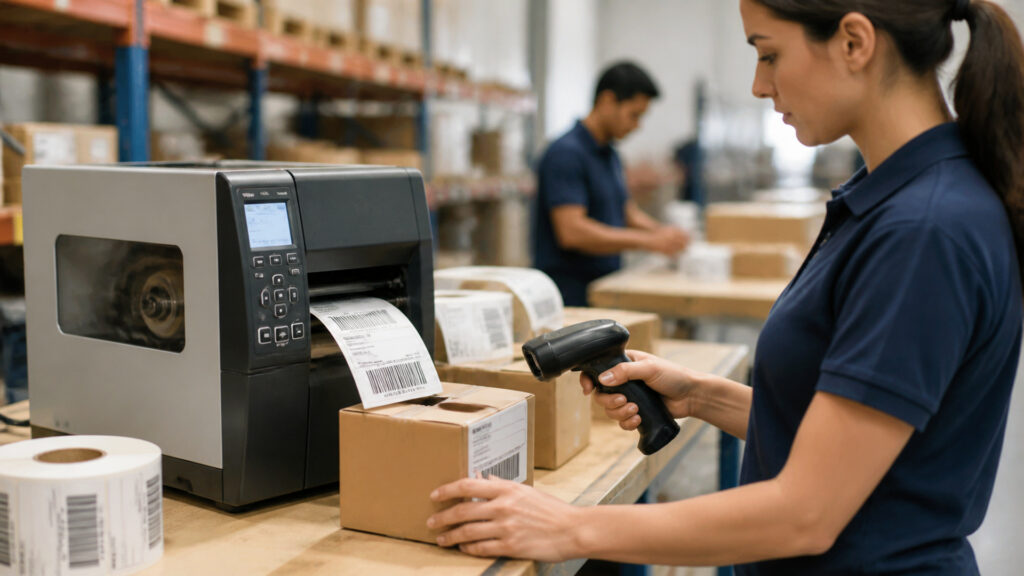
Barcode equipment works by carrying a controlled digital identifier across a physical surface and then converting that mark back into data at the point of work. Printers create symbols on labels, tags, receipts, or packaging; scanners and imagers capture them; software decodes the payload and resolves it against a product, asset, location, shipment, or transaction record.

A beep is only the middle of the mechanism. The identifier must be valid, the symbol printable and readable, the application must recognize the payload in the current context, and the resulting transaction must reach the system of record. This explainer traces that complete chain and separates print quality, decode success, business validation, and committed inventory or operational state.

By: Review Streets Research Lab
Updated: September 1, 2026
Explainer · 8-12 min read
Editorial business scene illustrating barcode equipment
What You'll Learn

Following Barcode Equipment From Item Identifier to Exception Queue

Trace one item identifier through label stock, scan engine, and transaction event, then test exception queue against system of record.

  • Assigning an Identifier and Encoding Rule
  • Producing a Physical Symbol
  • Capturing and Decoding the Mark
  • Resolving the Payload in an Application
  • Committing and Reconciling the Event
  • How scan engine changes the conclusion

Tip: Choose a real item identifier; record its source, state, responsible barcode systems owner, exception route, and final evidence in the identifier lineage record.

Definitions

Terms That Keep Barcode Equipment Mechanisms Separate

These definitions prevent barcode equipment, item identifier, and application lookup from becoming one vague idea.

Barcode equipment

Printers, scanners, imagers, mobile computers, verifiers, and supporting devices that create or capture machine-readable identifiers.

  • Here, barcode equipment connects physical items to digital records.
  • Its limit is that it does not establish item truth by itself.
  • Verify barcode verifier before the barcode systems owner relies on it in the identifier lineage record.

Item identifier

A controlled value that distinguishes a product, asset, location, shipment, container, document, or transaction unit.

  • Here, item identifier provides the lookup key.
  • Its limit is that it must be unique within its governing namespace.
  • Verify scan engine before the barcode systems owner relies on it in the identifier lineage record.

Symbology

The encoding rules and visual structure used by a barcode such as code 128, data matrix, or qr code.

  • Here, symbology determines how characters and error checks are represented.
  • Its limit is that it must suit the payload and scanner environment.
  • Verify decode result before the barcode systems owner relies on it in the identifier lineage record.

Scan engine

The optical and decoding component that illuminates or images a symbol and converts it into data.

  • Here, scan engine captures the encoded value.
  • Its limit is that it cannot decide the business meaning alone.
  • Verify application lookup before the barcode systems owner relies on it in the identifier lineage record.

Application lookup

The software request that uses a decoded identifier to retrieve or validate the relevant record.

  • Here, application lookup connects a scan to context.
  • Its limit is that it can fail even when decoding succeeds.
  • Verify transaction event before the barcode systems owner relies on it in the identifier lineage record.

Verification result

A measured assessment of printed symbol quality against an applicable method or standard.

  • Here, verification result predicts readability under defined conditions.
  • Its limit is that it is not the same as one successful scan.
  • Verify exception queue before the barcode systems owner relies on it in the identifier lineage record.

Tip: Keep barcode equipment distinct from item identifier; they control different transitions and failure meanings.

Assigning

Assigning an Identifier and Encoding Rule

A governed master record supplies the identifier, payload, symbology, size, quiet zone, check character, and human-readable text appropriate to the use case.

  • Name the barcode systems owner responsible for item identifier
  • Retain the source establishing symbology
  • Record encoded payload as a separate state
  • Route uncertain label stock into an owned decode fault
  • Validate barcode verifier against independent scan engine evidence
  • Preserve the identifier lineage record when decode result is corrected

This mechanism closes only when barcode verifier, the originating fact, the barcode systems owner's decision, and every material decode fault agree in the identifier lineage record.

Producing

Producing a Physical Symbol

Label software translates the design into a printer language; the device controls dots, heat, ribbon, media movement, calibration, and placement on suitable stock.

  • Name the barcode systems owner responsible for symbology
  • Retain the source establishing encoded payload
  • Record label stock as a separate state
  • Route uncertain print language into an owned decode fault
  • Validate scan engine against independent decode result evidence
  • Preserve the identifier lineage record when application lookup is corrected

This mechanism closes only when scan engine, the originating fact, the barcode systems owner's decision, and every material decode fault agree in the identifier lineage record.

Capturing

Capturing and Decoding the Mark

A laser scanner or imager detects contrast and geometry, corrects orientation where supported, validates the symbol structure, and emits the decoded payload.

  • Name the barcode systems owner responsible for encoded payload
  • Retain the source establishing label stock
  • Record print language as a separate state
  • Route uncertain barcode verifier into an owned decode fault
  • Validate decode result against independent application lookup evidence
  • Preserve the identifier lineage record when transaction event is corrected

This mechanism closes only when decode result, the originating fact, the barcode systems owner's decision, and every material decode fault agree in the identifier lineage record.

Resolving

Resolving the Payload in an Application

The connected application interprets prefixes or field structure, finds the product, asset, location, or shipment, validates the expected state, and proposes a transaction.

  • Name the barcode systems owner responsible for label stock
  • Retain the source establishing print language
  • Record barcode verifier as a separate state
  • Route uncertain scan engine into an owned decode fault
  • Validate application lookup against independent transaction event evidence
  • Preserve the identifier lineage record when exception queue is corrected

This mechanism closes only when application lookup, the originating fact, the barcode systems owner's decision, and every material decode fault agree in the identifier lineage record.

Committing

Committing and Reconciling the Event

A user or automated rule confirms the quantity and action; the system records time, device, location, identity, exceptions, and synchronization status against the authoritative record.

  • Name the barcode systems owner responsible for print language
  • Retain the source establishing barcode verifier
  • Record scan engine as a separate state
  • Route uncertain decode result into an owned decode fault
  • Validate transaction event against independent exception queue evidence
  • Preserve the identifier lineage record when system of record is corrected

This mechanism closes only when transaction event, the originating fact, the barcode systems owner's decision, and every material decode fault agree in the identifier lineage record.

Quick Reality Check

What Barcode Equipment Evidence Can—and Cannot—Prove

The model can expose how label stock, print language, and barcode verifier connect. It cannot invent missing facts, make unsupported decisions, or turn exception queue into universal proof.

Evidence That Makes label stock Defensible

A stable item identifier identifier preserves the initiating fact through correction and rework.

A reconciled print language identifier lineage record shows whether transaction event reached its intended state.

Limits Beyond the scan engine Mechanism

Local rules, materials, environments, contracts, and professional judgment can change the appropriate decode result treatment.

A successful exception queue milestone cannot prove the source was complete, authorized, readable, or substantively correct.

Common Myths

Misconceptions About Barcode Equipment

These misconceptions confuse visible item identifier activity with the independent controls required at print language, decode result, and exception queue.

Does visible item identifier prove label stock is correct?

No. item identifier and label stock establish different facts in barcode equipment. The barcode systems owner must connect them through the identifier lineage record, test scan engine, and route any decode fault before relying on the result.

Can successful barcode verifier close the entire process?

No. barcode verifier proves one stage. The design must separately preserve decode result, transaction event, and the final system of record evidence, including failures and authorized reversals. Check symbology against encoded payload.

Is application lookup only a device setting?

No. application lookup affects business interpretation, ownership, and the evidence surrounding exception queue. Configuration can enforce rules, but the barcode systems owner still owns exceptions and change control. Check encoded payload against label stock.

Does exception queue guarantee the outcome?

No. exception queue is a milestone rather than proof that every input, decision, and handoff is complete. Reconcile it with the authoritative system of record before closing the identifier lineage record.

Tip: Challenge a universal claim by locating its symbology source, decode fault route, and transaction event completion evidence.

FAQ

Frequently Asked Questions About Barcode Equipment

These implementation questions assign authority for item identifier, separate states, route scan engine failures, and test the exception queue handoff.

Which source should control item identifier?

Use the authoritative record that assigns or establishes item identifier. Record its identifier, version, owner, effective time, and correction route in the identifier lineage record. Check print language against barcode verifier.

Which states need independent timestamps?

Track encoded payload, label stock, barcode verifier, and decode result separately. A label stock transition needs its triggering event, acting identity, source reference, failure meaning, and authorized reversal rule. Check barcode verifier against scan engine.

How should a scan engine problem be handled?

Create an owned decode fault with the affected identifier, current state, observed evidence, operational impact, permitted remedies, and closure test. Preserve the earlier event rather than overwriting it. Check scan engine against decode result.

What must reconcile before exception queue is accepted?

Compare the originating item identifier, intermediate print language, recorded application lookup, acknowledgments, exceptions, and authoritative system of record. Separate timing, duplication, mapping, version, and omission causes. Check decode result against application lookup.

When should the design be changed?

Redesign when item identifier lacks an owner, scan engine has no exception route, or system of record requires recurring manual reconstruction. In barcode equipment, those patterns identify a failing system boundary rather than a simple shortage of operator effort.

Bottom Line

Barcode equipment connects physical objects and locations to digital records by encoding identifiers, producing readable symbols, decoding them, resolving them in an application, and recording the intended event.

Reliable operation requires governed identifiers, suitable symbology and media, calibrated devices, contextual validation, exception handling, and reconciliation with the system of record. A printed label or successful beep proves only one stage—not that the business transaction is correct.

Next Steps

Continue Beyond Barcode Equipment

Use the adjacent explainer for the next barcode verifier boundary, or browse the direct category for systems sharing item identifier and system of record.

Barcode Equipment

Browse the direct Barcode Equipment category for related systems involving item identifier, scan engine, and exception queue.

Quick Summary

Barcode Equipment Explained

  • Item identifier establishes the starting fact.
  • Label stock has an independent completion test.
  • Scan engine changes the downstream decision.
  • Transaction event needs retained authority and evidence.
  • Exception queue must reconcile with system of record.