Why Barcode Equipment Operating Model Matters

Barcode equipment can perform well in a pilot and still fail as an operating capability when identifier rules drift, label supplies vary, device profiles diverge, batteries disappear, damaged scanners stay in service, or no team owns a failed print station. The equipment fleet is part of a recurring production system, not a collection of isolated peripherals.

The operating model assigns durable ownership for standards, templates, consumables, deployment, maintenance, spares, support, change, and retirement. It differs from workflow, which follows a specific scan-driven task, from data flow, which traces identifiers and events between systems, and from permissions, which controls allowed actions. Those distinctions make recurring reliability diagnosable.

By: Review Streets Research Lab
Updated: September 1, 2026
Explainer · 8-12 min read
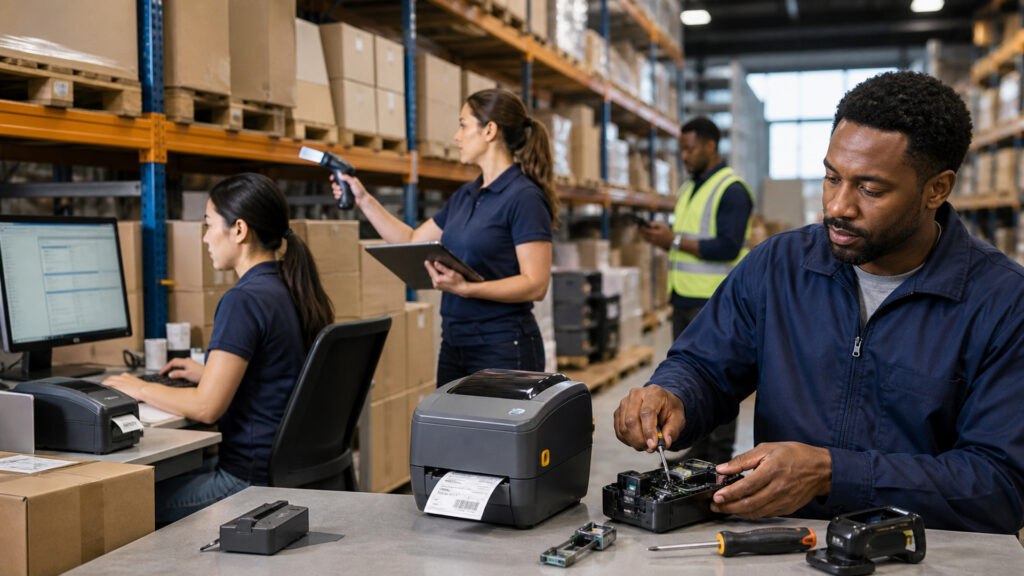
Editorial business scene illustrating barcode equipment operating model
What You'll Learn

Following Barcode Equipment Operating Model From Identifier Governance to Support Escalation

Trace one identifier governance through print station, location owner, and spare pool, then test support escalation against lifecycle record.

  • Governing Identifiers, Templates, and Standards
  • Operating Supplies and Production Stations
  • Deploying a Consistent Scanner and Printer Fleet
  • Maintaining Readability and Availability
  • Controlling Change and Retirement
  • How location owner changes the conclusion

Tip: Choose a real identifier governance; record its source, state, responsible fleet steward, exception route, and final evidence in the fleet lifecycle log.

Definitions

Terms That Keep Barcode Equipment Operating Model Mechanisms Separate

These definitions prevent barcode operating model, identifier governance, and spare pool from becoming one vague idea.

Barcode operating model

The recurring ownership, standards, supplies, deployment, maintenance, support, and lifecycle structure surrounding barcode devices.

  • Here, barcode operating model keeps capture capability dependable across sites.
  • Its limit is that it must cover failures and change.
  • Verify device profile before the fleet steward relies on it in the fleet lifecycle log.

Identifier governance

The rules for assigning, reusing, retiring, and interpreting encoded values.

  • Here, identifier governance prevents ambiguous lookups.
  • Its limit is that it must span every issuing system.
  • Verify location owner before the fleet steward relies on it in the fleet lifecycle log.

Device profile

The approved configuration for symbologies, prefixes, connectivity, application behavior, security, and update settings.

  • Here, device profile makes fleet behavior repeatable.
  • Its limit is that it needs version control.
  • Verify maintenance interval before the fleet steward relies on it in the fleet lifecycle log.

Print station

The combined printer, driver, template, media, ribbon, network, application, and operator context at a production point.

  • Here, print station creates physical labels.
  • Its limit is that it must have a named service owner.
  • Verify verification sample before the fleet steward relies on it in the fleet lifecycle log.

Spare pool

Tested replacement equipment and consumables reserved for operational continuity.

  • Here, spare pool reduces outage time.
  • Its limit is that it must be charged, configured, rotated, and inventoried.
  • Verify spare pool before the fleet steward relies on it in the fleet lifecycle log.

Lifecycle record

The history of assignment, configuration, repair, calibration, firmware, custody, and retirement for a device.

  • Here, lifecycle record supports fleet control.
  • Its limit is that it must follow the physical asset.
  • Verify support escalation before the fleet steward relies on it in the fleet lifecycle log.

Tip: Keep barcode operating model distinct from identifier governance; they control different transitions and failure meanings.

Governing

Governing Identifiers, Templates, and Standards

Named owners control number ranges, payload structure, approved symbologies, label versions, regulatory content, and compatibility across suppliers and systems.

  • Name the fleet steward responsible for identifier governance
  • Retain the source establishing label template
  • Record media supply as a separate state
  • Route uncertain print station into an owned fleet outage
  • Validate device profile against independent location owner evidence
  • Preserve the fleet lifecycle log when maintenance interval is corrected

This mechanism closes only when device profile, the originating fact, the fleet steward's decision, and every material fleet outage agree in the fleet lifecycle log.

Operating

Operating Supplies and Production Stations

Media, ribbons, printheads, cleaning materials, batteries, chargers, mounts, and network access are replenished and checked against actual site demand.

  • Name the fleet steward responsible for label template
  • Retain the source establishing media supply
  • Record print station as a separate state
  • Route uncertain scanner fleet into an owned fleet outage
  • Validate location owner against independent maintenance interval evidence
  • Preserve the fleet lifecycle log when verification sample is corrected

This mechanism closes only when location owner, the originating fact, the fleet steward's decision, and every material fleet outage agree in the fleet lifecycle log.

Deploying

Deploying a Consistent Scanner and Printer Fleet

Approved models, device profiles, application versions, pairing rules, roaming behavior, and site assignments reduce unpredictable local variation.

  • Name the fleet steward responsible for media supply
  • Retain the source establishing print station
  • Record scanner fleet as a separate state
  • Route uncertain device profile into an owned fleet outage
  • Validate maintenance interval against independent verification sample evidence
  • Preserve the fleet lifecycle log when spare pool is corrected

This mechanism closes only when maintenance interval, the originating fact, the fleet steward's decision, and every material fleet outage agree in the fleet lifecycle log.

Maintaining

Maintaining Readability and Availability

Cleaning, calibration, verification samples, battery health, damage inspections, preventive replacement, spares, and escalation paths address degradation before throughput collapses.

  • Name the fleet steward responsible for print station
  • Retain the source establishing scanner fleet
  • Record device profile as a separate state
  • Route uncertain location owner into an owned fleet outage
  • Validate verification sample against independent spare pool evidence
  • Preserve the fleet lifecycle log when support escalation is corrected

This mechanism closes only when verification sample, the originating fact, the fleet steward's decision, and every material fleet outage agree in the fleet lifecycle log.

Controlling

Controlling Change and Retirement

Template revisions, firmware updates, application changes, relocations, repairs, reassignment, secure wiping, disposal, and identifier retirement remain traceable through the lifecycle record.

  • Name the fleet steward responsible for scanner fleet
  • Retain the source establishing device profile
  • Record location owner as a separate state
  • Route uncertain maintenance interval into an owned fleet outage
  • Validate spare pool against independent support escalation evidence
  • Preserve the fleet lifecycle log when lifecycle record is corrected

This mechanism closes only when spare pool, the originating fact, the fleet steward's decision, and every material fleet outage agree in the fleet lifecycle log.

Quick Reality Check

What Barcode Equipment Operating Model Evidence Can—and Cannot—Prove

The model can expose how print station, scanner fleet, and device profile connect. It cannot invent missing facts, make unsupported decisions, or turn support escalation into universal proof.

Evidence That Makes print station Defensible

A stable identifier governance identifier preserves the initiating fact through correction and rework.

A reconciled scanner fleet fleet lifecycle log shows whether spare pool reached its intended state.

Limits Beyond the location owner Mechanism

Local rules, materials, environments, contracts, and professional judgment can change the appropriate maintenance interval treatment.

A successful support escalation milestone cannot prove the source was complete, authorized, readable, or substantively correct.

Common Myths

Misconceptions About Barcode Equipment Operating Model

These misconceptions confuse visible identifier governance activity with the independent controls required at scanner fleet, maintenance interval, and support escalation.

Does visible identifier governance prove print station is correct?

No. identifier governance and print station establish different facts in barcode equipment operating model. The fleet steward must connect them through the fleet lifecycle log, test location owner, and route any fleet outage before relying on the result.

Can successful device profile close the entire process?

No. device profile proves one stage. The design must separately preserve maintenance interval, spare pool, and the final lifecycle record evidence, including failures and authorized reversals. Check label template against media supply.

Is verification sample only a device setting?

No. verification sample affects business interpretation, ownership, and the evidence surrounding support escalation. Configuration can enforce rules, but the fleet steward still owns exceptions and change control. Check media supply against print station.

Does support escalation guarantee the outcome?

No. support escalation is a milestone rather than proof that every input, decision, and handoff is complete. Reconcile it with the authoritative lifecycle record before closing the fleet lifecycle log.

Tip: Challenge a universal claim by locating its label template source, fleet outage route, and spare pool completion evidence.

FAQ

Frequently Asked Questions About Barcode Equipment Operating Model

These implementation questions assign authority for identifier governance, separate states, route location owner failures, and test the support escalation handoff.

Which source should control identifier governance?

Use the authoritative record that assigns or establishes identifier governance. Record its identifier, version, owner, effective time, and correction route in the fleet lifecycle log. Check scanner fleet against device profile.

Which states need independent timestamps?

Track media supply, print station, device profile, and maintenance interval separately. A print station transition needs its triggering event, acting identity, source reference, failure meaning, and authorized reversal rule. Check device profile against location owner.

How should a location owner problem be handled?

Create an owned fleet outage with the affected identifier, current state, observed evidence, operational impact, permitted remedies, and closure test. Preserve the earlier event rather than overwriting it. Check location owner against maintenance interval.

What must reconcile before support escalation is accepted?

Compare the originating identifier governance, intermediate scanner fleet, recorded verification sample, acknowledgments, exceptions, and authoritative lifecycle record. Separate timing, duplication, mapping, version, and omission causes. Check maintenance interval against verification sample.

When should the design be changed?

Redesign when identifier governance lacks an owner, location owner has no exception route, or lifecycle record requires recurring manual reconstruction. In barcode equipment operating model, those patterns identify a failing system boundary rather than a simple shortage of operator effort.

Bottom Line

The barcode equipment operating model matters because scan-dependent work relies on persistent standards, configured devices, compatible supplies, maintenance, spares, and accountable support across the entire fleet.

A strong model prevents local fixes from becoming invisible technical debt. It gives every identifier range, label template, print station, scanner profile, outage, repair, and retired device a responsible owner and a verifiable lifecycle record.

Next Steps

Continue Beyond Barcode Equipment Operating Model

Use the adjacent explainer for the next device profile boundary, or browse the direct category for systems sharing identifier governance and lifecycle record.

Barcode Equipment

Browse the direct Barcode Equipment category for related systems involving identifier governance, location owner, and support escalation.

Quick Summary

Barcode Equipment Operating Model Explained

  • Identifier governance establishes the starting fact.
  • Print station has an independent completion test.
  • Location owner changes the downstream decision.
  • Spare pool needs retained authority and evidence.
  • Support escalation must reconcile with lifecycle record.