How Cardio Equipment Works

Cardio equipment creates repeatable cycles—steps, pedal revolutions, strides, or rowing strokes—while controlling some combination of pace, resistance, and body support. Those mechanical choices determine whether the user matches a moving surface, drives a flywheel, climbs against a step mechanism, or follows linked pedals.

The machines can all raise breathing and heart rate, but they do not create the same movement. Treadmills, bikes, rowers, ellipticals, and steppers differ in impact, fit, local muscle demand, technique, and measurement. Understanding those differences makes console numbers and resistance settings easier to interpret.

By: Review Streets Research Lab
Updated: August 26, 2026
Explainer · 8-12 min read
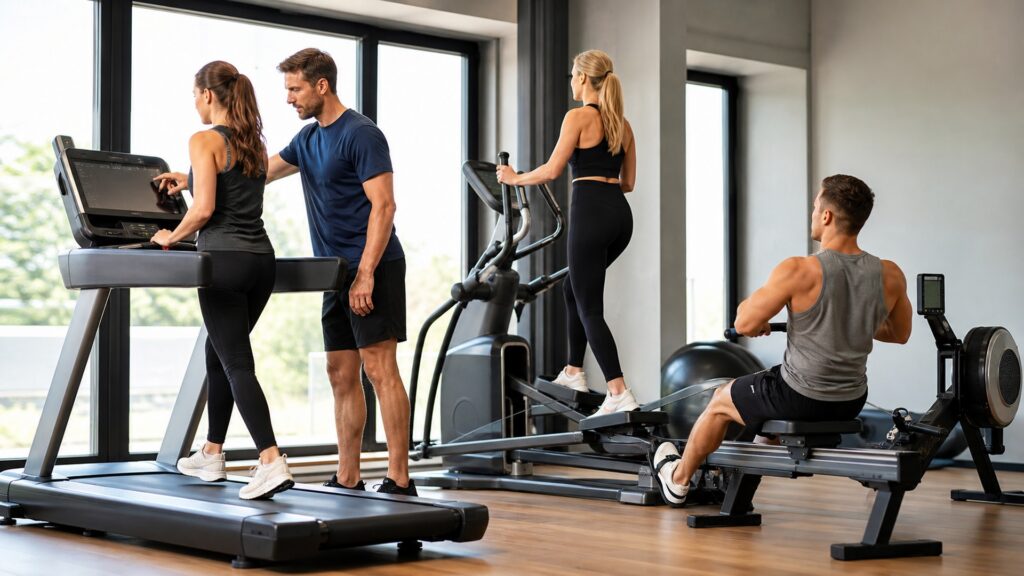
cardio equipment explainer hero image for Review Streets
What You'll Learn

How Machines Turn Repeated Motion Into a Cardio Workload

Cardio equipment combines cyclic movement, pace or resistance control, body support, adjustment, and measurement in distinct ways.

  • Which machines drive pace and which respond to the user
  • How magnetic, air, friction, fluid, and incline resistance behave
  • Why seats, pedals, rails, and handles change body support
  • How machine geometry affects fit and movement
  • What cadence, pace, power, and resistance levels mean
  • Why calorie estimates are not direct measurements
  • When local fatigue or technique limits the session

Tip: Identify whether the machine controls speed, resists user-created motion, or does both; that reveals how effort and fatigue will change the movement.

Definitions

Key Concepts That Define Cardio Equipment

These concepts make it possible to compare machine families without assuming equal console levels create equal work.

Cyclic Movement

A repeated motion pattern—steps, pedal revolutions, strides, or strokes—that can continue for a sustained period.

  • Cycle: Returns to a repeatable starting phase
  • Rate: Described by cadence, pace, or stroke rate
  • Skill: Efficiency changes with familiarity

Pace Control

The method that sets or responds to movement speed. A treadmill drives belt speed, while most bikes and rowers let the user establish cadence.

  • Driven: User must match a motorized surface
  • Self-paced: Machine responds to user movement
  • Effect: Changes how errors and fatigue appear

Resistance System

The mechanism opposing motion, such as magnetic braking, friction, air drag, fluid drag, incline, or the user's interaction with a moving belt.

  • Magnetic: Adjusts braking without contact on many designs
  • Air: Resistance rises with fan speed
  • Friction: Uses contact and requires wear checks

Body Support

The extent to which a seat, handles, pedals, rails, or frame carries body weight and stabilizes posture.

  • Bike: Seat supports substantial body weight
  • Treadmill: User bears body weight while moving
  • Elliptical: Pedals guide the feet through a linked path

Machine Geometry

The fixed dimensions and paths created by crank length, rail angle, stride linkage, handle reach, seat position, and step height.

  • Fit: Determines available adjustment window
  • Motion: Shapes joint angles and path
  • Boundary: One geometry does not fit every body equally

Console Metric

A displayed value such as time, speed, distance, cadence, power, resistance level, heart rate, or estimated calories.

  • Direct: Time and rotation counts can be measured
  • Calculated: Distance or power may use machine models
  • Estimated: Calories depend on assumptions and input data

Tip: Record the exact machine and adjustment settings when using its metrics to compare sessions.

Motion and Pace

Treadmills Drive a Surface While Other Machines Follow the User

A treadmill motor sets belt speed, requiring the user to maintain walking or running pace. Bikes, rowers, and many ellipticals rotate or slide when the user applies force, so cadence or stroke rate can fall as fatigue increases.

  • Treadmill speed is externally imposed by the belt
  • Bike cadence is created through pedal revolutions
  • Rowers respond to stroke force and rate
  • Elliptical linkages coordinate foot and often arm paths
  • Steppers recycle vertical or angled foot travel

Driven and self-paced machines create different control and stopping problems.

Resistance

Brakes, Fans, Fluids, Incline, and Friction Shape the Work

Machines regulate demand through different mechanisms. Magnetic brakes oppose flywheel rotation, fans and fluids increase drag with speed, friction pads apply contact, and incline changes the work of moving body mass.

  • Magnetic settings change braking force
  • Air resistance rises as the fan spins faster
  • Fluid systems use drag through a contained medium
  • Friction components wear and may need adjustment
  • Incline changes treadmill or stepper mechanics without one universal equivalence

A resistance level is meaningful within its machine, not as a standard unit across brands.

Fit and Setup

Geometry Determines Whether the Movement Is Workable

Seat height, fore-aft position, pedal stance, handle reach, foot placement, and stride geometry shape joint positions. A machine can offer smooth resistance yet remain a poor fit if its adjustment window does not suit the user.

  • Bike seats influence knee and hip position
  • Rower footplates and handle path affect the stroke setup
  • Elliptical stride length and pedal spacing are largely fixed
  • Stepper rail use changes support and posture
  • Treadmill deck size affects available walking or running space

Fit is a mechanical compatibility question, not merely a comfort preference.

Impact and Local Demand

Body Support Changes What Limits the Session

A seated bike supports body weight and concentrates repeated work around pedaling. Treadmill running is weight-bearing and includes repeated foot contact. Rowing distributes work across a coordinated stroke, while steppers create sustained lower-body demand.

  • Impact differs from cardiovascular intensity
  • Local leg fatigue can limit cycling or stepping
  • Rowing technique can limit output before breathing does
  • Ellipticals guide the feet and remove landing impact
  • Handle support can reduce balance and change workload

Similar heart rates do not mean the muscles and joints experienced the same task.

Feedback

Consoles Combine Measurement with Estimation

Time, belt speed, cadence, and revolutions can be measured directly, while distance, power, fitness scores, and calories may be calculated from machine-specific models. Maintenance and calibration affect the meaning of displayed work.

  • Use the same machine for cleaner trend comparisons
  • Enter body data only when comfortable sharing it
  • Treat calorie numbers as estimates
  • Chest straps may provide more stable heart-rate signals than console grips
  • Check whether power is measured, calculated, or absent

Machine data is most useful for repeatability when its measurement method stays consistent.

Quick Reality Check

What Cardio Machines Standardize—and What Still Varies

Machines make pace and resistance repeatable, but fit, technique, calibration, and individual response remain important.

Where Equipment Helps

Indoor machines provide controllable speed, resistance, incline, and interval timing without weather or route changes.

Different movement modes let users choose body support, impact profile, and technique demands that fit the intended training task.

Where the Numbers Mislead

Resistance levels, distances, power values, and calorie estimates may not be comparable across brands or even across different models.

A machine cannot determine medical suitability, diagnose symptoms, or guarantee that its fixed geometry fits every user.

Common Myths

Misconceptions About Cardio Equipment

These corrections separate the machine with the highest calorie number is best from low impact means low intensity, two shortcuts that distort cardio equipment.

The machine with the highest calorie number is best

Calorie displays are estimates built from machine data and assumptions. A larger number can reflect a different algorithm rather than more useful training, and it says little about fit or repeatability.

Low impact means low intensity

Impact describes collision and loading characteristics, while intensity describes demand. Cycling, rowing, or elliptical work can be vigorous without repeated running landings, though each creates its own local muscular load.

The same resistance level means the same work

Numbered levels are manufacturer-specific settings. Flywheel size, braking method, leverage, cadence, calibration, and machine geometry all affect the force and power associated with a displayed level. Low resistance is appropriate while checking the initial setup.

Holding the rails does not change the exercise

Hand support can alter balance, posture, and how much body weight the legs move, especially on steppers and steep treadmills. If repeatability matters, rail use should remain consistent. Sensor contact and signal quality should remain consistent.

Rowing is mainly an arm exercise

A rowing stroke coordinates leg drive, body swing, and arm pull, then reverses that sequence during recovery. Technique determines how force is distributed through the repeated stroke. The same device provides the cleanest performance comparison.

Tip: Check each claim against cyclic movement and the article's resistance explanation.

FAQ

Frequently Asked Questions About Cardio Equipment

These answers resolve remaining questions about cyclic movement, pace control, and their practical limits.

Which cardio machine is easiest to control?

Control depends on familiarity and design. Self-paced bikes and rowers slow when the user slows, while a treadmill belt continues at the selected speed until changed or stopped. Suitability questions can require qualified individual guidance.

Why can two ellipticals feel completely different?

Stride length, pedal spacing, linkage path, flywheel behavior, incline, handle geometry, and braking system vary. The category name does not standardize the movement or resistance curve. Algorithms do not establish whether the movement fits the user.

What should be adjusted on an exercise bike?

Seat height and fore-aft position are primary settings, with handle position and pedal interface also relevant. Use the manufacturer's guidance and verify that the motion remains controllable before raising resistance.

Are console heart-rate readings reliable?

Contact grips and wrist sensors can lose signal during movement, and machines may display paired sensor data differently. Use readings as estimates and trends, not medical measurements or automatic intensity prescriptions.

How should progress be compared?

Repeat the same machine, settings, duration, measurement source, and similar conditions. Then compare pace, cadence, power if meaningfully measured, perceived effort, and the ability to sustain the task. Rail use should stay consistent when tracking repeated sessions.

When should a machine not be used?

Do not use damaged, unstable, improperly assembled, or poorly fitting equipment. Stop and seek appropriate guidance when symptoms, medical considerations, or uncertainty make self-directed exercise unsuitable. Stroke sequencing determines whether the legs meaningfully contribute.

Bottom Line

Cardio equipment works by organizing repeated movement through a pace or resistance system, fixed geometry, body support, adjustments, and console feedback.

Machine families can create similar cardiorespiratory demand through very different mechanics. Choose and compare them by movement fit, control, workload method, and measurement limits.

Next Steps

Continue from Cardio Equipment to Related Fitness Explanations

Each destination extends the article's motion and pace or feedback model into a nearby fitness question.

Why Cardio Training Matters

Understand why sustained rhythmic work matters and how intensity, duration, intervals, and mode shape aerobic training.

How Fitness Equipment Works

Place cardio machines inside the broader model of resistance source, load path, adjustment, stability, and feedback.