
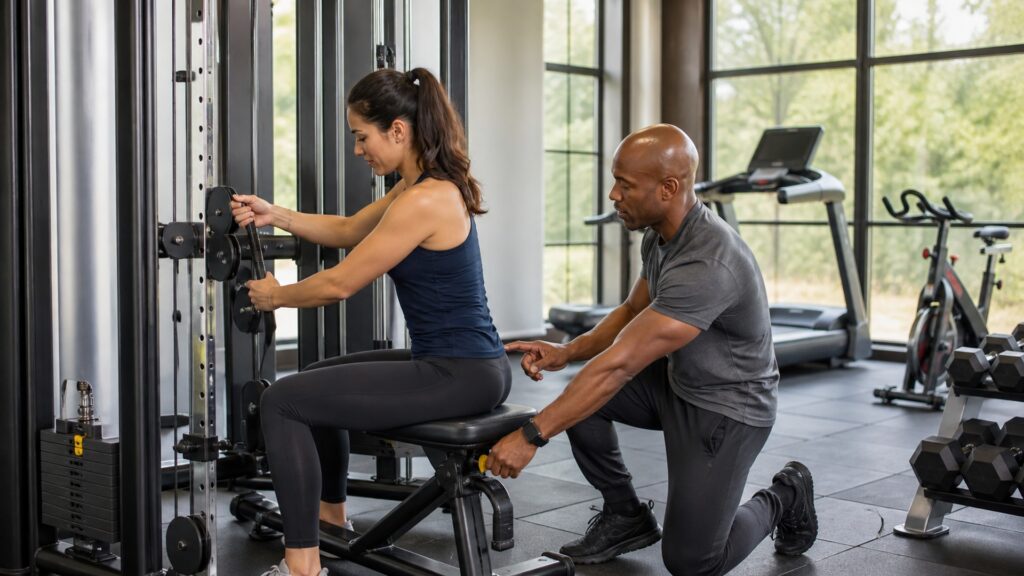
How Fitness Equipment Works

Fitness equipment does not create results by itself. It creates a physical arrangement in which a person can push, pull, step, pedal, row, carry, or stabilize against a known form of resistance. The important question is how the device shapes that movement and where the load travels.

Understanding the load path, contact points, adjustment range, and feedback makes unfamiliar equipment easier to read. It also shows why a treadmill, cable station, dumbbell, and rowing machine demand different setup decisions even when all are used to train effort and movement. The same framework also exposes the limits of equipment labels and console claims.

By: Review Streets Research Lab
Updated: August 26, 2026
Explainer · 8-12 min read
fitness equipment explainer hero image for Review Streets
What You'll Learn

From Resistance Source to Repeatable Movement

Fitness equipment becomes understandable when resistance, geometry, support, adjustment, and feedback are examined as separate parts of one movement task.

  • Where resistance comes from and how it reaches the body
  • How rails, pivots, cables, and free space shape movement paths
  • Why seats, pads, grips, and pedals affect alignment
  • How resistance changes across a repetition or stride
  • What equipment settings can and cannot standardize
  • Why machine displays are useful but incomplete
  • Where equipment design ends and training decisions begin

Tip: Before judging a machine, trace one repetition from the resistance source through every lever, cable, contact point, and joint position.

Definitions

Key Concepts That Define Fitness Equipment

Six mechanical ideas explain most equipment without reducing every device to a list of features.

Load Path

The route force follows between the resistance, the equipment, and the user. It determines where force is applied during each part of a repetition.

  • Source: May begin at a plate, stack, band, flywheel, or the user's body
  • Transfer: Travels through cables, levers, rails, pedals, or handles
  • Meaning: Explains why two devices can load the same motion differently

Movement Path

The trajectory allowed or encouraged by the equipment, ranging from tightly guided machine arcs to the open paths of free weights.

  • Guidance: Rails and pivots reduce possible directions
  • Freedom: Unfixed implements allow the user to organize the path
  • Fit: Joint position depends on setup and individual proportions

Resistance Curve

How the external challenge changes across the movement rather than remaining equally difficult at every joint angle.

  • Leverage: Cam shapes and lever arms alter moment demand
  • Elasticity: Bands generally add tension as they lengthen
  • Momentum: Flywheels and moving masses influence transitions

Contact Point

Any place the body meets a pad, seat, belt, grip, platform, or pedal. Contact points establish alignment and transmit force.

  • Support: Pads can reduce the need to balance
  • Alignment: Seat and handle positions shape joint angles
  • Pressure: Poor placement can make an otherwise suitable motion awkward

Adjustment Range

The available changes in seat height, lever start position, cable height, stride setting, or other geometry used to fit the user and task.

  • Fit window: Determines which body sizes can use the device comfortably
  • Start position: Changes where force first enters the motion
  • Constraint: More settings do not guarantee a better fit

Training Feedback

The information equipment returns, such as load selected, repetitions, pace, distance, time, power estimates, or heart-rate display.

  • Measurement: Some values are direct while others are estimates
  • Consistency: Repeatable settings help compare sessions
  • Limit: A display cannot judge technique or choose a suitable program

Tip: A useful setup aligns the movement path and contact points before load or speed is increased.

Resistance Source

How Equipment Produces an External Challenge

Fitness equipment begins with a resistance method. Gravity acts on plates and free weights, stacks move through cables, elastic materials create tension as they stretch, and cardio machines regulate friction, magnets, air, fluid, or motor speed.

  • Gravity-based loads depend on mass and orientation
  • Cable systems redirect force through pulleys
  • Elastic resistance changes as the material lengthens
  • Flywheels store rotational energy between strokes or steps
  • Motorized belts set a moving surface the user must match

The source sets the basic behavior, but geometry determines how that resistance is felt.

Movement Geometry

How Frames and Linkages Guide the Body

Rails, hinges, lever arms, and cable origins limit the directions in which an implement can travel. That guidance can make a movement repeatable, but it also means the machine's path must be compatible with the user's proportions and intended exercise.

  • A fixed pivot organizes motion around a predetermined arc
  • Sliding rails constrain travel to a line
  • Cable origins change the direction of pull
  • Free weights leave path control largely to the user
  • Guidance reduces some balance demands without removing effort

A guided path is a design choice, not proof that a movement is automatically suitable for everyone.

Setup and Fit

Why Adjustments Change More Than Comfort

Seat height, pad position, handle reach, and starting angle determine where the body sits relative to the machine's pivots and force. Small setup changes can alter range of motion, leverage, and which positions feel most demanding.

  • Adjust contact points before selecting a heavy load
  • Match machine pivots to the intended joint region when possible
  • Use start-position controls to avoid forced end ranges
  • Check that grips and pedals allow stable force transfer
  • Record repeatable settings when consistency matters

Adjustment is part of the exercise configuration, not a cosmetic step.

Stability and Control

What the Equipment Stabilizes—and What the User Still Controls

A bench, seat, rail, or track can support body position and reduce unwanted motion. That support may help focus force on a task, while open implements require the user to organize more of the path and balance independently.

  • External support can reduce balance as a limiting factor
  • Guided motion still requires controlled force and position
  • Unfixed loads allow more path variation
  • More instability does not automatically create more useful resistance
  • Control requirements should match the exercise purpose

Stability changes the coordination problem; it does not replace resistance or sound technique.

Feedback and Limits

How Equipment Makes Work Measurable

Pins, plates, speed settings, timers, cadence, and distance displays make sessions easier to reproduce. Yet many console values are calculated from assumptions, and identical numbers on different machines may not represent identical mechanical work.

  • Selected load is a setup value, not a complete measure of effort
  • Pace and cadence help repeat cyclic sessions
  • Power and calorie displays may be estimates
  • Maintenance affects friction and measurement consistency
  • Programming still determines sets, duration, recovery, and progression

Use equipment data to compare like with like, while keeping its measurement method in view.

Quick Reality Check

What Equipment Can Standardize—and What It Cannot

Equipment can make a task repeatable, but fit, execution, maintenance, and program design still shape what the session becomes.

Where Equipment Helps

Defined settings, contact points, and resistance levels can make a movement easier to reproduce across sessions.

Different resistance systems let users train cyclic endurance, external loading, assisted movement, or skill practice within a controlled setup.

Where the Device Stops Helping

A machine cannot determine whether its movement path fits every body or whether the selected load suits the user's current ability.

Displays and labels do not replace technique assessment, maintenance checks, or a training plan that manages volume and recovery.

Common Myths

Misconceptions About Fitness Equipment

These corrections separate every machine isolates one muscle from a heavier stack always means a harder exercise, two shortcuts that distort fitness equipment.

Every machine isolates one muscle

Most exercises involve several joints and muscles, even when a machine guides the path. The frame may reduce balance demands or emphasize a region, but it does not turn movement into a single-muscle event.

A heavier stack always means a harder exercise

Pulley ratios, lever arms, friction, range of motion, and machine geometry affect the force reaching the user. Stack labels are most useful for repeating settings on the same maintained machine.

More instability makes equipment more effective

Instability changes the coordination demand and may reduce how much external force can be controlled. Whether that is useful depends on the movement objective, not on instability being inherently superior.

Console calories are a direct measurement

Many machines estimate energy expenditure from speed, resistance, time, and entered user data. The number can support consistent tracking, but it should not be treated as a precise physiological measurement.

Correct adjustment guarantees correct technique

Adjustment creates a workable starting geometry. The user still controls tempo, range, posture, and force, and some machine paths may remain unsuitable for particular proportions or limitations. A low-load test remains necessary after every adjustment.

Tip: Check each claim against load path and the article's movement geometry explanation.

FAQ

Frequently Asked Questions About Fitness Equipment

These answers resolve remaining questions about load path, movement path, and their practical limits.

Why can the same weight feel different on two machines?

Different pulley ratios, lever lengths, cam profiles, friction, and movement paths change the force delivered through the handles or pads. Compare stack numbers within one machine rather than assuming equal labels mean equal resistance.

Do guided machines remove the need for balance?

They reduce movement options and may support the torso or limbs, but the user still has to maintain contact, control force, and follow the intended path. Guidance changes stability demands rather than eliminating control.

What should be adjusted before starting?

Set the seat, pads, handles, pedals, and start position so the intended joints can move through a controllable range without reaching awkward contact points. Begin with low resistance to check the path.

Why does resistance change during a repetition?

Joint leverage changes as body segments move, while cams, cables, gravity, bands, and flywheels each alter external force differently. The hardest point therefore depends on both the device and the user's position.

Are machine metrics comparable across brands?

Time and cadence are often straightforward, but resistance levels, distance models, power calculations, and calorie estimates may use different methods. Cross-machine comparisons need caution unless the measurement standard is known.

Can one piece of equipment cover every training need?

A versatile device can support many movements, but no single setup supplies every resistance pattern, movement skill, speed, or environment. Coverage depends on what the training plan actually asks the equipment to do.

Bottom Line

Fitness equipment works by pairing a resistance source with a movement path, contact points, adjustments, and some degree of feedback.

Read those elements separately. The device determines the mechanical opportunity; the user's setup, execution, and program determine how that opportunity is used.

Next Steps

Continue from Fitness Equipment to Related Fitness Explanations

Each destination extends the article's resistance source or feedback and limits model into a nearby fitness question.

How Cardio Equipment Works

Follow how treadmills, bikes, rowers, steppers, and ellipticals regulate repeated movement and resistance.