How Right-Angle Drills Handle Tight-Space Drilling

Right-angle drills are often associated solely with confined work areas, yet their ability to function in tight spaces is rooted in specific mechanical design rather than simple compactness. The defining feature is the 90-degree gear housing, which redirects rotational force from the motor to the chuck. This configuration alters how torque is transferred, how force is distributed, and how the operator stabilizes the tool within restricted clearances.

This explainer outlines the internal drive mechanism, gear orientation, head geometry, and balance considerations that enable controlled drilling in narrow cavities. By the end, readers will understand how right-angle drills manage spatial constraints through mechanical structure, torque transmission, and ergonomic alignment within limited working envelopes.

By: Review Streets Research Lab
Updated: April 19, 2026
Explainer · 8–12 min read
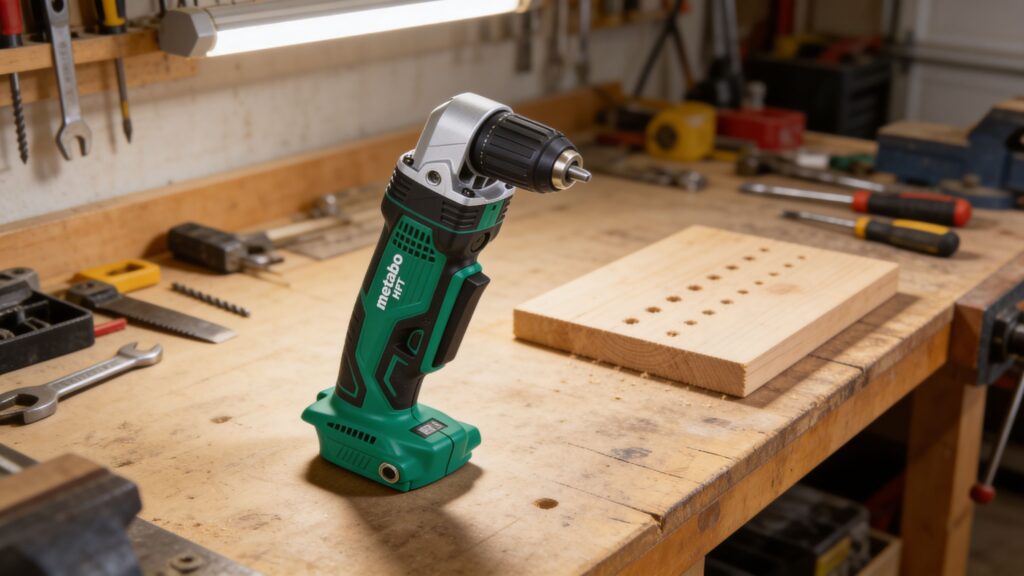
Right-angle drill operating between wall studs in a narrow framing cavity, demonstrating tight-space drilling control and compact head design
What You’ll Learn

Tight-Space Drilling Mechanics

A structured breakdown of how right-angle drills route rotation through a 90-degree head to function within restricted clearance.

  • How bevel gears redirect motor rotation into a perpendicular drive path
  • Why head length and offset determine usable clearance in framing cavities
  • How torque loads concentrate in the gear housing and spindle supports
  • What stabilizing forces prevent bit wander when space limits hand placement
  • How chuck alignment affects straightness when drilling near obstructions
  • Why side-handle leverage changes reaction torque in constrained positions
  • How trigger control and speed selection influence low-clearance drilling stability

Tip: Think in terms of the force path: motor rotation turns gears, gears turn the chuck, and your grip manages reaction torque.

Definitions

Core Components Behind Tight-Space Drilling

Understanding confined drilling begins with the internal components that redirect force, manage load, and stabilize rotation within restricted clearance.

Right-Angle Gear Housing

The gear housing redirects rotational force from the motor into a perpendicular output. Its compact geometry determines how close the tool can operate against surrounding surfaces.

  • Bevel gears: Transfer rotation through a 90-degree intersection
  • Housing length: Sets minimum clearance required inside cavities
  • Load transfer: Concentrates torque where gears mesh under resistance

Drive Shaft Alignment

The internal shaft carries rotation from the motor to the angled gear set. Its alignment affects vibration, efficiency, and how smoothly force reaches the chuck.

  • Centering: Reduces lateral wobble under constrained drilling
  • Support bearings: Stabilize rotation at directional changes
  • Energy flow: Maintains consistent torque through the angle transition

Compact Head Profile

The head profile defines the physical envelope of the drill near the bit. Its shape governs how the tool fits between studs, joists, and other structural barriers.

  • Offset spacing: Determines distance between body and drilling axis
  • Depth clearance: Controls reach inside narrow framing gaps
  • Mass distribution: Influences stability in confined positions

Spindle and Output Shaft

The spindle connects the angled gears to the chuck, translating redirected rotation into usable drilling motion. Its rigidity affects straightness and load response.

  • Axial support: Keeps the bit aligned under side pressure
  • Torque channel: Carries multiplied force from the gear set
  • Runout control: Limits deviation during close-quarters drilling

Chuck Interface

The chuck secures the bit at the end of the angled drive system. Its alignment and grip determine how accurately rotation translates into forward cutting force.

  • Jaw symmetry: Centers the bit along the redirected axis
  • Grip pressure: Prevents slippage under confined leverage
  • Bit projection: Affects reach within tight structural spacing

Reaction Torque Path

Reaction torque is the counterforce generated as the bit resists material. In tight spaces, this force travels through the housing and into the operator’s stabilizing grip.

  • Counter-rotation: Pushes opposite the drilling direction
  • Grip positioning: Manages force where clearance is limited
  • Structural bracing: Uses nearby surfaces to stabilize load

Tip: Tight-space drilling works by redirecting rotation through gears, stabilizing the output shaft, and managing reaction torque within a confined physical envelope.

Power Path

How Rotation Is Redirected Through a 90-Degree Drive System

In a right-angle drill, power does not travel in a straight line from motor to bit. Instead, it is redirected through a compact gear assembly that changes the axis of rotation within a confined head.

  • The motor generates rotational force along the tool’s main body
  • An internal drive shaft transfers that rotation toward the angled head
  • Bevel gears intersect to redirect rotation ninety degrees
  • The output spindle carries redirected torque to the chuck

The effectiveness of tight-space drilling depends on how efficiently this angled power path manages torque without excessive vibration or loss.

Head Geometry

Why Compact Head Design Determines Usable Clearance

Tight-space capability is governed as much by physical geometry as by internal mechanics. The size and offset of the angled head define how close the bit can operate to surrounding structures.

  • Head length sets the minimum distance required between obstacles
  • Offset spacing determines how far the chuck sits from the tool body
  • Housing diameter affects entry into narrow framing cavities

Clearance limitations are therefore shaped by measurable head dimensions rather than overall tool length alone.

Gear Interaction

How Bevel Gears Manage Torque at an Angle

Bevel gears are the mechanical core of the right-angle mechanism. They convert straight-line rotation into perpendicular motion while transmitting load through meshing teeth under pressure.

  • Angled teeth distribute force across a sloped contact surface
  • Gear mesh quality influences smoothness under resistance
  • Load concentration occurs where torque changes direction

When material resistance increases, these gears absorb and redirect force without altering the drill’s external orientation.

Structural Forces

How Reaction Torque Is Managed in Confined Positions

As the bit encounters resistance, counter-rotational forces travel backward through the spindle and housing. In tight spaces, these forces interact with nearby surfaces and limited grip positions.

  • Counter-rotation pushes opposite the drilling direction
  • Housing rigidity distributes stress along the angled head
  • Contact with framing can stabilize or redirect force paths

The stability of the drilling action depends on how reaction torque is absorbed within the tool’s compact structural envelope.

Operator Interface

How Grip Position and Trigger Modulation Influence Control

Limited clearance changes how the operator holds and stabilizes the drill. Control is shaped by hand placement relative to the angled head and by gradual modulation of rotational speed.

  • Offset grips alter leverage against counter-rotational force
  • Variable speed input reduces sudden torque spikes
  • Body bracing against nearby surfaces can steady alignment

Precise drilling in narrow spaces emerges from coordinated interaction between redirected torque and controlled human input.

Quick Reality Check

Where Right-Angle Drills Help — and Where Limits Appear

A quick balance: what the angled drive system enables in tight spaces, and where geometry and load pathways impose practical constraints.

What Tight-Space Geometry Enables

A right-angle head shifts the chuck into spaces where a straight-line body cannot align with the drilling axis, keeping rotation directed through a compact 90-degree gear path.

In stud bays or cabinet interiors, the shortened head envelope can place the bit near the surface while the motor body remains outside the immediate obstruction zone.

Where Clearance Still Constrains

Even with an angled head, the tool still needs room for the housing diameter, spindle support, and hand placement, which can limit access when obstructions surround the chuck.

Under higher resistance, reaction torque travels through the gear housing and grip points, and confined bracing can amplify perceived twist when leverage is restricted.

Common Myths

Misconceptions About Tight-Space Drilling Mechanics

Right-angle drills are often reduced to simple compactness, but their confined performance depends on internal gearing, geometry, and force management.

Right-angle drills are just smaller drills

The defining difference is not size but the 90-degree gear system that redirects rotation. This change in force direction alters torque transfer, spindle support, and how reaction forces travel through the housing in confined spaces.

They can reach anywhere without limits

Even with an angled head, clearance is still governed by housing diameter, head length, and required hand placement. Physical geometry sets measurable limits on how close the chuck can operate to surrounding surfaces.

Angled gears reduce usable torque

Bevel gears are designed to transmit torque across intersecting shafts with minimal loss when properly aligned. Performance depends more on gear quality and load distribution than on the mere presence of a directional change.

Bit control is harder at ninety degrees

Stability is shaped by spindle rigidity and housing support rather than orientation alone. When the output shaft is well-supported, redirected rotation can remain steady even within narrow framing cavities.

Reaction torque disappears in tight spaces

Counter-rotational forces still travel through the angled head and into the grip. In confined positions, limited leverage can make these forces feel amplified because bracing options are restricted.

Tip: Tight-space performance is best understood as a system of redirected rotation, defined geometry, and managed reaction torque working together.

FAQ

Frequently Asked Questions About Tight-Space Drilling Mechanics

Clear answers to common questions about how right-angle drills redirect rotation, manage reaction forces, and operate within limited clearance.

What actually makes a right-angle drill work in tight spaces?

The key is the 90-degree gear head that redirects rotation from the motor body to a perpendicular output shaft. This geometry relocates the chuck into confined areas while the drive system transmits torque through bevel gears and a supported spindle.

Does the angled head change how torque is delivered?

The directional change itself does not inherently reduce torque, but it concentrates load at the gear mesh and bearings. Perceived differences usually come from how efficiently the gears transmit force and how rigidly the output shaft stays supported under resistance.

What determines whether the head will fit in a cavity?

Fit is governed by head length, housing diameter, and the offset distance between the chuck and the tool body. Clearance also includes space for the bit, the workpiece surface, and the operator’s stabilizing grip around the angled head.

Why can tight-space drilling feel “twistier” in the hand?

As the bit resists the material, reaction torque travels back through the spindle and housing into the grip. In confined positions, leverage is shortened and bracing options are limited, which can make the counter-rotation feel more pronounced even at similar torque.

When should I use low gear vs high gear?

Use low gear when resistance is higher so the drive system can deliver more torque at lower speed. Use high gear when resistance is lower and the bit can maintain speed without loading the gear head and spindle supports as heavily.

What causes wobble or misalignment when drilling near obstructions?

Misalignment usually comes from output shaft runout, chuck centering, or side loading when the bit is forced to start at an angle due to nearby surfaces. In tight spaces, limited hand placement can add lateral pressure that magnifies small deviations at the spindle.

Why does the drill slow down more in confined positions?

Restricted space can increase side loading and friction, which raises the torque demand at the gear head. Higher load draws more current, creates more heat, and can trigger controller or battery limits that reduce output to protect the drive components.

What matters more for tight-space drilling: layout or tool mechanics?

Both interact, but layout often sets the constraint by limiting head clearance and bracing points. The internal mechanics determine how smoothly torque is redirected and how stable the spindle remains, which becomes more noticeable when space restricts alignment and leverage.

Tip: When tight-space drilling feels unstable, trace the force path from bit resistance to reaction torque through the head, then identify where clearance limits grip and bracing.

Bottom Line

Right-angle drills work by redirecting torque within constrained geometry. The 90-degree gear system, compact head profile, and reaction torque pathway together determine how effectively rotation is delivered when clearance and leverage are limited.

Understanding this force path clarifies why tight-space drilling feels different and how geometry, load direction, and stabilization shape real-world performance.

Next Steps

Explore Lists, Comparisons, and Selection Guides

With the mechanics of tight-space drilling clarified, these pages extend the discussion into curated lists, structured comparisons, and practical selection frameworks.

Right-Angle Drill Lists

A structured overview of leading right-angle drill options organized by use case, performance focus, and working environment.

Right-Angle Drill Comparisons

Side-by-side breakdowns that examine size, gearing, torque handling, and clearance constraints across different right-angle drill formats.

Right-Angle Drill Buying Guides

In-depth guidance explaining head geometry, drive systems, ergonomics, and how to interpret specifications for confined drilling tasks.

Quick Summary

Tight-Space Drilling Mechanics

  • Bevel gears redirect motor rotation through a 90-degree head
  • Head geometry determines minimum clearance inside framing cavities
  • Torque loads concentrate where rotational direction changes
  • Reaction torque travels back through housing and grip
  • Stability depends on spindle support and controlled speed modulation