
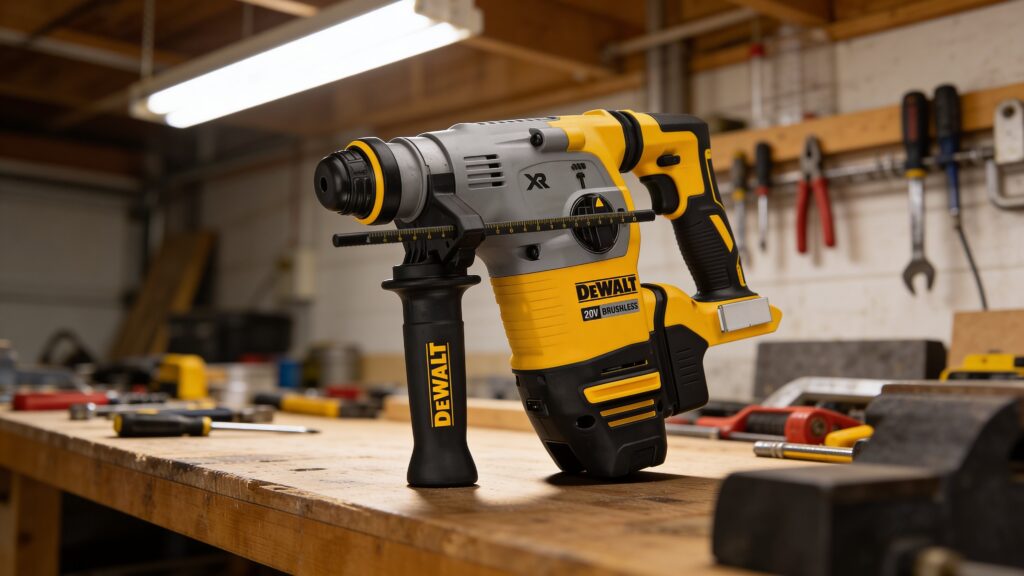
How Rotary Hammer Drills Works

Rotary hammer drills are often described in simple terms, but the mechanism behind them is more specialized than standard drilling. Their operation combines rotation with a separate hammering action generated inside the tool, which is why they are frequently misunderstood as ordinary drills with more force.

This explainer outlines the internal system that makes that motion possible, including how impact energy is created, how the drill bit moves, and how the rotary and hammering functions work together. By the end, the reader will have a clearer understanding of the core parts, motion, and operating principle behind a rotary hammer drill.

By: Review Streets Research Lab
Updated: April 19, 2026
Explainer · 8–12 min read
Heavy-duty rotary hammer drill boring into a concrete surface with dust in motion, showing the power and function of the tool in action
What You’ll Learn

How Rotary Hammer Drills Work

A focused explanation of the internal motion, impact system, and coordinated mechanisms that produce rotary hammer drilling inside dense masonry materials.

  • How rotation and hammering are generated as separate but synchronized motions
  • What the piston system does to create repeated internal impact energy
  • How air pressure transfers force through the striker to the bit
  • Why rotary hammers differ mechanically from standard percussion drilling systems
  • How the chuck and bit interface manage impact without losing alignment
  • What changes when hammer-only, rotation-only, or combined modes are engaged
  • How internal timing, mass, and motion shape the tool’s operating cycle

Tip: Think of a rotary hammer as a system that spins the bit while a separate internal mechanism repeatedly drives it forward.

Definitions

Key Parts That Make a Rotary Hammer Drill Work

To understand the mechanism clearly, it helps to separate the rotating system, the impact system, and the parts that transfer force to the bit.

Drive Motor

The motor supplies the initial rotational force that starts the tool’s operating cycle. That motion is then routed through internal parts that coordinate spinning and impact as separate actions.

  • Input: Provides the base mechanical energy for the system
  • Rotation: Keeps the bit turning during the drilling cycle
  • Linkage: Feeds motion into gears and hammer components

Gear Train

The gear train redirects and reduces motor speed into usable internal movement. It helps synchronize how rotational motion and hammer motion are produced inside the housing.

  • Transfer: Carries motion from the motor to working parts
  • Reduction: Converts speed into more controlled mechanical force
  • Timing: Helps coordinate repeated motion through each cycle

Piston Mechanism

The piston system creates the repeated forward-and-back motion that drives the hammering action. Instead of striking directly with gears, it uses reciprocating movement to generate impact energy.

  • Reciprocation: Moves back and forth within the cylinder
  • Compression: Builds the pressure that powers each impact event
  • Separation: Keeps hammer force distinct from simple rotation

Air Cushion and Striker

The air cushion transfers energy from the piston to the striker without rigid contact during normal operation. The striker then carries that energy forward to the end of the tool.

  • Transfer: Moves impact energy through compressed air pressure
  • Striker: Delivers the moving force toward the bit assembly
  • Rhythm: Repeats this process through every hammer cycle

Chuck and Bit Interface

The chuck system holds the bit in a way that allows rotation and controlled axial movement. That design lets impact travel through the bit while it remains guided inside the tool.

  • Retention: Keeps the bit engaged under repeated impact
  • Movement: Allows slight forward travel during hammering action
  • Alignment: Helps direct force along the drilling axis

Mode Selector

The mode selector changes which internal motions are active at a given time. It determines whether the system uses rotation alone, hammering alone, or both together.

  • Routing: Engages different motion paths inside the mechanism
  • Function: Changes how force is delivered through the tool
  • System: Alters the relationship between spin and impact

Tip: A rotary hammer works as two coordinated systems at once: one turns the bit, while another generates repeated forward impact.

Power Path

How Motion and Impact Move Through a Rotary Hammer Drill

A rotary hammer drill does not rely on simple spinning alone. Its internal system divides mechanical energy into rotational motion and repeated forward impact, then delivers both through the bit assembly.

  • The motor begins the cycle by producing continuous rotational force
  • Internal gears redirect that motion into both spinning and reciprocating movement
  • The piston system converts rotary input into repeated back-and-forth travel
  • Compressed air transfers impact energy to the striker without constant direct contact
  • The chuck and bit interface deliver rotation and axial force together

The tool’s drilling behavior depends on how efficiently these linked stages create and transfer energy through each cycle.

Motors

The Motor Starts the System but Does Not Create the Hammer Blow Alone

The motor is the source of continuous motion inside the tool, but the impact action comes from what that motion drives afterward. This distinction explains why a rotary hammer is mechanically different from a standard drill.

  • Continuous input keeps the internal mechanism moving through repeated operating cycles
  • Rotational force turns gears that drive both spin and hammer functions
  • System role is to supply motion that other parts reshape into impact

What reaches the bit is not raw motor output, but motor energy transformed by the tool’s internal mechanism.

Gearing

Gears Coordinate Rotation with the Hammering Cycle

Inside a rotary hammer drill, gears do more than reduce speed or redirect motion. They help coordinate the relationship between continuous motor rotation and the reciprocating movement that drives impact.

  • Gear reduction helps convert fast motor speed into controlled internal force
  • Cam or crank-like motion can be derived from rotating components
  • Timing between moving parts affects how consistently impacts are generated
  • Mechanical alignment keeps rotational and hammer functions working together

The gear system shapes how smoothly the drill converts spinning input into a repeating impact pattern.

Heat Management

Heat Changes How Efficiently the Internal System Transfers Energy

As internal parts cycle rapidly, friction and repeated motion generate heat throughout the tool. That heat influences how smoothly components move and how efficiently energy is carried from one stage to the next.

  • Friction between moving parts increases thermal load during repeated operation
  • Rising temperature can affect lubrication and internal mechanical resistance
  • Added resistance changes how efficiently motion becomes useful impact

When heat builds, the same mechanism may continue running while transferring energy less effectively through the system.

User Control

Mode Selection Changes Which Internal Motions Are Active

A rotary hammer drill can route its internal motion in different ways depending on the selected mode. This matters because the tool is designed to separate spinning, hammering, and combined action rather than treat them as one behavior.

  • Rotation-only mode keeps the bit turning without activating the hammer cycle
  • Hammer-only mode directs repeated impact without normal drilling rotation
  • Combined mode links spin and axial impact during the same operating cycle
  • The selector works by engaging different internal paths and couplings

Changing modes alters the mechanical relationship between the tool’s rotating system and its impact system.

Quick Reality Check

Where Rotary Hammer Drills Excel — and Where Their Limits Appear

A quick balance of what the mechanism does especially well, and where its design introduces tradeoffs in force delivery, heat, and control.

Where the System Excels

Rotary hammer drills are effective because they separate spinning motion from impact generation, allowing the bit to rotate while repeated internal blows drive it forward.

In dense masonry, that mechanism reduces reliance on rotation alone, since the piston and striker system supplies much of the force needed to keep progress moving.

Where Limits Show Up

The same impact system adds mass, moving parts, and thermal load, which means efficiency depends on internal timing, lubrication, and sustained energy transfer.

Under continuous heavy use, heat and mechanical resistance can change how smoothly the cycle runs, even when the motor continues turning at a steady rate.

Common Myths

Misconceptions About How Rotary Hammer Drills Work

Rotary hammer drills are often described too simply, which hides the separate systems that create rotation, impact, and controlled force transfer.

They are just regular drills with more force

A rotary hammer drill uses a different internal mechanism from a standard drill. Its hammering action comes from a piston-driven impact system, not from simply pushing a spinning bit harder.

The bit itself creates the hammering action

The bit transfers motion into the material, but it does not generate the impact. Hammer energy is produced inside the tool, then delivered forward through the striker and bit interface.

Rotation does all the real work

In a rotary hammer drill, rotation and impact play different roles in the same cycle. The bit turns to clear and guide the cut, while repeated axial blows supply much of the breaking force.

Hammering means the gears are striking directly

Under normal operation, the gear system does not deliver the blow by direct striking. It drives a piston mechanism that uses reciprocating motion and air pressure to move impact energy forward.

All operating modes use the same motion path

Different modes engage different internal relationships between rotation and hammering. The tool changes which motions are active, rather than running one fixed mechanism in every setting.

Tip: The clearest way to understand a rotary hammer drill is to see it as one system that spins the bit and another that independently creates repeated forward impact.

FAQ

Frequently Asked Questions About How Rotary Hammer Drills Work

Clear answers to the most common follow-up questions about the internal motion, impact cycle, and force transfer inside a rotary hammer drill.

What makes a rotary hammer drill different from a standard drill?

A standard drill mainly relies on rotation, while a rotary hammer drill adds a separate internal impact system. That system uses a piston and striker arrangement to send repeated forward blows through the bit as it turns.

How does the hammering action get created inside the tool?

The motor drives internal parts that convert rotational motion into reciprocating piston movement. That piston compresses air, which transfers energy to a striker that moves forward and delivers impact through the bit assembly.

Does the bit create the impact by itself?

No. The bit transmits force into the material, but the impact begins inside the tool’s hammer mechanism. The internal system generates the repeated axial blows, and the bit carries that energy outward while continuing to rotate.

Why does the bit need to rotate if the tool also hammers?

Rotation and hammering do different jobs in the same cycle. The hammering action breaks material by repeated forward impact, while rotation helps the bit cut, clear debris, and maintain its path through the hole.

What changes when different operating modes are selected?

The mode selector changes which internal motions are engaged. Depending on the setting, the tool may use rotation alone, hammering alone, or a coordinated combination of both through different internal couplings and motion paths.

Why can the bit move slightly inside the chuck?

That movement is part of how the impact system works. The chuck and bit interface are designed to retain the bit securely while still allowing controlled axial travel, so forward hammer energy can pass through the bit effectively.

Does the motor deliver the hammer blow directly?

Not directly. The motor provides continuous motion, but the hammer blow is created later in the chain by the piston, compressed air, and striker. The impact is the result of transformed motion, not simple direct drive.

Why does the mechanism feel different under sustained heavy use?

Repeated impact cycles create heat and mechanical resistance inside the tool. As temperature and friction rise, the system may transfer energy less efficiently, even though the motor continues driving the mechanism through the same basic cycle.

Tip: When a rotary hammer drill’s behavior seems confusing, trace the sequence from motor motion to gearing, piston movement, air transfer, striker impact, and finally the bit.

Bottom Line

Rotary hammer drills work by combining rotation with a separate internal impact system. The motor drives coordinated parts that transform continuous motion into repeated forward blows, allowing the bit to spin while impact energy moves through it.

Once that sequence is clear, the tool’s motion, mode changes, and behavior under load become much easier to interpret as parts of one connected mechanism.

Next Steps

Continue Through the Category

With the mechanism established, these pages extend the topic into broader category views, direct evaluations, and more detailed decision-oriented guidance.

Rotary Hammer Lists

A broader category page that organizes rotary hammer drills by intended use, working demands, and the general traits readers may want to sort through.

Rotary Hammer Comparisons

A focused set of side-by-side evaluations showing how rotary hammer drills differ in layout, operating behavior, and the tradeoffs built into each design.

Rotary Hammer Buying Guides

A practical guide library explaining which operating modes, tool dimensions, and functional features matter when narrowing the category with more clarity.

Quick Summary

How Rotary Hammer Drills Work

  • Rotation and hammering are separate motions working together in one cycle
  • A piston mechanism creates impact energy instead of direct gear striking
  • Compressed air transfers force from the piston to the striker
  • The chuck holds the bit while allowing controlled axial movement
  • Mode selection changes which internal motions are active and combined