
Right-Angle Drills Buying Guide for Plumbing Installations
Right-angle drills play a specialized role in plumbing installations where standard drill bodies cannot operate efficiently. Working between studs, inside cabinets, and within joist bays requires compact head geometry, controlled torque delivery, and balanced handling. Selecting the appropriate configuration involves more than choosing a smaller drill; considerations such as power source, chuck type, speed control, and durability all influence performance in confined structural environments.
This buying guide clarifies the technical factors that shape purchasing decisions, including head profile dimensions, motor output, clutch mechanisms, ergonomics, and compatibility with plumbing-specific drilling tasks. It outlines the tradeoffs between size and power, corded and cordless platforms, and lightweight design versus sustained torque. By the end, readers will understand the decision criteria necessary to select a right-angle drill suited to professional plumbing demands.
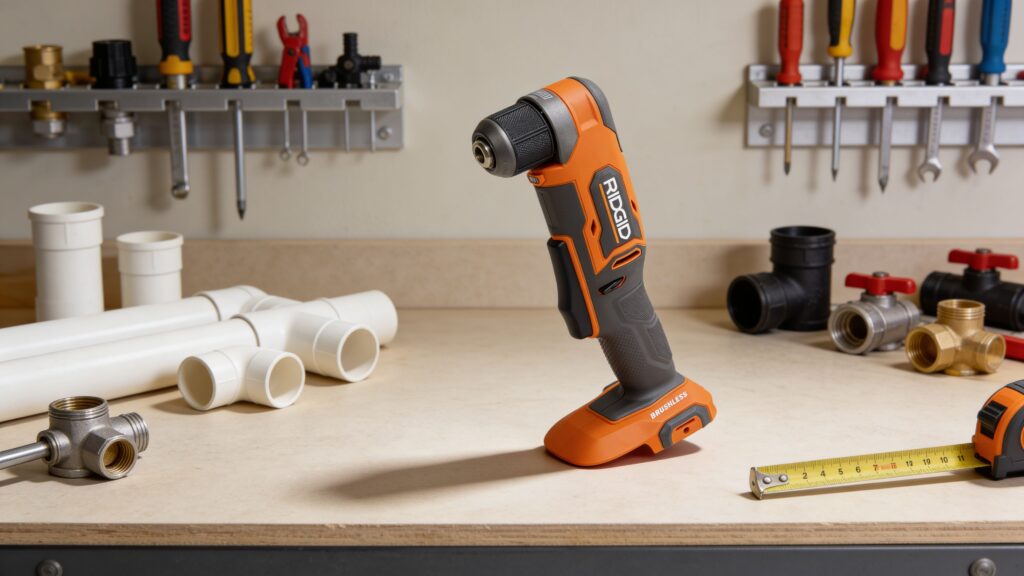
Buying framework
How to think about buying a right-angle drill for plumbing
Right-angle drills are designed for confined structural spaces where conventional drill bodies cannot operate efficiently. In plumbing installations, performance is defined less by raw output and more by head profile, torque control, and how the tool behaves between studs or inside cabinetry. Use this framework to evaluate tradeoffs before narrowing your options.
Head size defines access: The clearance between studs, joists, and pipe runs determines whether the tool can operate at all. Measure typical working gaps and compare them to head height and overall length, not just motor specifications.
Torque must match hole size: Boring larger-diameter holes through framing requires sustained torque and controlled speed. More power increases capability, but it also increases weight and reaction force in tight quarters.
Clutch and trigger control protect materials: Smooth low-speed modulation and a reliable clutch reduce tear-out, bit binding, and overdriving when working near finished surfaces or installed piping.
Power source affects mobility: Corded designs offer continuous runtime, while cordless systems improve maneuverability in confined or elevated areas. Consider jobsite access, extension needs, and battery rotation workflow.
Ergonomics influence long sessions: Handle angle, grip texture, and balance matter when drilling repeatedly between framing members. A tool that minimizes wrist strain improves consistency across an installation.
Who this is for
Pick the drill that matches how you actually work
The right-angle drill you choose depends on the type of plumbing work you perform, how often you drill through framing, and how confined your workspace tends to be. Use these profiles to align head size, torque delivery, and power source with your real installation demands.
Home plumbing upgrades: You install fixtures, run short pipe sections, and occasionally bore through studs during remodels. Priorities include compact head size, predictable trigger control, and manageable weight. What matters most is confident handling in tight wall cavities without excess power you rarely use.
Bathroom and kitchen remodelers: You regularly drill multiple framing members for supply and drain lines in partially finished spaces. Sustained torque, balance during repetitive drilling, and reliable clutch control become critical. What matters most is consistency under moderate load across longer sessions.
New construction plumbers: You bore repeated large-diameter holes through studs and joists before walls are closed in. High torque capacity, durability, and stable ergonomics under reaction force are key priorities. What matters most is maintaining control and productivity during continuous framing work.
Service and retrofit technicians: You work inside finished homes, navigating cabinets, crawl spaces, and tight utility chases. Compact dimensions, cordless mobility, and smooth low-speed starts protect surrounding surfaces. What matters most is maneuverability without sacrificing necessary drilling capability.
Mixed-trade contractors: You alternate between plumbing, light electrical, and general framing tasks throughout the week. Versatility, battery platform compatibility, and balanced power-to-size ratios are central concerns. What matters most is a configuration that adapts across environments without becoming cumbersome.
What to pay attention to
Which cordless drill specs actually matter
Right-angle drill spec sheets can appear technical and definitive, but many figures don’t translate directly to plumbing performance. The dimensions, control behavior, and sustained torque characteristics matter far more than isolated peak numbers. Focus on how the tool fits framing cavities and how it behaves during repeated hole boring.
Specs that affect feel
Trigger response, grip angle, clutch tuning, and balance determine how controlled the drill feels in tight structural spaces.
Specs that affect capability
Head height, overall length, battery configuration, and sustained torque output determine what framing tasks are realistically manageable.
Trigger modulation: Smooth low-speed control allows you to start large bore bits accurately between studs without sudden torque spikes that can twist the tool or damage framing.
Weight and balance: Published weights rarely reflect the battery installed. The combination of motor position and battery size determines wrist strain during repeated horizontal drilling.
Clutch behavior: A consistent clutch helps prevent overdriving fasteners or binding when drilling near finished surfaces, even though torque ratings may look similar on paper.
Head height and overall length: Clearance between studs and inside cabinets is often the limiting factor. A few millimeters in head profile can determine whether the drill fits without repositioning pipe runs.
Battery capacity and runtime: Higher amp-hour batteries extend runtime but add weight and shift balance. In confined plumbing work, maneuverability can matter more than maximum continuous runtime.
Often overhyped: Peak torque figures and voltage branding emphasize momentary output rather than sustained performance, which is what actually defines drilling through multiple framing members.
Avoid these traps
Common mistakes people make when buying a cordless drill
Most dissatisfaction with a right-angle drill comes from mismatching the tool to the plumbing environment it will actually face. These are the most common misunderstandings—and how to think about them before committing to a configuration.
Focusing on torque instead of fit: High torque ratings can distract from the reality of tight framing cavities. If the head profile cannot comfortably fit between studs or inside cabinets, power becomes irrelevant. Clearance and control should be evaluated before output numbers.
Choosing maximum size for occasional heavy holes: Larger right-angle drills add weight and reaction force that can become fatiguing during routine drilling. Tools optimized for rare large-diameter boring may feel cumbersome during everyday supply line work.
Overlooking balance in confined spaces: Battery size and motor placement significantly affect wrist strain when drilling horizontally between framing members. A tool that appears manageable on paper can feel unstable during repeated installations.
Ignoring clutch and trigger behavior: In finished homes and retrofit work, abrupt starts or inconsistent clutch engagement increase the risk of surface damage and bit binding. Smooth modulation often matters more than peak output.
Assuming voltage labels define performance: Voltage branding does not fully describe sustained torque or motor efficiency. Real-world plumbing work depends more on how consistently the drill maintains speed under load.
Forgetting long-term platform considerations: A right-angle drill often connects to a broader battery ecosystem. Overlooking compatibility and workflow implications can limit flexibility on future projects.
Decision guidance
Which type of cordless drill is right for you
The right-angle drill configuration depends on how often you bore through framing, how tight your working clearances are, and how long each session lasts. Use this guidance to align size, torque capacity, and power source with your actual plumbing workload.
Choose a compact right-angle drill if: most of your work happens inside cabinets, between closely spaced studs, or in finished homes where maneuverability is critical. Compact configurations reduce fatigue and improve visibility, especially during shorter drilling runs and retrofit installations.
Choose a higher-torque model if: you regularly bore larger-diameter holes through multiple framing members in new construction. Greater sustained output helps maintain speed under load, though the added weight and reaction force require more control during extended sessions.
Opt for cordless mobility if: you move frequently between rooms, floors, or confined areas where extension cords limit positioning. Corded setups make more sense in fixed locations with consistent access to power and long, uninterrupted drilling cycles.
Prioritize balance over maximum runtime if: your drilling is intermittent throughout the day rather than continuous. A lighter battery that improves handling can be more practical than extended runtime that adds strain in tight framing cavities.
Consider alternative tools if: your primary tasks involve driving long structural fasteners or mixing materials rather than boring framing holes. In those cases, a different tool category may better match the dominant workload, with a right-angle drill serving as a complementary solution rather than the primary one.
Ownership & compatibility
What you’re really buying into long term
A right-angle drill for plumbing installations is part of a broader system, not a standalone purchase. Long-term satisfaction depends on battery compatibility, parts support, service access, and how well the tool integrates into your daily workflow as projects evolve.
Battery ecosystem depth: Different battery sizes affect weight, balance, and runtime in tight framing work. Over time, battery lifespan and replacement costs become one of the primary ownership considerations, especially for high-frequency use.
Platform continuity: Committing to a battery platform shapes future tool purchases across trades. Consider how widely supported the system is, how often new tools are introduced, and whether it fits the broader scope of your plumbing or mixed-trade work.
Serviceability and wear components: Chucks, switches, and clutches experience regular stress in repetitive drilling through framing. Access to replacement parts and straightforward service options can extend tool life beyond the initial ownership period.
Workflow friction: Charging routines, battery rotation, and storage solutions influence daily efficiency more than spec sheets suggest. A system that simplifies swapping packs and keeping backups ready reduces downtime on multi-room installations.
Total ownership costs: Tool-only versus kit purchases affect initial setup, but long-term expenses often center on additional batteries and replacements. Planning for battery turnover and expanded tool needs prevents incremental costs from accumulating unexpectedly.
FAQ
Cordless drill buying guide FAQ
Quick answers to the questions people ask most when choosing a right-angle drill for plumbing installations—focused on real framing work, not spec-sheet noise.
Do I really need a right-angle drill for plumbing?
Is cordless powerful enough for boring through studs?
How much torque do I actually need?
Does head size really make that big of a difference?
What battery size makes sense for plumbing work?
Is corded better than cordless for plumbing installations?
Do I need a clutch on a right-angle drill?
What features matter most in tight spaces?
How long should a right-angle drill last?
Bottom line
The simplest way to pick the right cordless drill
Most right-angle drills are capable of handling standard plumbing installations. The right choice comes down to how often you bore through framing, how tight your working clearances are, and how the tool feels during repeated use in confined spaces.
If access is your main constraint: prioritize compact head height, manageable weight, and smooth trigger control. A drill that fits comfortably between studs will serve you better than one with higher peak output that rarely gets used fully.
If sustained drilling is routine: choose a configuration built for consistent torque under load. Accept the tradeoff in added weight only if large-diameter holes and repeated framing runs are part of your weekly workload.
If mobility matters: favor cordless flexibility and a battery size that keeps balance comfortable. Extended runtime is useful, but daily handling comfort often defines long-term satisfaction.
If your tasks vary across trades: think in terms of ecosystem continuity and battery compatibility. The platform you commit to will influence future tools and workflow more than small differences in drill specifications.
Final check: picture the space where you drill most often and the bit size you use most frequently. Choose the right-angle drill that feels balanced and controlled in that scenario, not the one optimized for rare edge cases.
Reading Shortcuts
Jump to the sections that matter most for choosing the right-angle drill for plumbing work.
Decision Reminders
A quick checklist before you commit to a drill + battery platform.
- Prioritize head clearance first: if the drill can’t fit comfortably between studs or inside cabinets, torque won’t matter.
- Match torque to hole size: choose sustained output for frequent large-diameter boring, not occasional edge-case tasks.
- Balance affects daily comfort: battery size and motor placement determine wrist strain during repeated horizontal drilling.
- Think in systems, not single tools: battery compatibility and charger workflow shape long-term convenience.
- Runtime isn’t everything: lighter batteries swapped more often often feel better than one heavy pack during tight installations.
- Question peak performance claims: sustained control under load matters more than isolated torque or voltage labels.
Glossary Snippets
Quick translations for the terms that confuse buyers most.
When to Use a Top 10 Review
If you want the fastest shortlist, this is the format that gets you to a confident pick.
- You’re early in your research: A ranked list translates key specs and workload fit into a clear starting point.
- You want structured “best for” categories: Formats like Best Overall or Best for Tight Spaces help narrow use cases quickly.
- You’re comparing capability tiers: Side-by-side summaries clarify differences in torque class, head size, and battery ecosystem.
- You need a smart shortlist: A Top 10 helps reduce dozens of options to a manageable few before deeper comparison.
Already down to 2–3 models? A Comparison is usually faster than reading full reviews.
When to Use a Comparison
Best when you’re choosing between specific models and want the clearest tradeoffs.
- You’re down to 2–3 configurations: a side-by-side view clarifies head size, torque class, and battery setup quickly.
- You want clear tradeoffs: comparisons highlight differences in control, sustained output, and ownership factors without extra noise.
- You value category callouts: winner-by-category summaries (control, ergonomics, runtime) simplify nuanced distinctions.
- You need to decide today: once your shortlist is set, a comparison page acts as the final filter.
Still exploring? Start with a Top 10 to identify the right drill type before narrowing to finalists.