
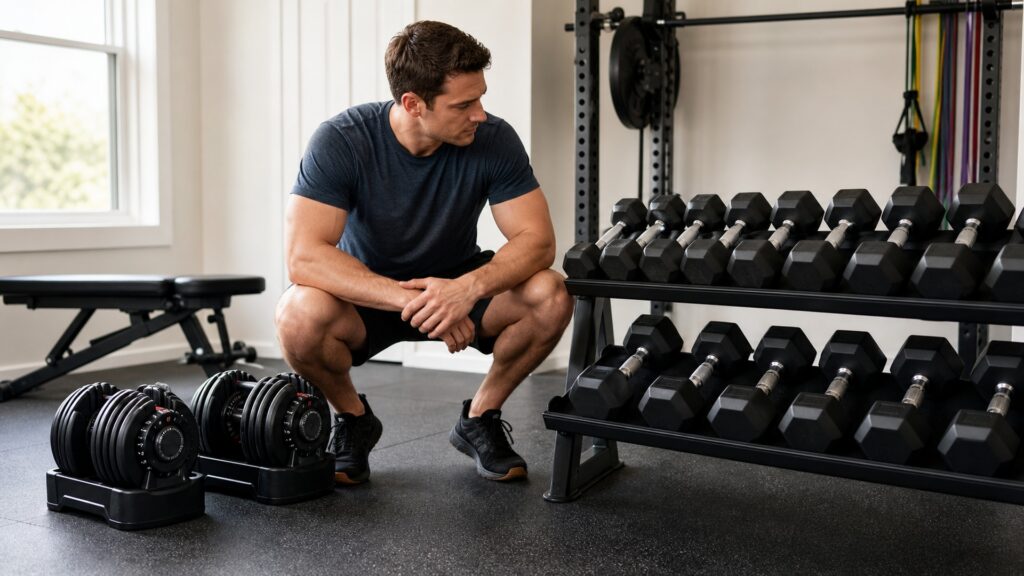
What Makes Adjustable Dumbbells Different from Traditional Dumbbells

Adjustable dumbbells and traditional dumbbells differ in how they store and change load. Adjustable models compress many weight options into one handle system; traditional dumbbells keep each weight as a fixed pair.

That changes footprint, changeover time, durability, balance, handle feel, and progression increments. The better choice depends on space, budget, workout pace, and whether quick reliable transitions matter more than compact storage.

By: Review Streets Research Lab
Updated: September 2, 2026
Explainer · 8-12 min read
adjustable dumbbells explainer hero image for Review Streets
What You'll Learn

How Load Selection Changes Dumbbell Training

Adjustable and traditional dumbbells differ through storage footprint, load-change mechanism, balance, durability, changeover time, and progression increments.

  • How selector systems replace multiple fixed pairs
  • Why fixed dumbbells usually change faster during busy circuits
  • How handle length and plate shape affect movement feel
  • Where drop tolerance and durability differ
  • Why small load increments matter for progression
  • How home-gym space changes the value of adjustability

Tip: Judge the equipment by the training job it changes, then compare features.

Definitions

Key Concepts That Define Adjustable Dumbbells and Traditional Dumbbells

An adjustable dumbbell changes load on one handle through dials, pins, plates, or locking mechanisms. The remaining concepts define the variables that change actual use.

Adjustable dumbbell

An adjustable dumbbell changes load on one handle through dials, pins, plates, or locking mechanisms.

  • It saves storage space compared with a full rack.
  • The mechanism controls change speed and durability.
  • Some designs feel long or bulky at lighter weights.

Traditional dumbbell

A traditional dumbbell has a fixed weight built into one implement.

  • It is simple to grab and usually durable.
  • A full set needs more space and cost.
  • Progression depends on available pairs.

Selector mechanism

A selector mechanism is the dial, pin, lever, or plate system used to choose weight.

  • It determines how fast load changes.
  • It can be sensitive to drops or misalignment.
  • The mechanism is part of training feel.

Changeover time

Changeover time is the pause needed to move from one load or exercise to another.

  • Traditional dumbbells are fast when pairs are nearby.
  • Adjustable models vary by mechanism.
  • Circuits expose slow changes.

Handle geometry

Handle geometry is the shape, length, grip texture, and balance of the dumbbell.

  • Bulky handles can affect curls, presses, and rows.
  • Knurling changes grip security.
  • Balance affects control.

Drop tolerance

Drop tolerance is how well a dumbbell survives being set down hard or dropped.

  • Fixed dumbbells usually tolerate abuse better.
  • Adjustable systems can be more fragile.
  • Dropping weights is still a safety concern.

Tip: A traditional dumbbell has a fixed weight built into one implement.

Storage

Adjustable Dumbbells Trade a Rack for a Mechanism

The main advantage is compression. One adjustable pair can replace many fixed pairs, which matters in small rooms.

  • Compact storage helps apartments.
  • Stands improve access.
  • Weight range still has limits.
  • A full fixed rack is faster but larger.
  • The mechanism becomes the weak point.

Adjustability solves space by adding complexity.

Speed

Traditional Dumbbells Win When Transitions Are Constant

Fixed pairs are simple: pick up the next weight and go. That matters for supersets, classes, drop sets, or shared spaces.

  • No dial needs resetting.
  • Two users can use different pairs.
  • Circuits move faster.
  • A rack costs and occupies more.
  • Missing pairs interrupt progression.

Fixed dumbbells favor quick changes.

Feel

Shape and Balance Change Exercise Control

Adjustable dumbbells can be longer, boxier, or differently balanced than fixed dumbbells. That changes how some movements feel.

  • Long handles can bump the body.
  • Square plates can alter curls.
  • Grip texture changes security.
  • Balance affects presses and rows.
  • Traditional pairs often feel more predictable.

The load number is not the whole feel.

Durability

Selector Systems Need More Care

Adjustable dumbbells include moving parts. That makes them convenient but can reduce tolerance for drops, dirt, and rough handling.

  • Pins and dials can misalign.
  • Plastic parts may crack.
  • Fixed rubber or urethane heads are simpler.
  • Warranty language matters.
  • Controlled lowering protects both types.

Durability follows the construction.

Decision

Choose Compact Range or Fast Simplicity

Adjustable dumbbells fit users who need many weights in little space. Traditional dumbbells fit users who prioritize speed, durability, and familiar feel.

  • Choose adjustable for small home gyms.
  • Choose fixed pairs for high-use rooms.
  • Check increments against exercises.
  • Test handle size before buying.
  • Do not ignore storage access.

The difference is storage efficiency versus immediate simplicity.

Quick Reality Check

Where Adjustable Dumbbells and Traditional Dumbbells Helps and Where It Needs Context

The useful answer follows the actual mechanism, setup, and training condition rather than a generic upgrade claim.

What This Clarifies

It explains what adjustable dumbbells and traditional dumbbells changes in real training.

It gives readers practical comparison criteria without overstating outcomes.

What It Cannot Prove

It cannot guarantee performance, recovery, injury prevention, safety, or health outcomes.

Dumbbell selection cannot answer pain, rehab, or individualized programming questions; those need coaching or clinical context outside a gear explainer.

Common Myths

Misconceptions About Adjustable Dumbbells and Traditional Dumbbells

Common shortcuts and misunderstandings can make the topic seem simpler than it is.

Adjustable Dumbbells and Traditional Dumbbells works the same for everyone

The useful choice depends on body size, skill, setup, environment, goal, and tolerance.

More equipment automatically means better training

Extra features help only when they solve a specific movement, setup, or feedback problem.

A product can guarantee results or safety

Gear can support training decisions, but it cannot control technique, fatigue, progression, recovery, or risk.

Comfort proves the mechanism is correct

A tool can feel good while still being poorly matched to the goal.

One setup choice replaces coaching or judgment

Complex lifts, stroke changes, pain, and symptoms need more context than a product page can provide.

Tip: For adjustable dumbbells and traditional dumbbells, follow the mechanism before accepting broad gear claims.

FAQ

Frequently Asked Questions About Adjustable Dumbbells and Traditional Dumbbells

Concise answers to common questions readers may have after the main explanation.

Which mechanism should guide decisions about adjustable dumbbells and traditional dumbbells?

Start with the physical job: load support, resistance path, grip, stability, vision, buoyancy, propulsion, or stroke feedback.

Does this guarantee better results?

No. It can support better training decisions, but it cannot guarantee performance, safety, recovery, or injury prevention.

What should readers compare first?

Compare the mechanism, fit, setup, adjustment range, durability, and training context before brand claims.

How should someone test it?

Test the setup during ordinary training before using it for heavy attempts, races, long sessions, or technical work.

When is qualified help useful?

Qualified coaching or medical guidance matters for complex technique, pain, symptoms, injury concerns, or individualized programming.

Bottom Line

Adjustable Dumbbells and Traditional Dumbbells matters when it changes a specific movement, setup, feedback, or progression problem.

The best decision matches mechanism, fit, training context, and evidence limits instead of treating equipment as a shortcut.

Next Steps

Go Deeper or Compare Your Options

Use these related explainers to continue the Review Streets fitness decision path around adjustable dumbbells and traditional dumbbells.

Quick Summary

Adjustable Dumbbells and Traditional Dumbbells Explained

  • How selector systems replace multiple fixed pairs
  • Why fixed dumbbells usually change faster during busy circuits
  • How handle length and plate shape affect movement feel
  • Where drop tolerance and durability differ
  • Claims about safety, injury prevention, recovery, or performance need limits.