
Spatial Target
A spatial target gives the athlete a place to move, cut, stop, or react.
- Example: cones marking a shuttle drill
- Check: check distance and angle
- Limit: targets do not create strength by themselves
Agility training equipment and bodyweight training equipment both support movement practice, but they emphasize different problems. Agility equipment organizes space, direction, reaction, and footwork. Bodyweight training equipment supports strength, control, mobility, or leverage using the athlete's own body weight.
The difference matters because agility tools usually shape how an athlete moves across space, while bodyweight tools usually change how the athlete loads, supports, or controls the body in place or through a strength movement.
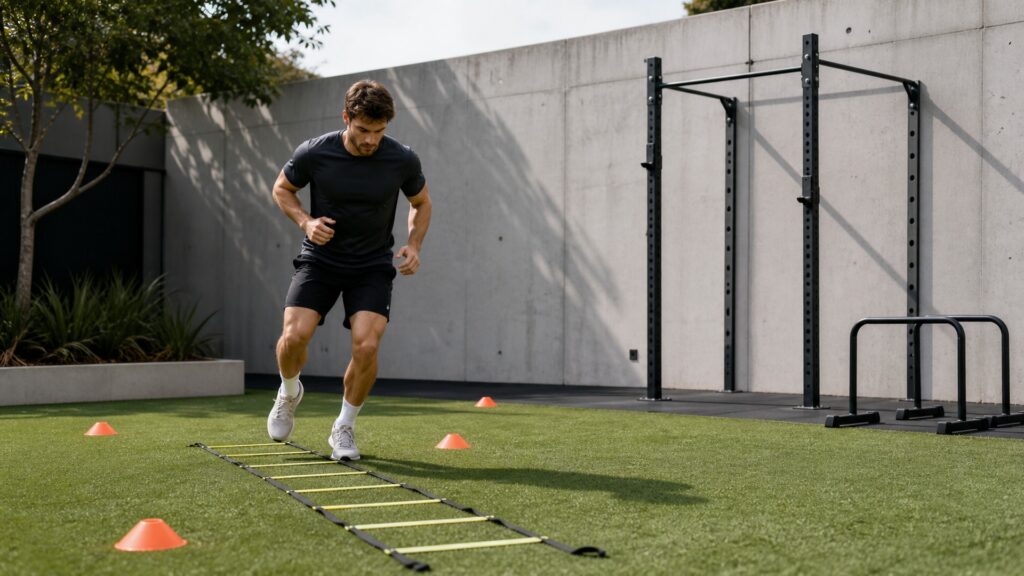
A practical comparison of direction-change practice and bodyweight strength support.
Tip: Start with the swimming situation, then choose the gear detail that solves that specific problem.
These concepts keep the decision tied to fit, water conditions, training purpose, and realistic limits.
A spatial target gives the athlete a place to move, cut, stop, or react.
Bodyweight load is resistance created mainly by the athlete's own body mass.
Direction change is movement that requires braking and redirecting the body.
A support point is where the athlete holds, hangs, presses, or anchors the body.
Reaction practice uses cues that make the athlete choose where or when to move.
Strength control is the ability to hold or move body weight through a stable range.
Tip: The useful feature is the one that makes the swim clearer, safer, or easier to repeat.
Cones, ladders, markers, hurdles, and reaction tools create routes, boundaries, cues, and targets. They help athletes practice moving, stopping, and redirecting.
Agility gear is strongest when movement through space is the goal.
Pull-up bars, rings, parallettes, benches, and suspension systems help athletes train strength, control, and body position using body weight.
Bodyweight tools are strongest when loading the body is the goal.
Agility drills can include unpredictable cues: a coach call, light, partner movement, or ball direction. Bodyweight equipment is usually less about reacting to external movement.
Reaction is a major reason agility gear exists.
Agility still needs strength and control. Bodyweight tools can build that foundation, especially in hips, trunk, shoulders, and pulling or pushing strength.
Strength supports agility, but it is not the same drill.
If the session asks how quickly and safely the athlete can move through space, agility equipment fits. If it asks how well the athlete can control body weight, bodyweight equipment fits.
The tools can complement each other when their roles stay clear.
Agility and bodyweight tools can work together, but they do different jobs.
The goal is footwork, braking, cutting, reaction, or spatial control.
The athlete needs targets and cues.
The goal is strength, control, leverage, or mobility.
The athlete needs scalable pushing, pulling, holding, or core work.
Different tools should not be ranked only by intensity.
They train coordination and rhythm, not full-body strength.
They can support the strength and control that agility requires.
The better tool is the one that matches the session goal.
Speed still needs braking, balance, and decision-making.
Tip: Strong claims still need to match the swimmer, pool, and session.
Short answers for practical swimming decisions.
Not usually. Agility tools shape movement through space, while bodyweight tools train strength and control.
Yes, by improving strength, balance, and control, but it should be paired with movement drills.
Choose it for footwork, cutting, reaction, acceleration, deceleration, or spatial drills.
Choose it for scalable strength, mobility, and body-control work.
Use agility gear for movement problems and bodyweight gear for strength-control problems.
Agility training equipment is different from bodyweight training equipment because it organizes movement through space instead of primarily loading bodyweight strength.
The two categories can support each other, but they solve different parts of athletic training.
Use these Review Streets paths to compare related categories and practical next decisions.
Explore tools for footwork, change of direction, and reaction drills.
See how cones, ladders, hurdles, cues, and timers shape practice.
Browse related fitness training equipment categories.
Choose a retailer
Prices checked regularly. We may earn a commission at no cost to you.