What Makes Agility Training Equipment Different from Functional Training Equipment

Agility training equipment and functional training equipment overlap, but they are not the same buying decision. Agility tools are built around speed, direction change, foot placement, reaction, and control through space. Functional training equipment is broader. It supports strength, balance, mobility, coordination, conditioning, and everyday movement patterns.

The difference matters because a ladder, cone set, hurdle, or reaction cue solves a different problem than kettlebells, suspension straps, resistance bands, medicine balls, or cable-style stations. Agility equipment is best when the goal is sharper movement and quicker transitions. Functional training equipment is better when the goal is whole-body capacity across many movement patterns.

By: Review Streets Research Lab
Updated: October 2, 2026
Explainer · 8-12 min read
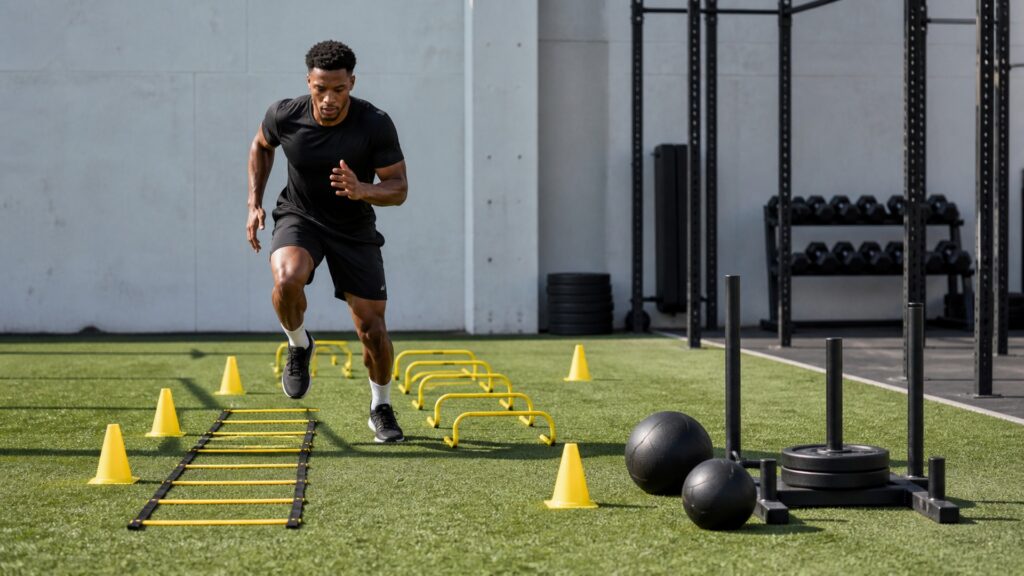
agility training equipment explainer hero image for Review Streets
What You'll Learn

How Agility Tools Differ From Functional Training Gear

A practical way to separate movement-speed tools from broader strength, mobility, and conditioning equipment.

  • What agility training equipment is designed to improve
  • How functional training equipment covers a wider training role
  • Why ladders, cones, hurdles, and reaction cues are not full training systems by themselves
  • When functional tools do more for strength, load, and movement variety
  • How to choose based on the workout problem, not the product label
  • Where the two categories can work together in the same routine

Tip: Start with the movement goal. Quick footwork calls for different tools than loaded strength or full-body conditioning.

Definitions

Key Concepts Behind The Difference

These concepts show why agility tools and functional training tools support different parts of a workout.

Agility Training Equipment

Agility training equipment is gear used to practice quick starts, stops, cuts, foot placement, reaction, and direction changes.

  • Example: cones, ladders, mini hurdles, marker discs, or reaction lights
  • Check: see whether the tool changes spacing, timing, or direction
  • Limit: it may not add much strength load on its own

Functional Training Equipment

Functional training equipment is gear used to train practical movement patterns such as pushing, pulling, squatting, hinging, carrying, rotating, and bracing.

  • Example: kettlebells, bands, suspension straps, medicine balls, cables, or sleds
  • Check: review which movement patterns and load options it supports
  • Limit: broad usefulness can make the category less specific

Movement Speed

Movement speed is how quickly the user can react, reposition, accelerate, decelerate, or change direction.

  • Example: cutting around cones after a visual cue
  • Check: look for drills that require timing and control
  • Limit: speed work needs space and good technique

Loaded Movement

Loaded movement adds resistance so the body must produce force while keeping control.

  • Example: carrying kettlebells, pressing bands, or throwing a medicine ball
  • Check: confirm the load can progress safely
  • Limit: load alone does not train quick direction change

Drill Layout

Drill layout is the pattern created by markers, hurdles, lines, or cues that tells the athlete where to move.

  • Example: a cone pattern for shuttle runs
  • Check: match the layout to the skill being practiced
  • Limit: a clever layout still needs appropriate volume

Training Role

Training role is the job the equipment performs inside the full workout.

  • Example: using agility ladders for warm-up coordination and bands for resisted strength work
  • Check: decide whether the tool is the main workout or one section of it
  • Limit: one tool rarely covers every training need

Tip: Agility gear is usually more specific. Functional training gear is usually more versatile.

Main Difference

Agility Equipment Trains Quick Movement Decisions

Agility equipment is built around space, timing, and direction. It helps create drills where the user has to move feet, hips, and body position quickly while staying controlled.

  • Cones and markers define routes.
  • Ladders and hurdles shape foot placement.
  • Reaction cues add timing pressure.

The category is strongest when movement quality and quick transitions are the point.

Broader Gear

Functional Training Equipment Covers More Movement Patterns

Functional training equipment is a wider toolbox. It can support strength, balance, mobility, power, core control, and conditioning depending on the tool and exercise.

  • Bands and cables train pushing and pulling.
  • Kettlebells and medicine balls add load and power.
  • Suspension straps and sliders challenge body control.

Functional gear is usually chosen for range of use rather than one movement skill.

Workout Fit

The Better Choice Depends On The Missing Piece

Agility equipment is the better fit when the workout lacks change-of-direction practice, footwork, or reaction work. Functional equipment is the better fit when the routine needs resistance, full-body movement variety, or scalable strength work.

  • Choose agility tools for cutting, spacing, and coordination drills.
  • Choose functional tools for loaded patterns and broader conditioning.
  • Combine them when the session needs both quick movement and resistance.

The right category depends on what the current routine cannot already do.

Limits

Agility Tools Are Often Incomplete By Themselves

A ladder or cone set can improve drill structure, but it does not replace strength work, mobility work, recovery planning, or sport skill practice. It is usually one part of a larger session.

  • Agility drills need room and safe surfaces.
  • Volume should stay realistic to avoid sloppy movement.
  • Progress should come from better control, not just faster chaos.

Agility equipment works best when it supports a planned drill, not when it becomes the whole plan.

Buying Check

Compare The Tool To The Training Job

The simplest test is to name the job before buying. If the job is to organize speed and direction drills, agility equipment fits. If the job is to build strength, power, balance, or conditioning across many exercises, functional training equipment fits better.

  • List the movements the workout needs.
  • Check whether load, space, and progression are available.
  • Avoid buying a narrow tool for a broad problem.

A clear training job keeps the categories from blending into one vague equipment bucket.

Quick Reality Check

Where Each Category Makes More Sense

Agility and functional training equipment can overlap, but they usually solve different workout problems.

Agility Equipment Makes Sense When

The workout needs footwork, acceleration, deceleration, reaction, or direction-change drills.

The user already has strength tools and wants better movement organization.

Functional Training Equipment Makes Sense When

The workout needs resistance, power, balance, mobility, or full-body movement variety.

The user wants one set of tools that can support many exercise types.

Common Myths

Misconceptions About Agility And Functional Training Equipment

The two categories are related, but they should not be treated as interchangeable.

Agility equipment is just functional training equipment

Agility tools are more specific because they organize quick movement, spacing, and reaction drills.

Functional training equipment always improves agility

Functional tools can support strength and control, but agility still needs directional practice and timing.

A ladder drill is enough for athletic training

Ladders can help coordination, but athletic training also needs strength, mobility, conditioning, recovery, and sport-specific work.

More complex drills are automatically better

A drill is useful only when the user can move well, recover, and understand the goal.

Tip: Specific tools work best when their role in the session is clear.

FAQ

Frequently Asked Questions About Agility And Functional Training Equipment

Short answers for deciding which type of equipment fits the workout.

Is agility training equipment a type of functional training equipment?

It can be part of a functional routine, but it is more specific. Agility gear mainly organizes quick movement and direction-change drills.

Which category should beginners buy first?

Beginners usually benefit from functional training tools first if they need broad strength and control. Agility tools make sense when footwork or sport movement is a clear goal.

Can I use both together?

Yes. A session might use cones for movement drills and bands, kettlebells, or medicine balls for resistance and power work.

What should I check before buying agility equipment?

Check space, surface, drill goals, progression options, and whether the user already has enough strength and mobility support.

What is the practical takeaway?

Use agility equipment for quick movement and direction-change practice. Use functional training equipment for broader loaded movement and conditioning.

Bottom Line

Agility training equipment is more specific than functional training equipment.

Choose agility tools when the goal is footwork, reaction, and direction change. Choose functional training equipment when the routine needs broader strength, mobility, power, and conditioning options.

Next Steps

Go Deeper or Compare Your Options

Use these Review Streets paths to compare related categories and practical next decisions.

Quick Summary

Agility Or Functional Gear

  • Agility tools organize quick movement and direction-change drills.
  • Functional tools cover broader strength, mobility, power, and conditioning needs.
  • Agility gear is often one section of a larger training plan.
  • The better choice depends on the missing workout job.