
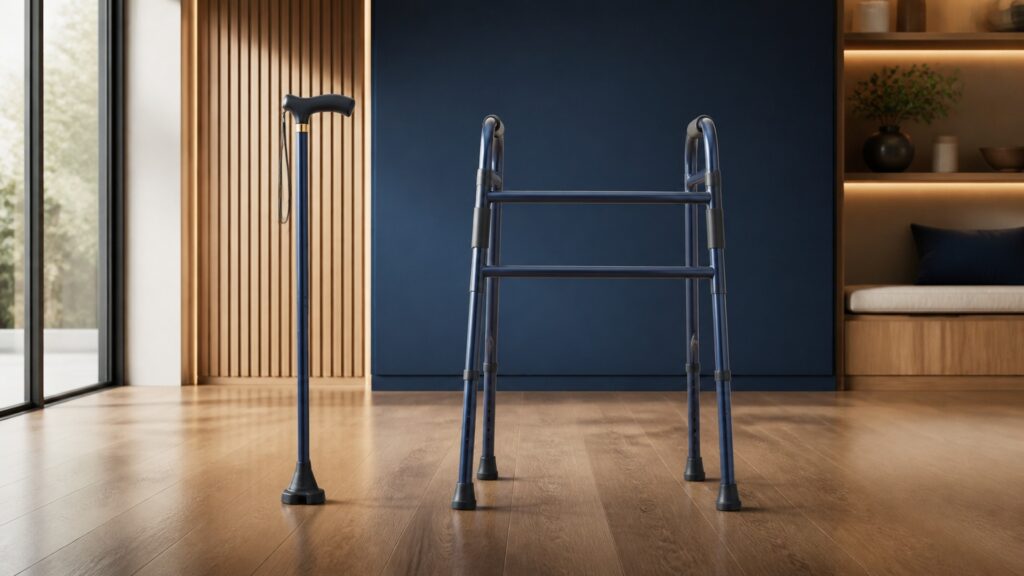
What Makes Canes Different from Walkers

A cane provides a single additional contact point and usually supports one side of the body. A walker surrounds the user with a multi-point frame, creating a larger support area and allowing both arms to contribute. That mechanical difference affects balance assistance, unloading, space, and gait technique.

Canes are lighter and easier to carry, but they provide less support and demand correct timing. Walkers can accept more load and offer a broader base, yet they require room, upper-body control, and a safe advancement pattern. Selection should follow the user's task and impairment.

By: Review Streets Research Lab
Updated: August 20, 2026
Explainer · 8-12 min read
People-free editorial still life illustrating canes different from walkers
What You'll Learn

Compare one-point assistance with frame-based support

Examine contact geometry, load capacity, gait sequence, fit, environmental demands, and changing function before choosing between a cane and walker.

  • Count and position contact points
  • Compare available load transfer
  • Learn the required gait sequence
  • Fit handle height correctly
  • Test route clearance
  • Know when support needs have increased

Tip: Read the concept as part of a system, then connect it back to the use case.

Definitions

Six Concepts That Shape This Decision

These definitions connect the main idea to the variables, limits, and practical signals readers need to compare options.

Cane

A handheld mobility aid that adds one primary support point through a shaft and tip or a small multi-tip base.

  • It can widen support modestly and transfer some load through one arm.
  • Use it on the side and in the sequence recommended for the individual's condition.
  • A cane cannot provide the surrounding stability or load capacity of a walker.

Walker

A frame with multiple floor contacts positioned in front of and beside the user during movement.

  • The frame enlarges the support area and can accept force from both arms.
  • Keep the body within the intended supported zone while advancing.
  • A walker may still tip, slide, or move away when technique or surface conditions are poor.

Contralateral use

Using a cane in the hand opposite the painful, weak, or affected leg when that pattern is appropriate.

  • This timing can coordinate cane force with the affected limb and improve leverage.
  • Learn the sequence from a qualified professional rather than copying another user.
  • Some conditions require a different pattern, and the rule is not universal.

Support polygon

The area created by the body's and aid's contact points with the floor.

  • A walker generally creates a much larger support polygon than a cane.
  • Observe whether the user stays within the supported area during turns and reaches.
  • A larger area cannot correct sudden collapse or every balance disturbance.

Unloading

Reducing the force carried by a limb by transferring part of the load through an aid and the upper body.

  • Walkers commonly permit greater unloading than canes when technique and device type are suitable.
  • Match the aid with any formal weight-bearing restriction.
  • A person should not guess how much weight is removed based on comfort alone.

Device progression

A planned change from more support to less support, or the reverse, as needs evolve.

  • Progression should reflect observed ability and task demands rather than a desire to appear less dependent.
  • Reassess gait, symptoms, fatigue, and falls during any change.
  • Moving to a cane too early or walker too late can both create risk.

Tip: Keep the definitions connected; the strongest answer usually comes from the whole system, not one term.

Geometry

Start with the amount and direction of support

A cane adds a point that can help with mild instability or one-sided unloading. A walker creates a surrounding frame for broader balance and bilateral load transfer. The direction of instability, not just the diagnosis, helps determine which geometry is useful.

  • Observe side-to-side control
  • Check forward instability
  • Estimate unloading need
  • Include turning behavior

Support geometry should match where control is being lost.

Sequence

Coordinate the aid with the moving limbs

Cane use depends on timing the tip and steps so support is available when needed. Walker patterns vary with wheels, strength, pain, and weight-bearing instructions. Incorrect sequencing can leave the aid behind, push it too far ahead, or overload the wrong limb.

  • Teach one clear pattern
  • Practice starts and stops
  • Keep the aid within reach
  • Review under fatigue

Technique converts equipment into support; ownership alone does not.

Fit

Set height for leverage and posture

A cane or walker handle that is too high can elevate the shoulders; too low can encourage trunk flexion and poor control. Fit should be observed during walking with usual shoes. Wrist, elbow, shoulder, and hand tolerance also affect use.

  • Check handle height
  • Observe elbow position
  • Use ordinary footwear
  • Assess hand comfort

Fit is both a mechanical and a tolerability requirement.

Environment

Balance portability against clearance

Canes fit narrow spaces, stairs, vehicles, and crowded settings more easily. Walkers require more width and may be difficult to lift or store. However, choosing a cane only for convenience is unsafe when the user needs frame-level support.

  • Measure doors and bathrooms
  • Plan stair strategy
  • Check vehicle loading
  • Do not trade away required support

Convenience matters after the minimum support requirement is satisfied.

Reassessment

Treat changing aid needs as information

A new need for a walker may reflect temporary recovery, pain, weakness, or a broader health change. Repeated stumbles with a cane deserve review. Likewise, unnecessary walker dependence can reduce speed and active balance demands when less support is safely possible.

  • Review after health events
  • Track falls and near falls
  • Progress only after observation
  • Investigate sudden decline

The device should change when evidence changes, not according to pride or habit.

Quick Reality Check

A cane adds one point; a walker creates a frame

The categories differ in support geometry and load capacity. A cane offers portability and modest assistance, while a walker supplies a broader base at the cost of space and handling demands.

What can be compared

A supervised trial can compare gait timing, posture, effort, control, and symptoms on the intended route.

Fit checks can show whether the hands, wrists, elbows, and shoulders tolerate the required loading.

What a product choice cannot resolve

Neither aid identifies the cause of new weakness, dizziness, pain, sensory loss, or falls.

Short showroom performance cannot prove safe use on stairs, wet surfaces, fatigue, crowds, or nighttime routes.

Common Myths

Misconceptions That Distort the Decision

Common shortcuts and misunderstandings can make the topic seem simpler than it is.

Myth: a cane is always the first step before a walker

Aid selection is not a fixed ladder. Someone may need a walker immediately because of bilateral weakness, substantial unloading, or broad instability, while another person may never need more than a correctly fitted cane.

Myth: using a walker means independence has been lost

A walker can enable independent toileting, meals, exercise, or community access that would otherwise require another person's immediate help. Independence concerns safe participation and choice, not the absence of equipment.

Myth: any cane can support full body weight

Cane designs and user technique generally provide limited assistance, not unrestricted weight-bearing. Heavy unloading needs, postoperative restrictions, or severe instability may require a walker, crutches, wheelchair, or another professionally selected solution.

Myth: the correct side for a cane is obvious

Opposite-side use is common for selected one-sided conditions, but neurological, balance, upper-limb, and orthopedic factors can change the recommendation. Technique should be individualized rather than copied from a diagram or another user.

Tip: Treat strong claims as starting points for comparison, not final answers.

FAQ

Questions to Ask Before Choosing

Concise answers to common questions readers may have after the main explanation.

How much support can a cane provide?

The answer depends on design, rating, hand and arm capacity, technique, and the user's condition. A cane usually offers modest balance and unloading assistance; it should not be assumed equivalent to a walker.

Can a walker be used on stairs?

Most standard walker use on stairs requires a specific technique, sufficient strength, suitable dimensions, and often professional instruction or assistance. Some environments need rails, another device, or an alternative route rather than improvisation.

What indicates that a cane may be insufficient?

Repeated loss of balance, heavy leaning, inability to keep sequence, substantial weight-bearing needs, worsening fatigue, frequent near falls, or inability to complete necessary routes should prompt reassessment rather than simply gripping the cane harder.

When might someone progress from walker to cane?

Progression may be appropriate when strength, balance, loading tolerance, coordination, and route performance improve under observation. The change should be tested across turns and fatigue, not based only on a few successful straight steps.

Bottom Line

A cane and walker solve different levels and directions of support need. Match the contact geometry, load transfer, gait sequence, fit, and route before considering convenience or appearance.

Reassess rather than improvising when falls, symptoms, or ability changes. The correct aid is the least restrictive option that still provides the support required for the actual task.

Next Steps

Go Deeper or Compare Your Options

Use these Review Streets paths to connect the explainer to related categories, comparisons, and next decisions.

Why Home Safety Matters

Use the home Safety Matters guide to examine a closely related decision that follows naturally from canes Different from Walkers.

Why Mobility Independence Matters

Continue into mobility Independence Matters for the neighboring mechanism, limitation, or use case most relevant to canes Different from Walkers.