
When to Use Transport Chairs Instead of Wheelchairs

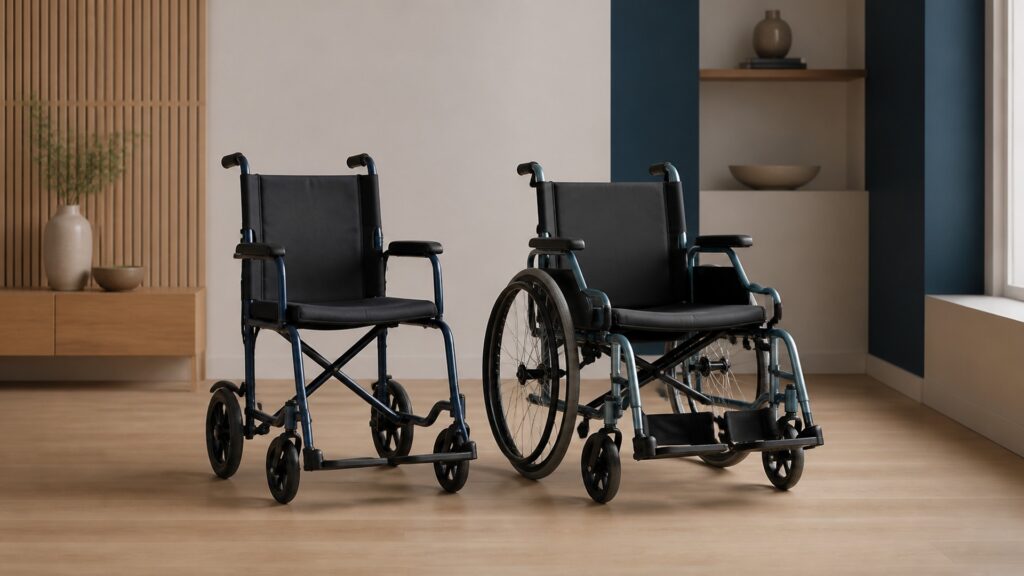
Transport chairs and self-propelled wheelchairs may look similar, but they assign movement control differently. A transport chair has small wheels and is designed primarily for an attendant to push. A wheelchair with large rear wheels can allow a seated user to propel, steer, and brake independently when ability and setup permit.

Choose a transport chair when trips are brief, a reliable attendant will control movement, and portability matters more than independent propulsion. Choose an appropriate wheelchair when the user needs greater postural support, repeated daily use, or meaningful control over mobility.

By: Review Streets Research Lab
Updated: August 20, 2026
Explainer · 8-12 min read
People-free editorial still life illustrating transport chairs instead of wheelchairs
What You'll Learn

Decide who controls seated mobility

Compare propulsion, braking, seating, transfers, terrain, transport, and attendant availability before treating two wheeled chairs as substitutes.

  • Assign the propulsion role
  • Compare wheel and brake systems
  • Assess seating and posture needs
  • Plan safe transfers
  • Test the actual route
  • Account for attendant capacity

Tip: Read the concept as part of a system, then connect it back to the use case.

Definitions

Six Concepts That Shape This Decision

These definitions connect the main idea to the variables, limits, and practical signals readers need to compare options.

Transport chair

A lightweight wheeled chair with small rear wheels, ordinarily pushed and controlled by another person.

  • Its compact frame can simplify vehicle loading and short accompanied trips.
  • Confirm an attendant is available and capable for the complete route.
  • The seated user usually cannot propel or operate all brakes independently.

Self-propelled wheelchair

A wheelchair with large rear wheels and hand rims that may allow the occupant to propel and steer.

  • Independent control can expand access when upper-limb ability, posture, cognition, and terrain are suitable.
  • Evaluate propulsion technique, reach, endurance, and pressure management.
  • Large wheels do not guarantee that every user can propel safely.

Attendant brake

A hand control used by the person pushing to slow or manage the chair.

  • It can improve control on slopes when correctly adjusted and operated.
  • Test gradual slowing, stopping, and parking before community use.
  • An attendant brake does not replace safe route selection or sufficient caregiver strength.

Wheel lock

A mechanism that holds a stationary wheelchair for transfers and other parked tasks.

  • Correct engagement helps prevent movement while someone sits, rises, or repositions.
  • Check reach, adjustment, tire pressure, and full contact before transferring.
  • Wheel locks are parking devices, not necessarily dynamic service brakes.

Postural support

Seat, back, cushion, footrest, and accessory features that help maintain alignment and distribute pressure.

  • Longer sitting and impaired trunk control increase the importance of individualized seating.
  • Observe posture, comfort, skin risk, and ability to perform functional tasks.
  • A folding transport seat is not a substitute for a prescribed seating system.

Transit use

Transporting an occupied chair in a vehicle using approved securement and occupant-restraint systems.

  • Crash safety depends on the exact chair, tie-down points, vehicle, and restraint process.
  • Follow product and transport-service instructions rather than improvising straps.
  • A chair that folds into a trunk is not automatically approved as a vehicle seat.

Tip: Keep the definitions connected; the strongest answer usually comes from the whole system, not one term.

Control

Begin by assigning who propels and stops

A transport chair makes the attendant responsible for steering, speed, obstacles, and much of the braking. A self-propelled wheelchair can return those decisions to the occupant, although assistance may still be needed. Control affects independence, communication, and the consequences of caregiver fatigue.

  • Name the responsible driver
  • Check user propulsion ability
  • Agree on movement cues
  • Plan for attendant absence

The chair should not quietly transfer responsibility to someone who cannot sustain it.

Seating

Match support to duration and body needs

Brief escorted use and all-day mobility impose different demands. Seat depth, width, back support, cushion, footrests, armrests, pressure risk, and posture matter more as duration increases. A compact chair can become painful or unstable when used beyond its intended role.

  • Measure seat dimensions
  • Support feet appropriately
  • Review pressure risk
  • Limit unsuitable sitting duration

Portability should not override seating needs that protect function and skin.

Transfers

Stabilize the chair before weight shifts

Position the chair close to the destination, clear footrests, engage appropriate locks, and define helper roles. Small transport wheels and lightweight frames can move or tip during poorly planned transfers. Technique should match the user's strength and the surface heights.

  • Set brakes or locks
  • Move footrests safely
  • Control the transfer gap
  • Avoid pulling on removable parts

Every seated-mobility choice also creates a transfer system.

Route

Test slopes, thresholds, surfaces, and stopping space

Small wheels can catch on cracks and demand more pushing force on rough ground. Large wheelchair casters and rear wheels have different obstacle behavior. Measure doors and ramps, inspect curb access, and test whether the attendant can control descents without overexertion.

  • Inspect surface transitions
  • Avoid uncontrolled slopes
  • Measure doorway clearance
  • Include turning and stopping

A chair proven indoors may be unsuitable for the community route.

Transport

Balance folding convenience with repeated use

Transport chairs often fold compactly and weigh less, which can help occasional appointments. Wheelchairs vary widely in folding, rigid frames, components, and lifting burden. Vehicle storage should be tested without sacrificing required seating or independent control.

  • Measure vehicle storage
  • Practice safe lifting
  • Secure loose components
  • Keep the daily role primary

The easiest chair to load is not always the right chair to occupy.

Quick Reality Check

The central difference is propulsion responsibility

Transport chairs prioritize accompanied movement and portability. Wheelchairs can provide occupant propulsion and more configurable seating. Neither category is universally safer or more independent.

What a route trial can show

A trial can reveal steering, stopping, pushing effort, doorway clearance, posture, and transfer difficulty.

Users and attendants can determine whether responsibilities remain manageable for the expected trip.

What the comparison cannot answer alone

A showroom trial cannot identify every seating, pressure, endurance, cognitive, or rehabilitation need.

Neither chair solves inaccessible transportation, missing curb access, caregiver shortages, or sudden functional decline.

Common Myths

Misconceptions That Distort the Decision

Common shortcuts and misunderstandings can make the topic seem simpler than it is.

Myth: transport chairs are just lightweight wheelchairs

Small wheels and attendant control change propulsion, braking, obstacle handling, and independence. The category is not defined only by weight. Using a transport chair for sustained self-mobility can leave the occupant unable to move independently.

Myth: a large-wheeled wheelchair guarantees independence

Independent propulsion requires reach, strength, endurance, coordination, sensation, cognition, and an accessible route. Some users need power mobility or assistance, while others use a manual wheelchair independently after individualized setup and training.

Myth: the attendant can sit someone anywhere in the chair

Seat width, depth, foot position, posture, cushion, clothing, and support affect comfort and skin. A quick placement that looks adequate may become painful or unstable during a longer appointment or outing.

Myth: folding size should decide the purchase

Vehicle fit matters, but choosing mainly for folding can sacrifice propulsion control, seating support, durability, or route performance. First establish the user's daily mobility and postural needs, then compare transport and storage options.

Tip: Treat strong claims as starting points for comparison, not final answers.

FAQ

Questions to Ask Before Choosing

Concise answers to common questions readers may have after the main explanation.

Who is a good candidate for a transport chair?

It may suit someone needing brief accompanied mobility who can sit safely and has a reliable attendant capable of controlling the route. Longer or independent use deserves a fuller wheelchair and seating assessment.

Can an occupant move a transport chair alone?

Some people may move it short distances with their feet, but small rear wheels generally prevent normal hand-rim propulsion. Do not assume independent exit, braking, or repositioning is possible during routine or emergency situations.

What should an attendant practice first?

Practice opening and locking the frame, positioning footrests, checking brakes, approaching thresholds, controlling slopes, communicating turns, parking for transfers, and loading the empty chair without unsafe twisting, lifting, or rushing.

When is professional wheelchair assessment important?

Seek individualized assessment for daily use, posture problems, skin risk, weakness, neurological conditions, amputations, significant pain, independent propulsion goals, repeated falls, or difficulty controlling transfers and community routes safely over time.

Bottom Line

Use a transport chair for short attendant-driven mobility when portability and accompaniment are established. Use an appropriately configured wheelchair when independent propulsion, repeated daily use, or individualized seating is central.

Evaluate the full system: occupant, attendant, seating, transfers, route, vehicle, maintenance, and emergency access. Similar appearance does not make the two categories interchangeable.

Next Steps

Go Deeper or Compare Your Options

Use these Review Streets paths to connect the explainer to related categories, comparisons, and next decisions.

Why Home Safety Matters

Compare home Safety Matters with the principles in this transport Chairs Instead of Wheelchairs explainer before choosing a practical next step.

Why Mobility Independence Matters

Use the mobility Independence Matters guide to examine a closely related decision that follows naturally from transport Chairs Instead of Wheelchairs.

Why Assistive Devices Matter

Continue into assistive Devices Matter for the neighboring mechanism, limitation, or use case most relevant to transport Chairs Instead of Wheelchairs.