
Cargo body
A cargo body encloses space intended for goods or working equipment.
- Example: an enclosed van carrying service tools
- Check: openings, internal dimensions, and load access
- Limit: the body description does not identify its powertrain
Cargo vans and commercial electric vehicles are overlapping categories. A cargo van has an enclosed body arranged primarily for goods or working equipment. A commercial electric vehicle is identified by its electric propulsion and business use; it might be a van, truck, or another vehicle type. An electric delivery van can therefore belong to both groups.
For a cargo job, start with the body: can the load enter, fit, be secured, and stay within the completed vehicle’s limits? Then assess the propulsion and its support. An electric powertrain does not guarantee suitable cargo space, while a suitable van body does not establish that its energy supply will support the assignment.
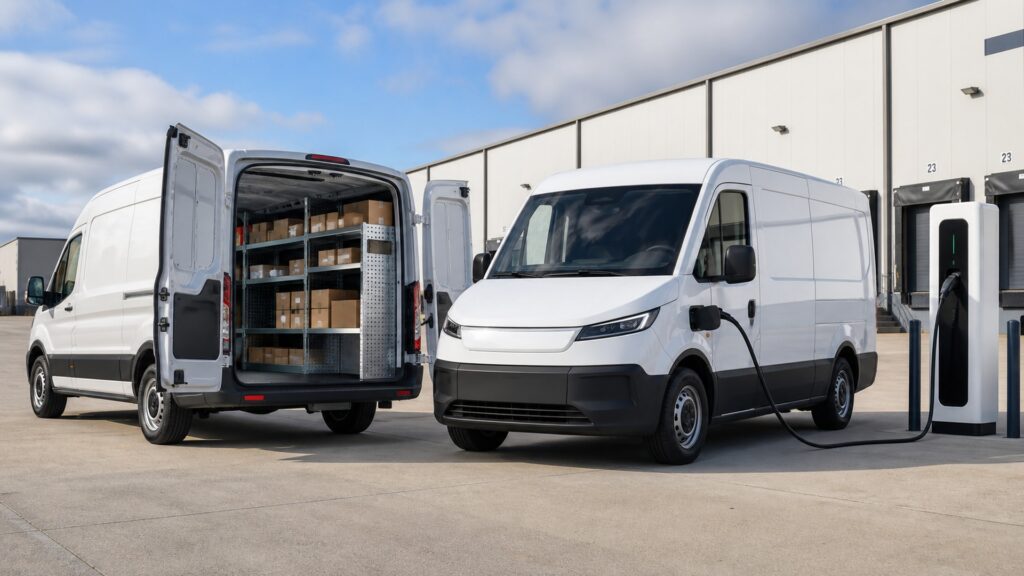
Ask two sets of questions before choosing a complete vehicle.
Tip: Specify the load and route together. Neither a body label nor a propulsion label supplies the whole answer.
Each term answers a different selection question.
A cargo body encloses space intended for goods or working equipment.
Electric propulsion uses an electric motor to drive the vehicle.
Usable load space is the portion of the interior available for the intended cargo and handling.
The completed configuration includes installed equipment and the vehicle’s actual operating setup.
Energy access is the practical ability to replenish the vehicle’s energy for its next assignment.
A duty pattern is the recurring combination of travel, stops, loads, and working time.
Tip: Evaluate an electric cargo van as a specific body and powertrain combination.
The two labels classify different attributes. Cargo van identifies the carrying arrangement; commercial electric vehicle identifies propulsion in a business setting. Comparing a diesel cargo van with a battery-electric cargo van is a propulsion comparison within a body category. Comparing a cargo van with an electric box truck also changes the body and its handling characteristics.
A large electric truck is not a useful substitute merely because the job is commercial. Its access, dimensions, and load arrangement still need to fit the site and assignment.
A shelf-lined van may carry small parts conveniently but have no clear path for a wide crate. Rear-door height, wheel housings, partitions, and side access can all affect the usable arrangement. Those constraints remain relevant whether an engine or electric motor moves the van. Measure the completed interior and load path rather than treating total volume as a guarantee.
For example, a crate that fits between the interior walls may still be too wide for the door opening. Changing the propulsion does not solve that obstruction.
Avoid blanket claims that one propulsion type always carries more. Body size, equipment, battery configuration, options, and vehicle ratings differ. Determine the completed operating mass and assess the remaining allowance, including individual axle loads. A lightly filled van can still be heavily loaded when its contents are dense.
Ford’s loading guidance illustrates why the loaded vehicle and its ratings must be considered together. An advertised cargo volume cannot establish an allowable load.
Reference: Ford vehicle loading guidance.
For a battery-electric van, connect route energy needs with usable charging opportunities. Depot dwell time, charger compatibility, electrical capacity, and charger availability influence readiness. Include demanding days and accessory use when evaluating the assignment. An engine-powered candidate needs its own fueling and service support; the comparison should examine the actual arrangements available.
DOE fleet guidance treats charging infrastructure and vehicle duty as connected decisions. A suitable cargo interior cannot compensate for an energy plan that leaves the van unavailable.
Reference: DOE electric fleet planning, DOE charging infrastructure guidance.
Build a short description of the job: what moves, how it is handled, where the vehicle travels, and when it must be ready again. Check body capability first, then verify the exact candidate’s mass limits, energy support, equipment compatibility, and service arrangements. Keep the same assignment assumptions when comparing alternatives.
A parcel route with predictable depot parking and a mobile service role with variable stops may lead to different choices even when both need enclosed cargo space.
Both sets must be answered for an electric cargo van.
Can the load enter, be handled, and be restrained?
Does the completed arrangement satisfy total and axle limits?
Can the duty pattern be supported by available energy?
Can charging and service restore readiness when needed?
Avoid decisions based on labels alone.
An electric cargo van fits both descriptions.
The body, openings, equipment, and carrying limits still need assessment.
Compare the exact configurations and their ratings.
Compatibility, access, charging time, and availability must also fit the assignment.
Tip: Keep the job consistent when comparing candidates so that a body difference is not mistaken for a propulsion difference.
Practical distinctions for vehicle selection.
Yes. Commercial electric propulsion appears in multiple body types, so identify the actual vehicle being considered.
Define both needs early. Reject an unsuitable body, and do not select a suitable body without a workable energy plan.
No. Door openings, interior obstructions, load restraint, mass limits, and access can differ.
Only after exact vehicle and equipment compatibility is confirmed, including mounting and protected components.
The same representative load, route, handling needs, and availability requirement assessed against each complete vehicle.
Cargo vans describe carrying space; commercial electric vehicles describe propulsion and business use. One vehicle can be both.
Choose the complete combination that supports the load, route, energy supply, and working equipment.
Use these Review Streets paths to compare related categories and practical next decisions.
Check equipment compatibility with the exact van.
Connect propulsion, structure, access, and restraint.
Explore charging and vehicle-duty considerations.
Choose a retailer
Prices checked regularly. We may earn a commission at no cost to you.