What Makes Compact Pickup Trucks Different from Heavy Duty Pickup Trucks

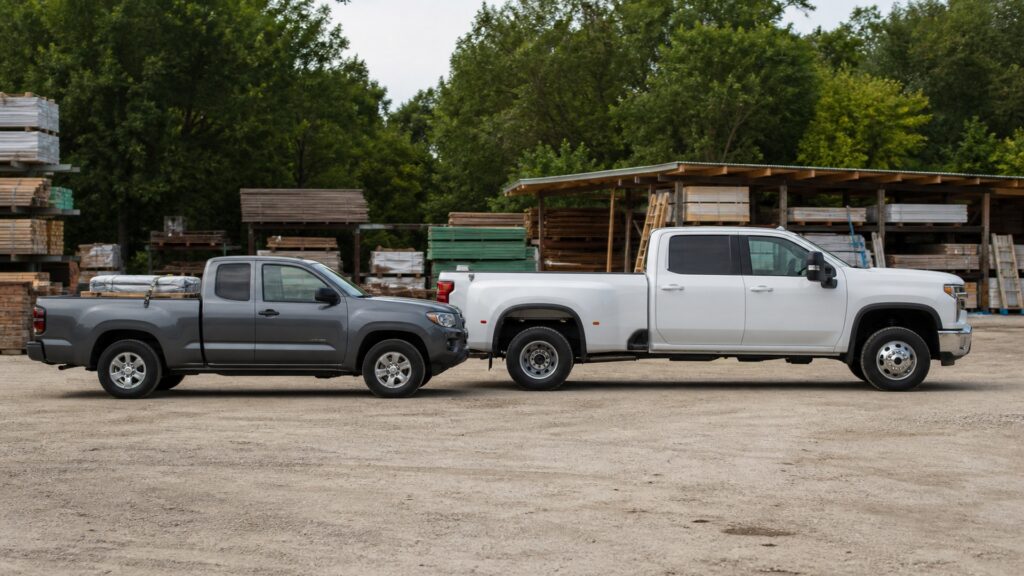
Compact pickups and heavy-duty pickups serve different balances of everyday space and rated working capability. A compact packages passenger travel and useful open-bed hauling into a smaller vehicle. An HD pickup is designed around more demanding load and towing configurations, often with hardware and options that would be unnecessary for a modest daily load.

Those descriptions are starting points, not specifications. A compact's suitability depends on its actual payload, trailer limits, cab, bed, and equipment. An HD truck's limits also vary by build. Compare complete vehicles for the same task rather than treating either a smaller footprint or a heavy-duty badge as a universal advantage.

By: Review Streets Research Lab
Updated: October 5, 2026
Explainer · 8-12 min read
compact pickup trucks explainer hero image for Review Streets
What You'll Learn

Where Compact and HD Designs Diverge

Look at the work each configuration supports and the space it requires every day.

  • Separate body size from specific load ratings
  • Compare chassis and equipment as complete systems
  • Check actual cab, bed, and hitch arrangements
  • Include access and maneuvering in the comparison
  • Choose the capability required for the recurring task

Tip: List the people, cargo, and trailer requirements first. The useful difference is the one that changes whether a truck can serve that list.

Definitions

Six Concepts Behind Compact and HD Capability

These terms connect vehicle design with practical use.

Vehicle Footprint

The exterior space and maneuvering room the truck needs.

  • Example: A compact configuration leaves more clearance in a particular parking space.
  • Check: Measure the actual length, mirror width, height, and approach.
  • Limit: Size labels do not supply every relevant dimension.

Duty Capability

The workload supported by the complete vehicle's approved design and equipment.

  • Example: An HD build supports a trailer arrangement beyond a particular compact's limits.
  • Check: Use configuration-specific ratings and instructions.
  • Limit: A badge does not establish the limits of every truck in the range.

Payload Allowance

The carrying capacity available for occupants, added equipment, cargo, and applicable hitch load.

  • Example: Passengers and tools use capacity before a trailer is attached.
  • Check: Check the actual vehicle's loading information.
  • Limit: A maximum trailer rating is not a payload figure.

Chassis Design

The structural, suspension, axle, and related systems that support and control the truck.

  • Example: Different designs transfer the load through different structural arrangements.
  • Check: Check construction and ratings for the model.
  • Limit: One visible component cannot establish whole-vehicle capability.

Trailer Interface

The approved hitch, electrical, braking, and other connections used with a trailer.

  • Example: A specialized trailer may require an approved fifth-wheel or gooseneck setup.
  • Check: Confirm the required connection is supported.
  • Limit: A receiver alone does not authorize every trailer type.

Configuration Choice

The available combination of cab, bed, drive system, and equipment.

  • Example: A long bed and a particular cab may serve a recurring material load.
  • Check: Compare the exact combinations that can be obtained.
  • Limit: Maximum values from different builds cannot be combined into one truck.

Tip: Capacity available after the normal crew and equipment are included is more useful than a model-family headline.

Design Priorities

Compact Packaging and HD Workloads Lead to Different Choices

A compact is useful when the owner needs pickup functions without the dimensions of a larger truck. HD ranges provide configurations for more substantial loads, with corresponding structural and mechanical requirements. Neither aim makes the other design inferior. A truck intended for a modest tool load and commuting is solving a different problem from one chosen around a demanding trailer.

  • Define the recurring task before comparing features.
  • Identify requirements the compact cannot meet.
  • Identify extra size or equipment the owner does not need.

The better design for a person depends on the job; unused capacity can still bring daily parking and ownership obligations.

Supporting Loads

Look at the Complete System Rather Than Construction Alone

Some contemporary compact pickups use integrated body construction, while familiar HD pickups use separate frames. Construction varies across models and markets, so verify the vehicle. Frames or body structures work with suspension, axles, tires, brakes, and cooling to support rated duties. There is no single component whose presence makes a truck suitable for every heavy task.

  • Use manufacturer specifications for the actual model.
  • Check vehicle and axle limits together.
  • Avoid inferring payload from appearance or ride height.

A compact can perform useful work within its design limits, and an HD truck can still be overloaded by the wrong occupied and equipped combination.

Trailer Work

Approved Connections Can Be as Decisive as Weight

Trailer suitability requires more than enough power to move it. Hitch type, attachment approval, electrical connections, trailer braking, and load on the truck all need to fit. Some HD configurations support demanding trailer arrangements unavailable on a particular compact. Confirm those provisions rather than assuming any aftermarket hitch can turn one class into the other.

  • Identify the trailer's required connection.
  • Include hitch load with occupants and cargo.
  • Check all truck, hitch, tire, axle, and combination limits.

A trailer can be unsuitable because its approved connection or hitch load does not fit, even before the advertised trailer-weight limit is reached.

Space and Access

Cab and Bed Choices Affect the Ordinary Day

Compare usable seating, cargo dimensions, bed reach, and the space needed to open doors and the tailgate. An HD truck may provide a configuration that accommodates a recurring requirement, while a compact may be easier to place at home or a worksite. Use actual measurements. Nominal size classes cannot tell whether the particular material or passenger arrangement fits.

  • Try seating with the people who normally travel.
  • Measure cargo space around wheel housings and accessories.
  • Check the regular parking and loading locations.

A larger truck may solve a load problem but introduce an access problem; both belong in the decision.

Ownership Balance

Carry Enough Capability Without Ignoring Daily Costs

Purchase price, insurance, tires, maintenance, energy use, and storage depend on the candidates and their use. Do not assume an HD is wasteful when its capacity is needed or that a compact is cheaper in every case. Compare quotes and the recurring routine. The consequences of insufficient capability can matter more than a small difference in an operating-cost estimate.

  • Price the actual configurations and required equipment.
  • Use the expected load and mileage pattern.
  • Account for service access and time out of use.

Choose the vehicle that can reliably complete the required work with an ownership commitment that fits the owner.

Quick Reality Check

Where Each Design Has a Useful Role

The question is sufficient capability with practical daily use.

Compact Strengths to Verify

A smaller configuration that meets required passenger, cargo, and modest trailer duties.

Convenient access and a suitable ownership budget for frequent everyday travel.

HD Strengths to Verify

Supported load, hitch, cab, or bed configurations needed for substantial recurring work.

The complete vehicle and equipment required for the intended demanding duty.

Common Myths

Misconceptions About Compact and HD Pickups

Neither label replaces a configuration check.

A compact is unsuitable for any real work.

It can handle useful work within its actual space and ratings.

An HD badge means unlimited payload.

Every build retains vehicle, axle, tire, and other applicable limits.

Installing a heavy hitch gives a compact HD capability.

Hitch hardware cannot independently increase the truck's approved ratings.

Frame construction alone decides suitability.

The whole vehicle, equipment, and required task determine the match.

Tip: Judge the task with the fully occupied and equipped truck rather than an empty vehicle's appearance.

FAQ

Questions About Compact Versus HD Design

Answers for comparing everyday packaging with substantial working requirements.

What is the main difference?

The balance between a smaller everyday pickup package and configurations designed for more demanding carrying and towing duties.

Can a compact tow a trailer?

An appropriately equipped model can tow within its specific limits; confirm the complete loaded arrangement.

When does HD become necessary?

When required loads, trailer interfaces, or configurations cannot be supported by the smaller candidate.

Does HD always mean diesel?

No. Identify the actual powertrain and configuration; the duty description is not a fuel type.

What should I compare first?

The required people, cargo, trailer connection, and loaded weights, followed by usable space and ownership practicality.

Bottom Line

Compact and HD pickups differ in the balance of packaging, equipment, and rated workload they are built to support.

Choose from actual configurations: enough capability for the job, with space and ownership demands that make sense every day.

Next Steps

Go Deeper or Compare Your Options

Use these Review Streets paths to compare related categories and practical next decisions.

Technical references: Ford Maverick configuration information; Chevrolet Silverado HD configurations; Ford towing information and vehicle-specific guides. Use the manual and ratings for your own model year and configuration.