
Designer Fragrance
A scent sold under a broader fashion, beauty, jewelry, or lifestyle brand.
- Use: Describe brand context
- Variable: licensing and portfolio strategy
- Tradeoff: The label says little about formula quality
Designer fragrances come from brands whose identity and revenue extend beyond perfume, while niche fragrances are typically positioned by companies focused primarily on scent. That business-model distinction can influence distribution, launch scale, packaging, advertising, sampling, and the creative audience, but it does not establish an ingredient or quality hierarchy.
Both segments can use renowned perfumers, natural and synthetic materials, trend-led briefs, unusual ideas, and premium pricing. Corporate ownership and licensing also blur the boundary. For shoppers, the useful differences are practical: where a fragrance can be tested, how easy returns and replacements are, whether smaller sizes exist, how distinctive the scent feels after full wear, and whether the experience justifies its total cost. Evaluate the bottle, not the category mythology.
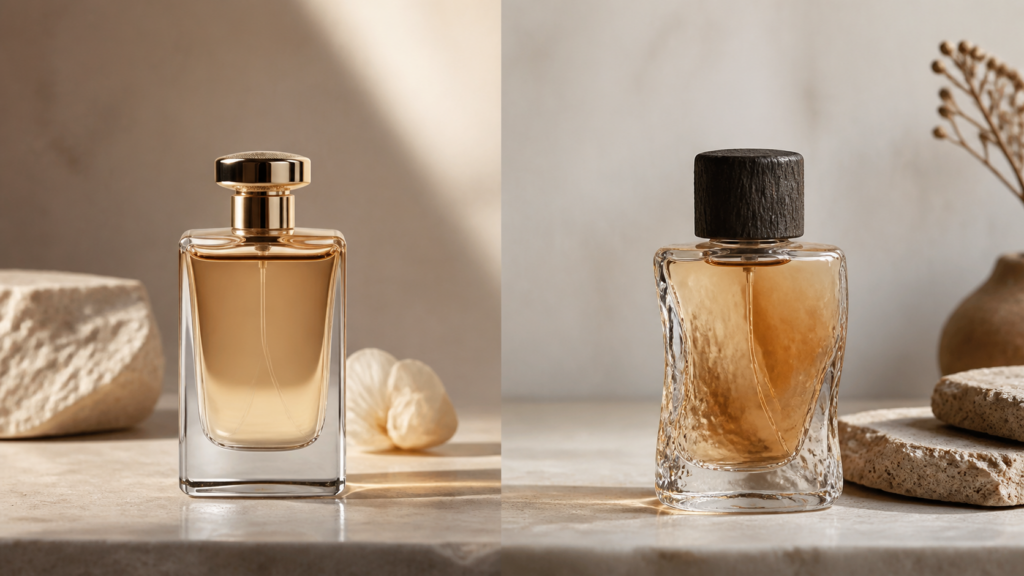
Designer and niche labels describe brand positioning imperfectly; formula quality, originality, wear, and value still require product-level evidence.
Tip: Sample blind and reveal the brand later when prestige may distort judgment.
These concepts explain category labels, creative direction, retail access, sampling, and price without pretending to grade formula quality.
A scent sold under a broader fashion, beauty, jewelry, or lifestyle brand.
A scent positioned by a perfume-focused or specialist fragrance house.
The commercial and artistic direction given to a perfumer or team.
Sale through a limited set of stores, regions, or authorized channels.
The ability to obtain samples, testers, decants, or travel sizes before purchase.
Price attributable partly to brand, packaging, scarcity, service, or positioning.
Tip: The commercial context is knowable; ingredient superiority still requires evidence the label does not provide.
Designer usually signals a wider luxury or consumer brand; niche signals fragrance specialization and selective positioning. Conglomerate ownership, licensing, private lines, and broad niche expansion mean many real brands sit between those poles.
The boundary is commercial and cultural, not a laboratory classification.
Large designer launches may target broad recognition, while specialist houses may accept narrower appeal, but exceptions are abundant. Test structure, distinctiveness, balance, and wear instead of assuming designer means safe or niche means experimental.
Originality that goes unworn has little personal value.
Both segments blend natural and synthetic materials, follow relevant safety requirements, manage supply constraints, and formulate to a budget. Retail price does not reveal ingredient cost, concentration, batch size, or technical difficulty.
The segment label cannot audit the formula.
Designer scents are often easier to test at department stores and authorized chains; niche access may rely on boutiques or mail-order samples. Limited distribution can complicate returns, damaged-bottle support, and authenticity verification.
A beautiful scent is a poor blind buy when access removes every safeguard.
Include bottle size, required sprays, wear frequency, duplication within the collection, sample cost, shipping, and resale difficulty. A versatile designer bottle can offer better value; a singular niche scent can justify a premium when it is genuinely worn.
Value follows use and satisfaction, not segment allegiance.
The labels can explain brand focus, distribution, marketing, and sampling context; they cannot certify originality, materials, concentration, safety, or craftsmanship.
It prepares shoppers for different tester access, launch scale, service channels, bottle sizes, and price structures.
It encourages a direct question about whether broad versatility or narrower creative character is the goal.
Ownership, licensing, private collections, and mass expansion blur the category boundary.
Outstanding and disappointing formulas exist in both segments, so product-level wear remains decisive.
Ingredient, originality, ownership, concentration, and permanence stereotypes can turn category identity into an expensive shortcut.
The niche label does not disclose raw-material grade, dosage, formula budget, stability work, or manufacturing quality. Both segments can use costly naturals, sophisticated synthetics, inexpensive materials, and expert perfumers in different combinations.
Many designer launches target broad audiences, but private collections and individual releases can be challenging or unusual. A commercial brief also does not prevent technical skill, distinctiveness, or excellent personal fit.
Some niche-positioned houses are owned by large beauty groups, while some independent brands sell broadly. Fragrance focus, ownership, distribution, and creative control are separate facts that should be checked rather than assumed.
Price can reflect packaging, distribution, small scale, prestige, retail margin, advertising, service, or scarcity. Concentration may be undisclosed, and a percentage alone would not prove superior materials, performance, or enjoyment.
Broad distribution can improve access today, but designer lines are also reformulated, discontinued, regionally limited, or replaced by flankers. No segment guarantees permanent availability, so scarcity should not force a rushed backup bottle.
Tip: Wear the fragrance before joining a side.
Practical answers focus on access and product-level evidence rather than segment loyalty.
Not necessarily. Niche is a flexible market term, and perfume-focused companies range from tiny independent studios to globally distributed group-owned brands. Review ownership, positioning, distribution, and actual creative output separately.
Some pursue unusual structures or materials, while others follow popular amber, gourmand, woody, or clean-musky trends. Compare against fragrances you know and decide whether the difference remains meaningful after full wear.
Neither. Familiar designer distribution may provide more testers and returns, while niche discovery sets can enable deliberate home sampling. Notes, reviews, prestige, and popularity cannot substitute for wearing the exact fragrance.
Small-scale filling, packaging, labor, shipping, and selective distribution raise costs, and some brands price discovery as a separate product. Check whether sample cost is redeemable against a bottle before ordering.
A familiar or versatile style may be easier to dose, but segment does not determine office suitability. Test projection at low spray counts and prioritize shared-space comfort, workplace rules, and colleagues' sensitivity.
Use the brand or authorized retailers, verify seller identity and return terms, inspect packaging and batch details cautiously, and distrust prices that rely on urgency. Authentication cannot rest on cellophane or one visual cue.
Designer and niche fragrances differ most reliably in brand focus, positioning, distribution, launch strategy, and shopping experience. They do not form clean tiers of ingredients, originality, concentration, or quality.
Sample the exact scent, investigate ownership only if it matters to you, price discovery and service, and buy the bottle whose character and wear justify its total cost—not the mythology of its segment.
These guides help compare niche options, conventional perfume, and gift risk without blind-buy pressure.
Compare niche scent direction, sampling access, bottle sizes, distribution, and value.
Evaluate perfume by formula, wear, setting, size, service, and price rather than label prestige.
Assess sampling, recipient taste, presentation, returns, and blind-buy risk for niche gifts.
Choose a retailer
Prices checked regularly. We may earn a commission at no cost to you.