
What Makes Digital Thermometers Different from Infrared Thermometers

A conventional digital thermometer uses an electronic temperature sensor that reaches thermal contact with a specified body site. An infrared thermometer detects emitted infrared energy from an intended target, then uses calibration and an algorithm to estimate a displayed temperature.

Neither label guarantees the better reading in every situation. Measurement site, device mode, distance, angle, environmental temperature, drafts, sweat, coverings, recent activity, sensor cleanliness, and user technique can affect the result. Comparisons are meaningful only when each device is used as instructed.

By: Review Streets Research Lab
Updated: August 13, 2026
Explainer · 8-12 min read
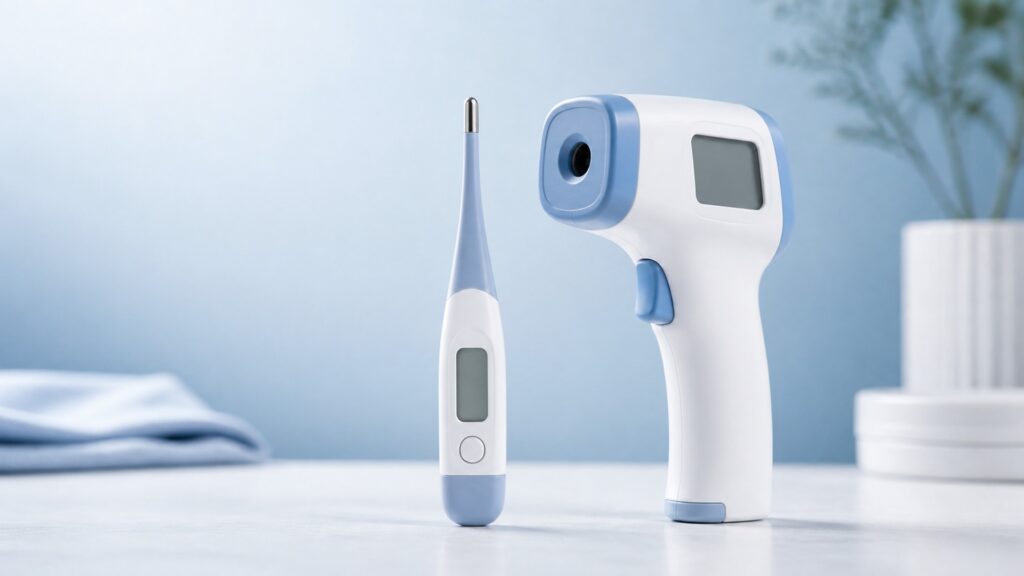
People-free comparison of an unbranded contact digital thermometer and non-contact infrared thermometer on a clean home counter
What You'll Learn

Contact Sensing Versus Infrared Estimation

Trace how heat reaches each sensor, why measurement site matters, and which practical tradeoffs influence a home reading.

  • How contact sensors reach thermal equilibrium
  • How infrared detectors estimate surface temperature
  • Why body sites cannot always be compared directly
  • Where distance and angle affect non-contact readings
  • How hygiene and speed differ
  • When an unexpected value deserves confirmation

Tip: Read the concept as part of a system, then connect it back to the use case.

Definitions

Key Concepts That Define What Makes Digital Thermometers Different from Infrared Thermometers

These definitions connect the main idea to the variables, limits, and practical signals readers need to compare options.

Contact Sensor

An electronic element that changes output as its temperature changes

  • System role: Requires physical placement at the intended site
  • Decision use: Follow contact sensor when comparing the relevant input and output
  • Boundary: Contact Sensor does not represent every factor in the result

Infrared Detector

A sensor that responds to thermal radiation emitted by a target surface

  • Why it matters: Enables contactless or ear-based estimation
  • Observation: Changes in infrared detector should be interpreted across comparable conditions
  • Caution: Treat infrared detector as one signal rather than a complete conclusion

Measurement Site

The anatomical location defined for taking the reading

  • Primary function: Changes expected values and technique
  • Comparison point: Check the stated range and method used for measurement site
  • Constraint: Context can change how measurement site affects the outcome

Emissivity

How effectively a surface emits infrared energy relative to an ideal emitter

  • Practical meaning: Supports infrared calibration assumptions
  • Buyer check: Ask how the product establishes or controls emissivity
  • Limit: A specification for emissivity needs real-use context

Thermal Equilibrium

The point at which a contact sensor stabilizes near the local temperature

  • Working effect: Influences contact measurement time
  • Feedback: Repeated observations make thermal equilibrium more interpretable
  • Uncertainty: Technique and conditions can alter the apparent result

Positioning Error

Bias caused by incorrect site, distance, angle, depth, or alignment

  • Decision relevance: Can dominate otherwise capable hardware
  • Use case: Connect positioning error with a defined action or comparison
  • Scope: Keep claims about positioning error inside the intended-use boundary

Tip: Keep the definitions connected; the strongest answer usually comes from the whole system, not one term.

Digital Contact

Let the Probe Reach the Intended Site Temperature

A thermistor or related sensor changes electrical behavior with temperature. The device waits for a stable pattern and converts it into a reading.

  • Use the specified body site
  • Maintain required contact
  • Clean the probe compatibly

Contact models exchange some speed for a direct thermal pathway.

Infrared Path

Estimate Temperature From Emitted Energy

Infrared optics collect thermal radiation from a target region. Calibration, ambient sensing, target assumptions, and software convert the signal.

  • Use the specified mode
  • Hold the correct distance and angle
  • Keep the sensing window clean

Fast collection does not eliminate environmental and positioning error.

Body Location

Keep Measurement Sites Consistent

Oral, axillary, rectal, ear, and forehead sites do not sample identical conditions, and age or clinical context may influence the appropriate method.

  • Do not mix sites in a trend casually
  • Follow age restrictions
  • Record the method with the result

A site change can look like a temperature change.

Conditions

Control Drafts, Heat, Coverings, and Moisture

Direct sun, radiant heaters, cold outdoor exposure, sweat, head coverings, bathing, exercise, eating, and drinking can distort particular methods.

  • Allow appropriate acclimation
  • Use a stable indoor setting
  • Repeat implausible results correctly

The thermometer measures within an environment, not outside it.

Tradeoffs

Choose Speed, Contact, and Repeatability for the Task

Infrared models support rapid, low-contact use, while contact models can be simpler and less dependent on aiming distance.

  • Consider cleaning and cross-contamination
  • Check display and user ability
  • Keep a confirmation method when needed

The best device is the one used correctly at a suitable site.

Quick Reality Check

What a Temperature Reading Represents

Both methods estimate a temperature at a defined site; neither reading alone explains why temperature changed or rules out every concern.

Useful Differences

Contact thermometers offer a familiar, direct heat-transfer pathway with site-specific technique.

Infrared models provide fast readings and can reduce contact when positioning and environmental requirements are controlled.

Shared Limits

Normal body temperature varies, and values differ across sites, times, people, and measurement conditions.

A thermometer does not diagnose the cause of fever or determine urgency without symptoms, age, history, and appropriate guidance.

Common Myths

Misconceptions About What Makes Digital Thermometers Different from Infrared Thermometers

Common shortcuts and misunderstandings can make the topic seem simpler than it is.

Infrared thermometers measure internal body temperature directly

Infrared devices detect thermal radiation from an intended surface or ear target and use calibration to estimate a temperature. They do not see through tissue or directly sample a universal internal core temperature.

A contact thermometer is accurate anywhere it touches the body

Contact models are designed for particular anatomical sites and placement methods. Skin, mouth, armpit, and rectal conditions differ, so using an unsupported site can produce a misleading but precise-looking reading.

Non-contact means the thermometer can be used from any distance

Infrared optics sample a defined field at a specified distance and angle. Holding the device too far, too close, tilted, or aimed at hair or coverings can change which surface reaches the detector.

Two different thermometer readings should match exactly

Devices may use different sites, sensors, algorithms, averaging, rounding, response criteria, and environmental compensation. Compare repeated readings only after controlling technique and recording the method rather than expecting perfect numerical identity.

Tip: Treat strong claims as starting points for comparison, not final answers.

FAQ

Frequently Asked Questions About What Makes Digital Thermometers Different from Infrared Thermometers

Concise answers to common questions readers may have after the main explanation.

Which type is faster for a home temperature check?

Non-contact infrared models typically display a result rapidly, while contact models need adequate thermal contact. Actual speed includes setup, positioning, cleaning, repeat checks, and whether an unexpected result needs confirmation.

Why does an infrared forehead reading change between attempts?

Distance, angle, target area, movement, sweat, hair, hats, direct sun, drafts, room temperature, sensor cleanliness, and insufficient acclimation can change the detected signal. Follow the exact device instructions for repeatability.

Can a digital contact thermometer be shared?

Sharing depends on the device, site, probe-cover system, and cleaning instructions. Use compatible covers or disinfection exactly as directed and avoid transferring a thermometer between incompatible body sites or users without proper hygiene.

What should I do with an unexpected temperature reading?

Check the device mode, site, positioning, environment, battery, and instructions, then repeat appropriately. Interpret the result with age and symptoms, and follow qualified or urgent-care guidance when the situation warrants it.

Bottom Line

Digital contact thermometers sense heat through physical placement; infrared thermometers estimate temperature from emitted thermal radiation at a defined target.

Choose the site and workflow first, control method-specific errors, keep trends method-consistent, and interpret the number within symptoms and appropriate care guidance.

Next Steps

Go Deeper or Compare Your Options

Use these Review Streets paths to connect the explainer to related categories, comparisons, and next decisions.

How Family Health Products Works

Family health products perform different jobs: measuring signals, reducing exposure, delivering a defined intervention, improving comfort, or supporting preparedness.

Quick Summary

What Makes Digital Thermometers Different from Infrared Thermometers Explained

  • Contact and infrared sensing use different pathways.
  • Measurement site changes interpretation.
  • Infrared readings depend on distance and angle.
  • Contact readings need stable placement.
  • A temperature number does not identify its cause.