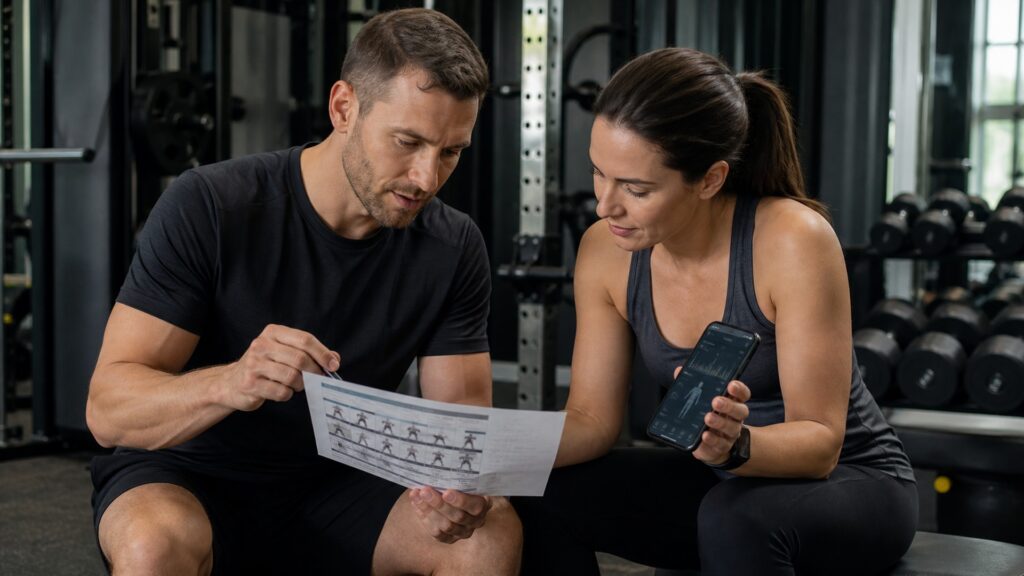
Exercise Program
A planned sequence of sessions organized around a goal, with exercise selection, workload, progression, recovery, and review built into the structure.
- Logic: Explains why sessions appear in an order
- Progression: Changes demand over time
- Format: Can exist on paper, in a spreadsheet, or inside an app
Workout App
Software that presents, records, schedules, demonstrates, or modifies workouts through a phone, watch, tablet, or web service.
- Interface: Delivers instructions and media
- Data: Stores completed sessions and metrics
- Range: May contain a program or only a workout library
Session Sequence
The order and spacing of workouts across days and weeks, designed to distribute practice, workload, and recovery.
- Order: Connects one session to the next
- Spacing: Manages repeated demands
- Meaning: Distinguishes a program from unrelated daily workouts
Progression Rule
A stated method for changing load, repetitions, duration, range, pace, or difficulty when current work meets defined conditions.
- Trigger: Uses performance or schedule criteria
- Change: Identifies the variable to adjust
- Boundary: Includes what happens when performance declines
Adaptive Algorithm
Software logic that changes recommendations from entered or recorded data, such as completed work, ratings, heart rate, or missed sessions.
- Input: Depends on data quality
- Rule: May be transparent or proprietary
- Limit: Cannot observe every relevant condition
Coaching Feedback
Interpretation from a qualified person who can observe context, ask questions, and adjust a plan beyond automated rules.
- Observation: Can include movement and symptoms
- Dialogue: Clarifies goals and constraints
- Boundary: Quality depends on credentials and scope