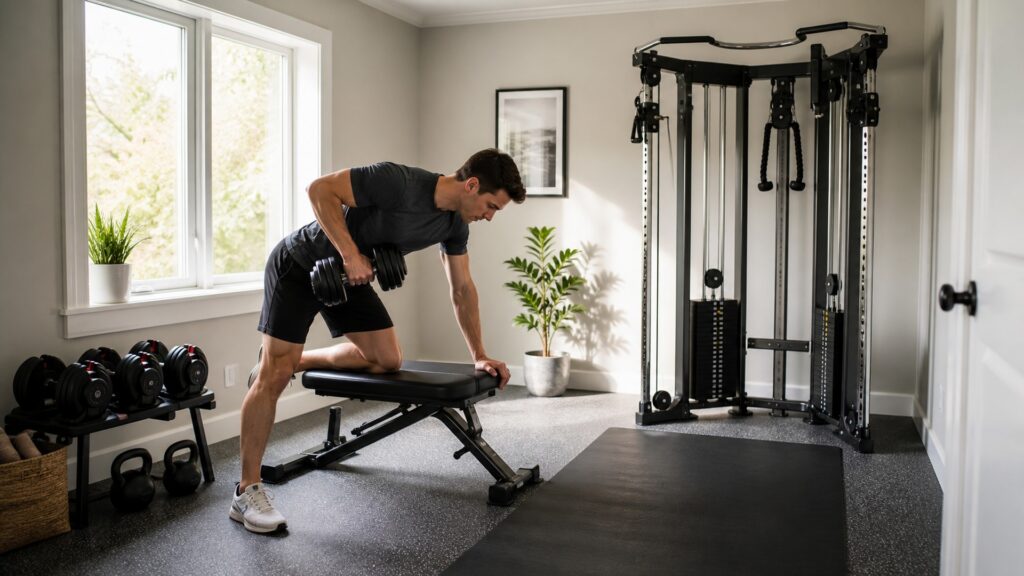
When to Use Home Gym Equipment Instead of a Commercial Gym

Home gym equipment is most useful when access and consistency matter more than having every machine available. Removing a commute can make short or irregularly timed sessions practical, but ownership transfers space planning, setup, inspection, and maintenance from a facility to the household.

A commercial gym becomes more valuable when a program depends on broad load ranges, large machines, specialty stations, coaching, or a training environment outside the home. The decision is therefore about constraints and routine design, not whether one location is inherently more serious. Those conditions can change as the program, household, or available space changes.

By: Review Streets Research Lab
Updated: August 26, 2026
Explainer · 8-12 min read
home gym equipment explainer hero image for Review Streets
What You'll Learn

The Conditions That Make Home Equipment the Better Fit

A defensible choice compares access, program requirements, physical space, ownership duties, supervision, and the social environment.

  • When removing travel changes session consistency
  • How much equipment a real program requires
  • Why stored footprint understates space needs
  • What ownership and maintenance add
  • When spotters, staff, or instruction matter
  • How queues and shared stations alter a plan
  • Which changes in life could reverse the decision

Tip: Write the actual weekly exercises and equipment requirements first; do not design a room around hypothetical variety the program may never use.

Definitions

Key Concepts That Define Home Gym Equipment Versus a Commercial Gym

These decision variables reveal whether convenience outweighs equipment breadth and facility support.

Access Friction

The time and effort required before training can begin, including travel, parking, opening hours, clothing, queues, or assembling a home setup.

  • Home: Removes travel but may require setup
  • Commercial: Adds a trip but provides ready stations
  • Effect: Shapes whether short sessions are practical

Equipment Breadth

The range of loads, machines, benches, racks, cardio modes, and specialty tools available for different exercises and progression needs.

  • Home: Limited by budget and space
  • Commercial: Broad but shared
  • Decision: Matters only if the program uses the extra variety

Dedicated Space

An area that can remain available for training with adequate clearance, flooring, ventilation, storage, and safe movement around equipment.

  • Footprint: Includes use space, not only stored dimensions
  • Structure: Floors and anchors must suit the equipment
  • Household: Noise and access affect other occupants

Load Capacity

The rated amount an equipment frame, bench, rack, cable, or floor arrangement is designed to support under stated conditions.

  • Rating: Must include user and external load where specified
  • Setup: Assembly and anchoring affect real use
  • Boundary: Manufacturer instructions govern the device

Shared Environment

A facility where equipment, staff, other members, schedules, and behavioral rules shape how a session runs.

  • Benefit: More stations and potential assistance
  • Cost: Queues and substitutions can interrupt plans
  • Context: Social energy helps some users and distracts others

Ownership Burden

The responsibility for purchase, assembly, inspection, cleaning, repairs, upgrades, storage, and eventual disposal of home equipment.

  • Control: Equipment is available on the owner's schedule
  • Maintenance: No facility staff handles problems
  • Cost: Expenses arrive unevenly rather than as one membership fee

Tip: Measure the area with the equipment in use, including plate loading, bench movement, cable travel, and a clear exit path.

Routine Access

Use Home Equipment When the Commute Is the Main Barrier

Home equipment removes facility travel and opening-hour constraints, making brief sessions and split schedules easier to execute. That advantage is strongest when the household space remains ready enough that setup does not recreate the same friction.

  • Short sessions become practical without travel time
  • Early or late training is less tied to facility hours
  • A permanent station reduces assembly between sessions
  • Household interruptions can replace gym travel as the new barrier
  • Consistency still depends on a realistic schedule

Home wins this boundary when immediate access changes what actually gets done.

Program Requirements

Stay Commercial When Equipment Breadth Is Essential

A commercial facility can supply multiple machine geometries, heavier load ranges, cardio modes, platforms, and specialty tools. That breadth matters when the program genuinely rotates through them, not simply because more options exist.

  • Large machines are difficult to duplicate at home
  • Commercial racks and plates can support broader loading
  • Multiple cardio modes allow mechanical variety
  • Queues may require exercise substitutions
  • A focused home program may need surprisingly few tools

Count required stations, not attractive possibilities, when comparing equipment access.

Space and Structure

Use Home Equipment Only When the Room Supports Real Operation

A product's listed footprint rarely includes the space needed to mount it, load plates, move a bench, swing a kettlebell, or access adjustments. Ceiling height, floor construction, noise, and anchoring also constrain the plan.

  • Measure movement clearance on every side
  • Check doorways and stairs before delivery
  • Confirm floor and equipment load requirements
  • Protect surfaces from repeated impact and abrasion
  • Plan storage so walkways remain clear

A compact purchase can still create an unusable room if operational clearance is ignored.

Support and Environment

Commercial Facilities Add People as Well as Machines

Staff, coaches, classes, training partners, and other members can provide instruction, spotting, accountability, or energy. The same environment can also add crowding, noise, distraction, or unwanted observation.

  • Qualified instruction can simplify unfamiliar equipment
  • Some heavy free-weight work benefits from appropriate safeties or help
  • Classes create fixed times and social structure
  • Home offers privacy and control over music and pace
  • Motivation can rise or fall in either environment

Choose the setting whose human environment supports the intended routine and skill level.

Ownership Boundary

Home Equipment Makes Sense When Maintenance Is Acceptable

At home, the user owns every loose fastener, worn cable, battery, belt, upholstery tear, software update, and cleaning task. Commercial facilities spread those duties across staff and membership fees.

  • Inspect equipment according to manufacturer guidance
  • Budget for repair and replacement rather than purchase alone
  • Keep assembly documentation and hardware records
  • Consider resale, moving, and disposal constraints
  • Reassess the setup when the training plan changes

Use home equipment when control and access are worth the long-term ownership work.

Quick Reality Check

When the Convenience Trade Pays Off—and When It Does Not

Home access can remove a decisive barrier, but limited space and equipment may matter more as a program changes.

Strong Home-Gym Conditions

The routine uses a stable set of exercises, suitable space already exists, and travel time frequently disrupts otherwise realistic sessions.

The user is comfortable with setup, inspection, maintenance, and training without relying on facility staff or a social environment.

Strong Commercial-Gym Conditions

The program needs large or specialized machines, wide load ranges, classes, qualified instruction, or equipment that cannot be housed responsibly.

Available home space conflicts with floor capacity, clearance, noise, household access, or the cost and maintenance burden of ownership.

Common Myths

Misconceptions About Home Gym Equipment Versus a Commercial Gym

These corrections separate a home gym automatically saves money from commercial gyms always have better equipment, two shortcuts that distort home gym equipment versus a commercial gym.

A home gym automatically saves money

Ownership replaces membership payments with purchase, delivery, flooring, maintenance, repairs, upgrades, and moving costs. Whether it costs less depends on the exact setup and years of actual use, not a universal break-even point.

Commercial gyms always have better equipment

Facilities usually offer more equipment, but availability, maintenance, fit, and queue time vary. A carefully chosen home setup can be better suited to a narrow program than many shared options.

Training at home requires a full room

Some programs use compact adjustable loads, bands, a bench, or bodyweight stations. Other goals require racks and machines. Space needs follow the exercise list, not the label home gym. The program should define the room rather than vice versa.

Privacy guarantees consistency

Privacy removes one possible barrier, but household interruptions, low accountability, and equipment setup can introduce others. Consistency depends on how the environment fits the person's routine and preferences. Routine design still determines whether privacy helps adherence.

A gym membership removes all safety concerns

Facilities provide more infrastructure, but users still need appropriate setup, technique, equipment checks, and judgment. Staff presence does not mean every session is supervised or every machine fits every person.

Tip: Check each claim against access friction and the article's program requirements explanation.

FAQ

Frequently Asked Questions About Home Gym Equipment Versus a Commercial Gym

These answers resolve remaining questions about access friction, equipment breadth, and their practical limits.

What is the clearest reason to choose home equipment?

Choose it when removing travel and scheduling friction materially increases access to a program that can be performed with the available space, equipment range, and level of independent training skill.

How should space be measured?

Use operational dimensions: access paths, exercise travel, bench movement, plate loading, cable extension, ceiling clearance, and storage. Also consider floor requirements, ventilation, noise, and other household users. Operational clearance should be marked before equipment is ordered.

When is a commercial gym the easier option?

It is often easier when the program needs many large machines, heavy or varied loads, classes, staff assistance, pools, courts, or specialty equipment that would be impractical to own. That breadth is valuable only when sessions actually require it.

Does home equipment need professional installation?

Some products require specific assembly, anchoring, electrical supply, or structural checks. Follow manufacturer instructions and use qualified help where the installation or building conditions exceed the owner's competence. Complex installation should not be improvised beyond available expertise.

Can one home setup support progression?

Yes, if its load range, increments, adjustment options, and movement variety cover the program's foreseeable needs. A setup can become limiting when the training goal or required resistance changes. Foreseeable progression needs belong in the original equipment plan.

What if motivation depends on other people?

A commercial facility, class, coach, or training partner may provide valuable structure. Home access is not automatically helpful when social commitment is the factor that reliably starts the session. That social structure may outweigh the convenience of home access.

Bottom Line

Use home gym equipment when immediate access solves a real routine problem and a focused program fits the available space, load range, and ownership responsibilities.

Use a commercial gym when equipment breadth, instruction, facilities, or social structure outweigh travel and crowding. The decision can change as programs and living conditions change.

Next Steps

Continue from Home Gym Equipment Versus a Commercial Gym to Related Fitness Explanations

Each destination extends the article's routine access or ownership boundary model into a nearby fitness question.

How Fitness Equipment Works

Learn how resistance sources, movement paths, adjustments, stability, and feedback define what each piece of equipment can do.