
Standing Cardio
Standing cardio keeps the user upright while the legs drive the movement.
- Example: using a front drive elliptical with moving handles
- Check: test balance and posture during the stride
- Limit: standing work may not suit every user
Front drive ellipticals and recumbent exercise bikes are both cardio machines, but they ask the body to work in different positions. A front drive elliptical keeps the user standing on moving pedals, while a recumbent bike supports the user in a seated position with the legs pedaling forward.
That difference affects balance, joint loading, muscle use, room fit, and who is likely to feel comfortable. The better option depends on whether the user wants standing whole-body cardio or seated, supported cycling.
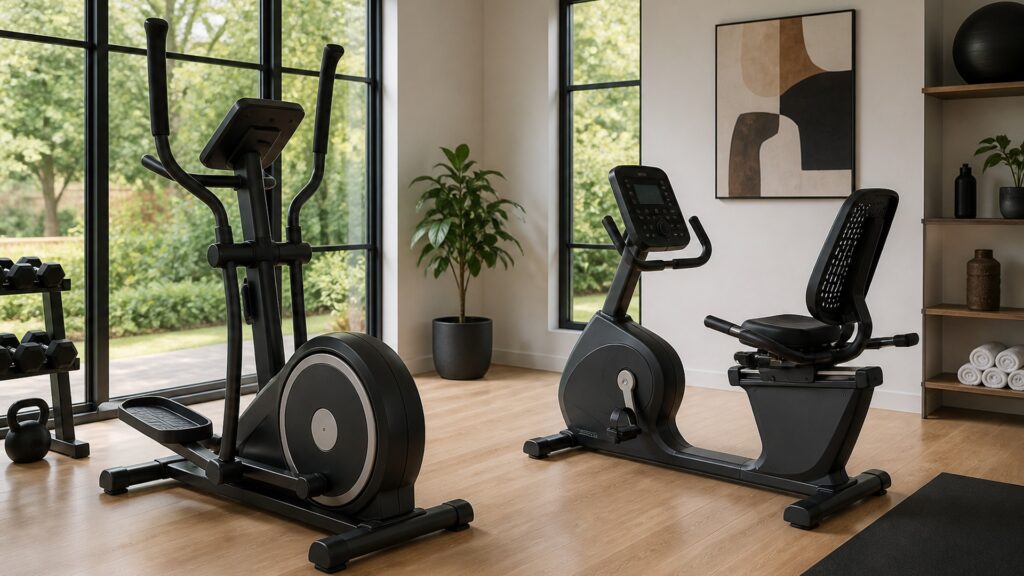
A practical comparison of posture, movement, support, and workout role.
Tip: Judge the machine by the workout it supports repeatedly, not by one label or specification.
These concepts connect the category name to the practical details a buyer should check.
Standing cardio keeps the user upright while the legs drive the movement.
Seated support holds the user's body on a seat and backrest during exercise.
Stride path is the oval motion created by an elliptical's pedals.
Pedaling motion is the circular leg movement used on a bike.
Balance demand is how much the user must stabilize the body during exercise.
Workout role is the job the machine fills in a fitness routine.
Tip: The best choice is the one whose motion, setup, and upkeep fit the user and the room.
A front drive elliptical asks the user to stand and move through a guided stride. That can feel more active through the hips, trunk, and upper body than seated cycling.
The standing position is the biggest practical difference.
A recumbent exercise bike gives the user a seat and backrest. That support can help people who want cardio with less balance demand or less time standing.
Seated support can make longer sessions feel easier to manage.
Ellipticals guide the feet through an oval path, while recumbent bikes use circular pedaling. The two motions can feel very different even at the same effort level.
The motion should match the user's body and preference.
A front drive elliptical needs standing height and safe step-on space. A recumbent bike may sit lower but can take floor length because of the seat track.
The better fit is the machine that works in the actual room.
The choice usually comes down to standing engagement versus seated support. Neither machine is automatically better for every user.
The right machine is the one the user can repeat comfortably.
The two machines solve different cardio needs.
The user wants standing cardio with a guided stride.
Upper-body handles and posture variety matter.
The user wants seated support and lower balance demand.
Back support and easy mounting are priorities.
Both are cardio machines, but they are not interchangeable.
Standing stride work and seated pedaling use different positions and movement patterns.
Effort depends on resistance, cadence, duration, and user fit.
A recumbent bike can still support demanding cardio when resistance is used well.
Height, mounting space, and seat adjustment matter too.
Tip: Use strong claims as a reason to inspect fit, motion, and use conditions more carefully.
Short answers for practical cardio equipment decisions.
A recumbent bike usually has lower balance demand because the user is seated.
A front drive elliptical is closer to a standing stride, though it is still a guided machine motion.
It depends on ceiling height, floor length, and mounting space.
Yes, but they do it with different body positions.
Choose the elliptical for standing stride work and the recumbent bike for seated support.
Front drive ellipticals differ from recumbent exercise bikes because they use standing guided stride motion instead of seated pedaling.
The choice should come from support needs, balance comfort, room fit, and the cardio sessions the user expects to repeat.
Use these Review Streets paths to compare related categories and practical next decisions.
Review the front drive layout and moving parts.
See how pedal path affects comfort.
Compare product options after checking the basics.
Choose a retailer
Prices checked regularly. We may earn a commission at no cost to you.