
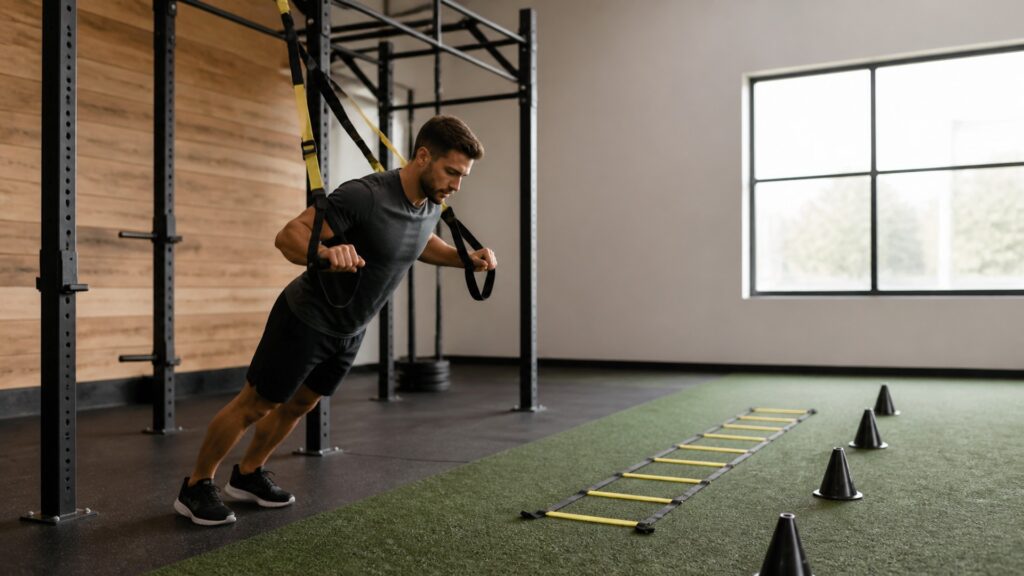
What Makes Functional Suspension Training Different from Agility Training Equipment

Functional suspension training and agility training equipment solve different movement problems. Suspension training uses anchored straps or rings to scale bodyweight resistance, support movement, and add controlled instability. Agility equipment uses cones, ladders, hurdles, markers, or cues to organize footwork, speed, reaction, and direction change.

The difference matters because straps are mostly about resistance and body control, while agility tools are mostly about movement through space. A suspension row and a cone shuttle may both be useful, but they do not train the same job.

By: Review Streets Research Lab
Updated: October 2, 2026
Explainer · 8-12 min read
functional suspension training explainer hero image for Review Streets
What You'll Learn

How Strap Training Differs From Agility Tools

A practical comparison of anchored bodyweight resistance and quick-movement drill equipment.

  • How suspension straps create adjustable resistance
  • Why agility tools organize spacing, timing, and direction changes
  • Where instability differs from reaction training
  • When each category fits a workout
  • How to combine both without confusing their roles

Tip: Start with the training job, then decide whether straps solve that job better than a fixed tool.

Definitions

Key Concepts Behind Functional Suspension Training Different from Agility Training Equipment

These concepts explain how strap setup, body angle, and movement control shape the training decision.

Functional Suspension Training

Functional suspension training uses anchored straps or rings to train bodyweight resistance through angle and control.

  • Example: suspension rows or strap-assisted lunges
  • Check: confirm anchor safety and body angle
  • Limit: straps do not create agility routes by themselves

Agility Training Equipment

Agility training equipment organizes quick movement, foot placement, reaction, and direction changes.

  • Example: cones, ladders, hurdles, or reaction lights
  • Check: match the drill to a movement goal
  • Limit: markers do not provide much strength loading

Body Angle

Body angle changes how much bodyweight the suspension exercise uses.

  • Example: stepping forward to make rows harder
  • Check: change angle in small steps
  • Limit: untracked angle changes make progress unclear

Spatial Drill

A spatial drill uses routes, markers, or cues to guide where the user moves.

  • Example: cutting around cones after a signal
  • Check: leave enough stopping room
  • Limit: space and surface can limit the drill

Instability

Instability is the control demand created when straps or rings move.

  • Example: handles shifting during a suspended push-up
  • Check: use only as much movement as the user can control
  • Limit: instability is not the same as agility

Training Role

Training role is the job each tool performs in the session.

  • Example: straps for rows and cones for change-of-direction work
  • Check: keep each tool assigned to a clear purpose
  • Limit: mixed tools can add clutter

Tip: Suspension training is useful when adjustability and control support the exercise rather than complicating it.

Resistance

Suspension Training Uses Bodyweight As Load

Straps make resistance adjustable by changing body angle, strap length, and support. The user is training against bodyweight and gravity.

  • Use straps for rows, presses, squats, lunges, and core drills.
  • Track angle and strap length for progression.
  • Choose easier angles before harder instability.

Suspension systems are strongest when resistance control is the goal.

Movement

Agility Equipment Organizes Space

Agility equipment gives the user places to move around, over, through, or toward. It is strongest when timing, route, foot placement, or direction change matters.

  • Use cones for routes and cutting points.
  • Use ladders for footwork patterns.
  • Use cues for reaction drills.

Agility gear is strongest when movement through space is the goal.

Control

Instability And Reaction Are Different Demands

Suspension instability asks the user to keep alignment while the handles move. Agility reaction asks the user to respond quickly and reposition the body.

  • Do not treat shaking straps as agility work.
  • Do not treat cone drills as strength progression.
  • Use each demand intentionally.

Both can train control, but they train different kinds of control.

Setup

The Space Requirements Are Different

Suspension training needs a secure anchor and room to lean. Agility training needs open space, surface grip, and stopping room.

  • Check anchor strength for straps.
  • Check floor and clearance for agility drills.
  • Use compact versions only when the goal still fits.

The room can decide which category is practical.

Decision

Choose Based On The Missing Training Job

Choose straps when the workout lacks scalable bodyweight resistance. Choose agility tools when it lacks footwork, reaction, or direction-change structure.

  • Buy straps for adjustable bodyweight strength.
  • Buy agility tools for spatial movement drills.
  • Combine them when the session needs both.

The categories work best when their roles stay separate.

Quick Reality Check

Where Each Category Makes More Sense

The choice depends on whether the session needs anchored resistance or spatial movement.

Suspension Training Fits When

The workout needs scalable bodyweight resistance.

A secure anchor and repeatable angle setup are available.

Agility Equipment Fits When

The workout needs footwork, reaction, acceleration, or direction change.

There is enough safe space for movement drills.

Common Myths

Misconceptions About Suspension Training And Agility Gear

The two categories can complement each other, but they are not substitutes.

Suspension instability is agility training

It trains control under unstable support, not route-based movement or reaction.

Agility tools build strength by themselves

They organize movement drills but do not provide much resistance.

Straps are always more versatile

They are versatile for bodyweight training, not for every movement skill.

One setup should replace the other

Many routines use straps for strength and agility gear for movement skill.

Tip: Judge the setup by the movement it improves, not by how many variations it promises.

FAQ

Frequently Asked Questions About Suspension Training And Agility Equipment

Short answers for practical training and buying decisions.

Which category should I choose first?

Choose straps for adjustable bodyweight resistance and agility tools for quick movement through space.

Can I use both together?

Yes. Use straps for strength or control and agility tools for footwork or direction-change blocks.

Does suspension training improve agility?

It can support strength and control that help movement, but agility still needs specific footwork and reaction practice.

Does agility equipment replace suspension straps?

No. Agility tools do not provide the same scalable bodyweight resistance.

What is the practical takeaway?

Use suspension training for anchored bodyweight control and agility equipment for spatial movement drills.

Bottom Line

Functional suspension training is different because it uses anchored straps to scale bodyweight resistance.

Agility equipment is different because it organizes quick movement, spacing, reaction, and direction changes.

Next Steps

Go Deeper or Compare Your Options

Use these Review Streets paths to compare related categories and practical next decisions.