
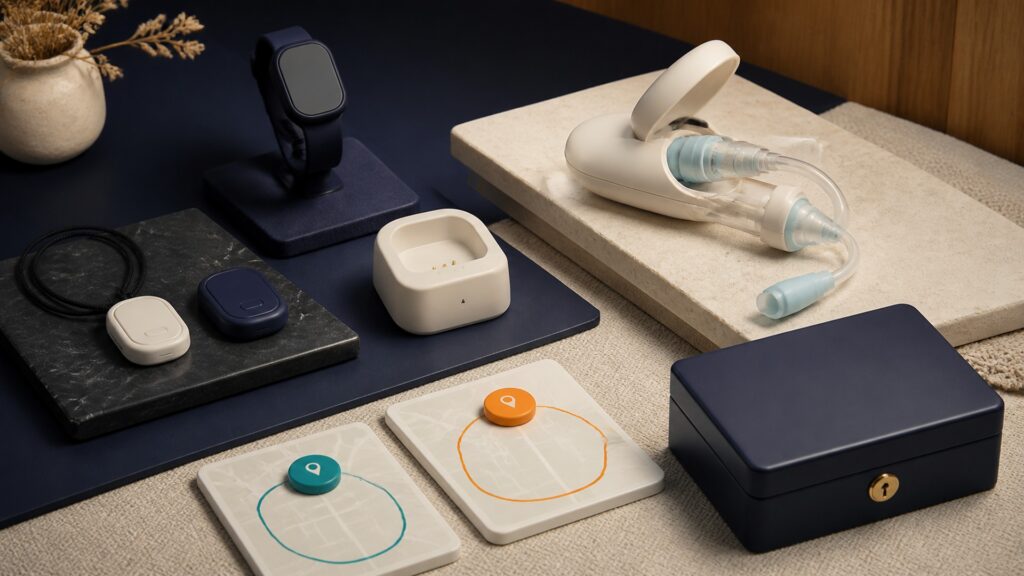
What Makes GPS Safety Wearables Different from Baby Nasal Aspirators

A GPS safety wearable is an information system worn or carried over time; a baby nasal aspirator is a hands-on tool used briefly to remove visible or suspected nasal mucus. The first estimates position and relays it to another person. The second applies controlled suction at the nostril. Electronics, batteries, and travel-friendly packaging can appear in either category, but those details do not erase the difference between surveillance and physical care.

Consider a family preparing to leave home with an older relative and a congested infant. The wearable must be charged, connected, and assigned to trusted contacts before the trip. The aspirator needs a clean collection path, an age-appropriate tip, gentle technique, and washing afterward. One supports a location response across distance; the other changes airflow resistance locally for a short period.

By: Review Streets Research Lab
Updated: August 19, 2026
Explainer · 8-12 min read
People-free editorial still life for What Makes GPS Safety Wearables Different from Baby Nasal Aspirators
What You'll Learn

Persistent location awareness versus brief mucus removal

The comparison follows what enters each product, what comes out, how long the benefit lasts, and which maintenance or safety errors matter in real use.

  • The wearable's continuing data cycle
  • The aspirator's short suction event
  • Different meanings of power and portability
  • Privacy compared with hygiene
  • Failure signs that require stopping
  • A practical selection boundary

Tip: Read the concept as part of a system, then connect it back to the use case.

Definitions

Six Concepts That Shape This Decision

These definitions connect the main idea to the variables, limits, and practical signals readers need to compare options.

Location fix

A location fix is the wearer's estimated position at a particular time. It may be based on several radio sources and carries uncertainty that the map icon can hide.

  • The wearable listens for available signals, computes or requests an estimate, and associates it with a timestamp. Later fixes reveal movement only when the device remains powered and connected.
  • Look for the time of the last update and test typical buildings, routes, and outdoor areas. A stationary marker should not be assumed current without its timestamp.
  • The fix belongs to the device, which may not be attached to the intended wearer.

Geofence event

A geofence event occurs when an estimated position appears to enter or leave a saved area. It is a software interpretation of successive fixes.

  • The service compares new coordinates against the digital perimeter and may wait for confirmation before messaging caregivers. Accuracy and polling intervals affect apparent crossing time.
  • Walk safely across the boundary from several directions, then record whether notices arrive promptly and reach backup contacts. Adjust the perimeter to reduce normal drift.
  • A geofence cannot physically prevent departure or summon assistance unless someone follows the alert.

Nasal suction

Nasal suction uses negative pressure to draw mucus toward a collection chamber. Manual bulbs, mouth-powered tubes, and electric aspirators create that pressure differently.

  • A tip seals near the nostril opening while the user applies a limited suction force. Loosened secretions travel into a reservoir that should isolate them from the pump or caregiver.
  • Read the age and insertion instructions, begin gently, and watch the infant's comfort. Stop if the nose bleeds, tissue appears injured, or breathing distress is present.
  • Aggressive or repeated suction may irritate delicate tissue and does not treat the illness causing congestion.

Collection barrier

The collection barrier keeps removed mucus out of reusable tubing, motors, or a caregiver-operated mouthpiece. Its design controls cleaning burden and contamination risk.

  • Filters, valves, and reservoirs interrupt the material path while allowing airflow to continue. Incorrect assembly may defeat that separation or reduce effective suction.
  • Inspect every seal and disposable component before use. Afterward, disassemble only the parts named in the instructions and confirm they dry completely.
  • A clean-looking exterior does not establish that hidden passages are dry or uncontaminated.

Duty cycle

Duty cycle describes how a product is expected to operate over time. Tracking is intermittent but ongoing; aspiration is episodic and deliberately brief.

  • A wearable balances sampling and transmission against battery consumption throughout the day. An electric aspirator runs for short sessions so tissue exposure and motor load remain limited.
  • Compare claimed endurance with the actual update setting, and time aspiration only as directed. Recharge or replace components before either schedule becomes unreliable.
  • Extending operation beyond intended intervals can shorten tracker availability or make nasal irritation more likely.

Care threshold

The care threshold is the point where home use stops and professional or emergency assessment becomes appropriate. It is unrelated to a device's number of settings.

  • For tracking, inability to locate a vulnerable missing person can trigger an established search or emergency plan. For congestion, breathing difficulty, poor feeding, color change, or other concerning signs require clinical judgment.
  • Write response instructions before relying on the wearable, and know pediatric warning signs before using an aspirator. Keep contact information accessible when apps or power fail.
  • Neither product determines medical severity, and troubleshooting should not postpone necessary help.

Tip: Keep the definitions connected; the strongest answer usually comes from the whole system, not one term.

Compare the Jobs Before the Hardware

The categories diverge at the problem they are built to solve.

A wearable reduces uncertainty about a person's location when direct sight is unavailable. An aspirator temporarily clears nasal material when a caregiver is physically present. Tracking therefore depends on coverage, consent, contact permissions, and a response network. Aspiration depends on technique, anatomy, cleanliness, and restraint. A rechargeable motor may appear in both products, yet power drives completely different work.

  • State the problem in one sentence
  • Name the required input
  • Identify the immediate output
  • List who must act next

Product selection becomes clearer when the verb is locate or remove.

Understand the Wearable's Repeating Loop

Location support works by cycling through observation, transmission, display, and human response.

The tracker periodically obtains radio information, generates a position, uploads it, and waits for the next interval. A platform may store route history or compare coordinates with a geofence. Faster updates can show more detail but consume energy and data. The practical outcome is not the map itself; it is a trusted person using a sufficiently recent estimate to check on the wearer.

  • Charge and attach the wearable
  • Acquire a time-stamped position
  • Share it with authorized contacts
  • Act according to the safety plan

A map becomes useful only when its wearer, timestamp, and responder are known.

Understand the Aspirator's One-Session Path

Nasal aspiration begins and ends at the infant's airway entrance.

Saline may be used when pediatric guidance and product directions allow it, followed by gentle suction at the nostril rather than deep insertion. Mucus moves into a chamber, after which the tool is taken apart for cleaning. The observable result may be easier nasal airflow or feeding, but improvement is not guaranteed. Technique should remain brief because nasal lining is sensitive.

  • Prepare clean approved parts
  • Position the infant safely
  • Apply shallow controlled suction
  • Wash and dry the material path

The useful effect is local and temporary, so restraint matters as much as suction strength.

Judge Maintenance by the Relevant Failure

Charging discipline and decontamination prevent different kinds of loss.

A discharged tracker creates an information gap during the very period caregivers expect visibility. An inadequately cleaned aspirator can retain secretions, harbor residue, or lose suction through a poorly seated valve. Build each routine around the actual hazard: scheduled charging and attachment checks for the wearable; immediate disassembly, washing, drying, and part replacement for the aspirator.

  • Review battery and network status
  • Confirm the wearable remains attached
  • Inspect aspirator seals and filters
  • Dry reusable passages before storage

Maintenance is not interchangeable merely because both products have removable parts.

Use Different Stopping Rules

Unexpected performance calls for a response matched to the category.

When a location stops refreshing, confirm the wearer's safety through another channel and then examine charge, attachment, coverage, and service status. When aspiration causes bleeding, pain, swelling, or worsening distress, stop the session and seek appropriate advice. A stronger suction setting is not the counterpart of a faster location interval; increasing either control can introduce new costs without fixing the underlying problem.

  • Respond to the person before the product
  • Inspect the likely failure source
  • Avoid escalating settings reflexively
  • Seek technical or clinical support as appropriate

Good judgment recognizes when the tool has reached the edge of its intended task.

Quick Reality Check

Realistic outcomes for each category

Both devices can be useful when the claimed result stays narrow and observable.

Reasonable expectations

A functioning wearable may reduce the time needed to establish where its device appears to be during a location concern.

Careful nasal aspiration may remove some accessible mucus and temporarily improve comfort before feeding or sleep.

What remains outside scope

Tracking does not prevent falls, wandering, illness, or harm, and a position estimate may be stale or separated from its wearer.

An aspirator cannot cure infection, assess oxygenation, or determine why an infant is having difficulty breathing.

Common Myths

Misconceptions That Distort the Decision

Common shortcuts and misunderstandings can make the topic seem simpler than it is.

Portability makes these products substitutes

Both may fit in a travel bag, but portability describes form rather than purpose. The wearable maintains a remote information link to a moving person. The aspirator performs brief, direct nasal care while an adult is physically beside the infant.

The strongest aspirator setting clears congestion best

Greater suction is not automatically more effective and may irritate nasal tissue. Use the lowest appropriate method described by the manufacturer or clinician, keep insertion shallow, and stop when discomfort, bleeding, or another warning sign appears.

A tracker always shows the wearer's exact live position

Map displays can lag, drift indoors, or reflect a device that was removed. Read the timestamp and any accuracy indicator, then verify through another contact method when safety is uncertain. The graphic should guide response, not replace it.

If either device works once, maintenance can wait

A successful outing does not preserve tomorrow's battery, and one clean suction session does not keep damp passages sanitary. Charging, account checks, washing, drying, and component inspection recur on different schedules because the two failure modes differ.

Tip: Treat strong claims as starting points for comparison, not final answers.

FAQ

Questions to Ask Before Choosing

Concise answers to common questions readers may have after the main explanation.

Which product is relevant when the concern is congestion?

A nasal aspirator may help remove accessible mucus when used gently and within pediatric and manufacturer guidance. A GPS wearable offers no airway function. Breathing trouble, poor feeding, color change, or other concerning symptoms need prompt professional assessment.

What matters most when testing a new safety wearable?

Verify that it produces recent locations along the wearer's ordinary route, not just beside the setup phone. Check indoor behavior, alert recipients, geofences, charging intervals, account permissions, and a backup plan for lost connectivity or removal.

Can an electric aspirator be treated like another gadget?

No. Anything touching or collecting nasal secretions needs careful assembly, shallow use, compatible cleaning, and complete drying. Motorized suction should remain within product limits. The presence of buttons or an app does not reduce tissue and hygiene concerns.

How should a family decide between them?

There is usually no either-or decision because they address unrelated needs. Choose a tracker for ongoing location awareness and an aspirator for brief nasal mucus removal. If both needs exist, evaluate, maintain, and supervise each product separately.

Bottom Line

GPS safety wearables turn radio observations into location information for a distant responder. Baby nasal aspirators turn controlled suction into local mucus removal during direct care. Their useful outcomes occur at different distances, timescales, and risk boundaries.

Start with the action required: locating a wearer or clearing an infant's nose. Then examine the corresponding failure points—battery, coverage, and privacy for tracking; technique, tissue irritation, and cleaning for aspiration—and keep an appropriate human fallback ready.

Next Steps

Go Deeper or Compare Your Options

Use these Review Streets paths to connect the explainer to related categories, comparisons, and next decisions.