What Makes Guided Meditation Different from Biofeedback Training

Guided meditation and biofeedback training can both support self-regulation, but they provide different kinds of help. A guided session directs attention with spoken prompts, imagery, pacing, or silence. Biofeedback first measures a body signal, then displays or sounds that signal so the user can practice changing a response.

The practical choice depends on what information the learner needs. Someone who benefits from structure may prefer guided meditation. Someone trying to connect an internal sensation with measurable change may benefit from biofeedback, provided the sensor, protocol, and interpretation are appropriate.

By: Review Streets Research Lab
Updated: August 20, 2026
Explainer · 8-12 min read
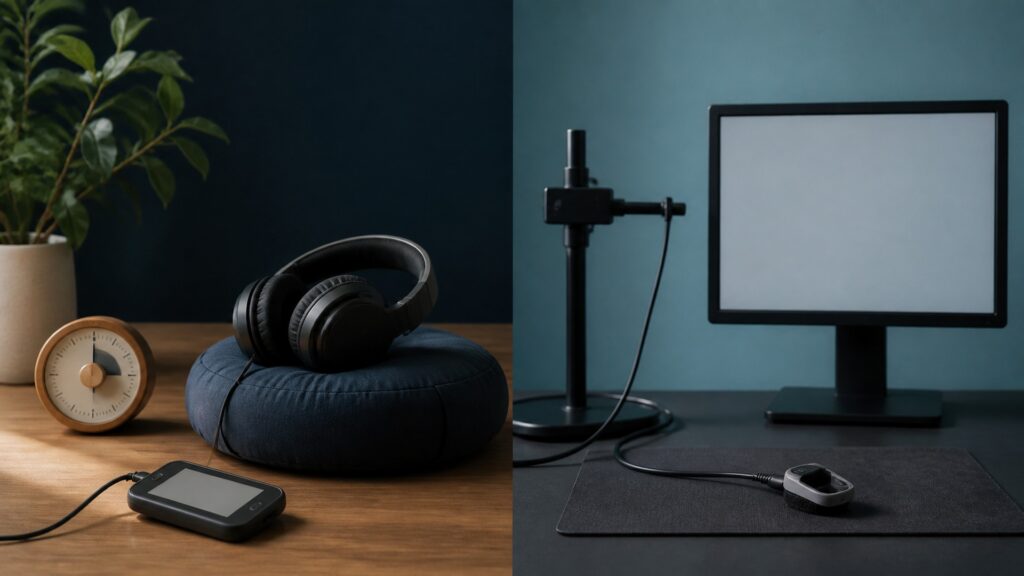
People-free editorial still life illustrating guided meditation different from biofeedback training
What You'll Learn

Distinguish instruction from measured feedback

Follow what each method supplies, what the participant does with it, and which limitations matter before treating the two approaches as substitutes.

  • Identify the information delivered to the user
  • Separate attention cues from physiological measurement
  • Match the method to a defined practice goal
  • Recognize sensor and interpretation limits
  • Plan a realistic practice routine
  • Know when broader care is needed

Tip: Read the concept as part of a system, then connect it back to the use case.

Definitions

Six Concepts That Shape This Decision

These definitions connect the main idea to the variables, limits, and practical signals readers need to compare options.

Guided meditation

A structured practice that uses a teacher or recording to direct attention through breath, sensation, imagery, sound, or reflection.

  • The guidance reduces the burden of deciding what to do next during a session.
  • Compare the pace, language, length, and sensory demands with the participant's preferences.
  • Guidance does not measure whether a physiological change occurred.

Biofeedback

A training process that measures a physiological signal and returns information about it to the participant in near real time.

  • The returned signal can make a normally subtle response easier to notice while practicing a strategy.
  • Ask which signal is measured, how it is collected, and what action the learner is expected to test.
  • A displayed change is not automatically a diagnosis or proof of a broad health benefit.

Physiological signal

A measurable body process such as heart-rate pattern, breathing rate, skin conductance, muscle activity, or peripheral temperature.

  • Each signal reflects a limited process and can also change for reasons unrelated to the training goal.
  • Interpret the signal with posture, movement, room conditions, medication, and emotional context in mind.
  • One signal cannot represent the whole nervous system or explain every symptom.

Feedback loop

The repeated sequence of measuring a signal, showing it to the learner, trying a response, and observing what changes.

  • Learning depends on linking an intentional action with a consistent and interpretable change.
  • A useful session gives the participant enough time to try, observe, and repeat without chasing every fluctuation.
  • A noisy or delayed loop can teach the wrong association.

Attentional cue

A word, sound, image, or timing instruction that brings attention back to the chosen object of practice.

  • Guided meditation relies on cues when attention wanders, while biofeedback may use cues alongside measured information.
  • Notice whether prompts help reorientation or become distracting, demanding, or emotionally uncomfortable.
  • A cue organizes attention; it does not verify calm, concentration, or physiological control.

Transfer

The ability to use a practiced skill outside the recording, sensor, clinic, or training session.

  • A method has limited practical value if the user cannot recognize when and how to apply the skill independently.
  • Test transfer in ordinary low-risk situations before relying on the technique during intense stress.
  • Improvement during a device session does not guarantee durable change in daily life.

Tip: Keep the definitions connected; the strongest answer usually comes from the whole system, not one term.

Purpose

Start with the learning problem

Guided meditation supplies a route for attention; biofeedback supplies evidence about a selected body response. The distinction matters when a buyer is choosing between a content subscription, a sensor-based system, or professional training. Define whether the immediate need is instruction, measurement, or both before comparing features.

  • Name the skill to be practiced
  • Decide whether measurement adds value
  • Account for sensory preferences
  • Set a modest observable goal

The right starting point is the missing information, not the most elaborate product.

Information Path

Trace what reaches the participant

In guided meditation, a voice or script prompts where attention should go and how the exercise unfolds. In biofeedback, electrodes or optical sensors capture a signal, software processes it, and a display converts it into visible or audible feedback. These information paths create different setup burdens and failure points.

  • Check whether prompts can be adjusted
  • Identify the exact sensor signal
  • Review delay and artifact handling
  • Confirm the user understands the display

Instruction and measurement may coexist, but they remain separate functions.

Practice Design

Match repetition to the intended skill

A meditation session can be practiced with minimal equipment once the method is understood. Biofeedback usually requires repeatable sensor placement and a defined experiment, such as changing breathing pace while observing a trend. Short sessions with a clear task are more interpretable than unstructured attempts to produce a desirable score.

  • Keep the practice task consistent
  • Change one variable at a time
  • Record comfort as well as results
  • Include device-free practice

Practice quality matters more than collecting a large volume of session data.

Measurement Limits

Treat the display as a narrow observation

Motion, poor contact, room temperature, and automatic smoothing can alter a biofeedback display. Guided meditation has no comparable sensor error, but it also cannot confirm what occurred internally. Self-report, observed function, and measured signals answer different questions and should not be collapsed into one outcome.

  • Inspect signal quality before interpretation
  • Avoid reading meaning into every fluctuation
  • Compare like conditions
  • Separate experience from measurement

Neither a pleasant session nor a changing graph proves a medical result.

Choice

Use each method where it adds distinct value

Guided meditation is often the simpler choice for learning an attentional routine without hardware. Biofeedback becomes more relevant when a specific measurable response would help the learner test technique. Some programs combine them, using spoken guidance while a sensor shows whether the selected signal changes.

  • Prefer guidance for procedural structure
  • Prefer feedback for signal awareness
  • Combine only with a clear rationale
  • Escalate persistent symptoms appropriately

A combined program should still explain what each component contributes.

Quick Reality Check

The defensible difference is functional

Guided meditation can structure attention, and biofeedback can reveal a selected physiological signal. Neither method can guarantee relaxation, diagnose a condition, or replace individualized care.

What a practical comparison can establish

A user can compare whether spoken guidance or measured feedback makes a defined practice easier to understand.

Repeated sessions can reveal whether the method remains usable, comfortable, and transferable outside the training setting.

What the comparison cannot establish

Consumer scores cannot demonstrate control over every stress response or predict a clinical outcome.

Preference for one format does not prove that it addresses the cause of ongoing distress, pain, sleep difficulty, or other symptoms.

Common Myths

Misconceptions That Distort the Decision

Common shortcuts and misunderstandings can make the topic seem simpler than it is.

Myth: biofeedback reads thoughts

Biofeedback systems measure selected physical signals, not private thoughts or emotional meaning. A change in heart-rate pattern, muscle tension, or skin conductance requires context and cannot reveal exactly what a person is thinking.

Myth: guided meditation should immediately stop stress

Attention may wander, discomfort may remain, and some prompts may not suit the participant. A useful session provides a repeatable practice structure; it does not require instant calm or eliminate the source of stress.

Myth: a better score always means better health

A score may reflect sensor placement, breathing strategy, movement, or software processing. It should be interpreted within the training protocol and never treated as a stand-alone diagnosis, prognosis, or universal measure of wellness.

Myth: combining both methods is automatically superior

Extra information can help, but it can also create cost, distraction, and dependence on equipment. A combined program is worthwhile only when guidance and measurement serve separate, clearly defined parts of the learning goal.

Tip: Treat strong claims as starting points for comparison, not final answers.

FAQ

Questions to Ask Before Choosing

Concise answers to common questions readers may have after the main explanation.

Which option is easier to start at home?

Guided meditation usually requires less setup because a recording can lead the practice without sensors. Biofeedback may still be practical at home, but reliable placement, signal quality, instructions, and interpretation deserve closer attention.

Can a meditation app provide biofeedback?

Only if it measures a physiological signal and returns that information meaningfully. Timers, animations, breathing cues, and self-ratings may guide practice, but they are not biofeedback simply because an app displays progress.

What should a buyer ask about a biofeedback sensor?

Ask what signal it measures, where the sensor sits, how artifacts are handled, whether raw trends are visible, what training protocol is supplied, and which claims are supported beyond the device's own scoring system.

When should someone stop a session?

Stop when the practice causes concerning symptoms, marked distress, dizziness, pain, skin irritation, or unsafe distraction. Persistent or worsening problems deserve qualified evaluation rather than repeated attempts to force a preferred reading or experience.

Bottom Line

Choose guided meditation for structured attentional instruction and biofeedback for practice informed by a specific body signal. The two can complement each other, but their mechanisms, setup needs, and evidence limits should remain explicit.

Judge success by a defined skill and its usefulness outside the session. A calmer feeling, an attractive graph, or a proprietary score is not enough to establish diagnosis, treatment effect, or lasting transfer.

Next Steps

Go Deeper or Compare Your Options

Use these Review Streets paths to connect the explainer to related categories, comparisons, and next decisions.

Why Stress Management Matters

Use the stress Management Matters guide to examine a closely related decision that follows naturally from guided Meditation Different from Biofeedback Training.

Why Mental Recovery Matters

Continue into mental Recovery Matters for the neighboring mechanism, limitation, or use case most relevant to guided Meditation Different from Biofeedback Training.