
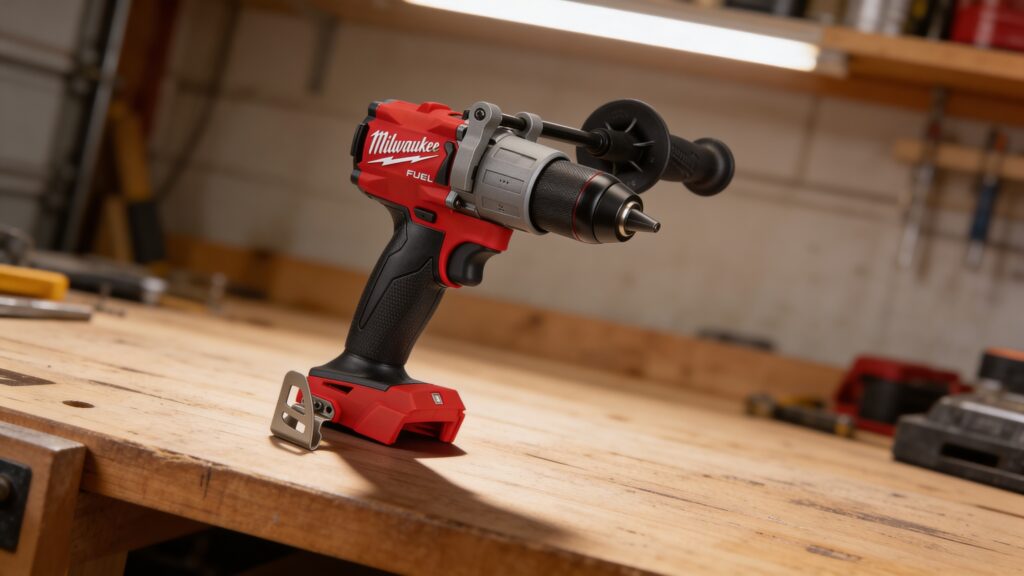
What Makes Hammer Drills Different from Rotary Drills

Hammer drills and rotary drills are often grouped together because both spin a bit to create a hole, yet their internal systems operate on fundamentally different mechanical principles. The confusion typically stems from surface similarity rather than structural design. A rotary drill relies on continuous rotational force alone, while a hammer drill integrates a secondary mechanism that introduces axial impact energy alongside rotation.

This explainer outlines how each system generates motion, how impact force is produced, and how the internal components differ in structure and function. By examining gear assemblies, cam mechanisms, and energy transfer, the reader will gain a clear understanding of impact versus rotary action and the mechanical distinctions that define each tool category.

By: Review Streets Research Lab
Updated: April 20, 2026
Explainer · 8–12 min read
Hammer drill and rotary drill side by side drilling into concrete and wood, showing impact mechanism difference
What You’ll Learn

Impact vs Rotary Mechanisms Explained

A focused breakdown of how rotational motion and axial impact are generated, transmitted, and controlled inside two fundamentally different drilling systems.

  • How continuous rotation is produced inside a standard rotary drill
  • How cam or ratcheting mechanisms generate axial impact motion
  • How rotational and percussive forces combine in hammer systems
  • What internal components separate impact-capable drills from rotary-only designs
  • How energy transfer differs between spinning and hammering actions
  • Why impact frequency and stroke length influence material interaction
  • How mode selection engages or disengages the hammer mechanism

Tip: Visualize rotary drills as continuous torque systems and hammer drills as torque systems with added linear impact pulses.

Definitions

Key Parts That Separate Impact and Rotary Action

To distinguish these drill systems, it helps to define the parts that generate motion, shape force paths, and determine whether impact energy is added to rotation.

Rotary Drive Path

The linked set of components that turns motor output into steady bit rotation. In a rotary drill, this path stays continuous and uninterrupted through the load.

  • Continuity: Rotation is delivered as a constant, smooth torque stream
  • Reduction: Gearing trades speed for torque while keeping motion purely rotational
  • Stability: Alignment and stiffness help maintain a consistent rotation axis

Impact Mechanism

An internal system that converts rotation into repeated axial impulses along the bit axis. It adds short bursts of linear energy while rotation continues.

  • Conversion: A cam or ratchet turns spin into forward-and-back motion
  • Pulses: Impacts arrive as discrete events rather than continuous force
  • Engagement: The mechanism activates only when axial resistance reaches a threshold

Cam Plate Pair

A matched set of ridged discs that ride against each other under spring pressure. Their ramps cause rapid separation and re-contact, producing axial impacts.

  • Geometry: Ramp shape governs how abruptly the plates slip and strike
  • Preload: Spring force controls contact pressure and impact initiation
  • Wear: Surface finish and hardening influence consistency over time

Gear Reduction Stage

A gear train that transforms high-speed motor rotation into usable spindle rotation. In hammer systems, it also provides the rotation that drives the impact mechanism.

  • Ratio: Reduction sets the balance between spindle speed and available torque
  • Load path: Gear interfaces transmit force and can introduce backlash or noise
  • Coupling: The output stage links to the spindle and, when present, the hammer drive

Spindle and Bit Interface

The rotating output shaft and its clamping system that transfers motion into the bit. It must handle torsion and, in hammer mode, repeated axial shocks.

  • Concentricity: The spindle’s alignment governs how true the bit rotates
  • Clamping: Jaw pressure and contact area determine how securely the bit is held
  • Shock handling: Axial impacts add cyclic loading to the interface surfaces

Axial Impact Energy

The linear energy delivered along the drilling axis during each strike. It is created by moving mass and contact events, not by torque alone.

  • Stroke: Travel distance sets how much kinetic energy can build
  • Frequency: Impacts per minute define how often energy is delivered
  • Transfer: Contact stiffness and damping determine how much reaches the bit

Tip: Think in force directions: rotary drills deliver torque around the axis, while hammer systems add repeated force pulses along the axis.

Power Path

How Rotary and Impact Motion Travel Through the Drive Train

Both systems begin with the same rotating power source, but they route that rotation differently at the output stage. The branching point is where axial impacts are either created or excluded.

  • The motor produces continuous rotation that enters the gear reduction stages
  • The gearbox sets spindle speed and torque by changing rotational ratios
  • In rotary-only systems, rotation couples directly to the spindle and bit interface
  • In hammer systems, rotation also drives a mechanism that generates axial impulses
  • The spindle transmits torque and, when engaged, repeated linear shock loads

The system behavior reflects whether the drive train remains purely rotational or adds a second, axial force path.

Motors

How the Motor’s Rotation Becomes the Input for Two Different Actions

The motor supplies rotational energy that can be used directly for drilling or used as the driver for an impact mechanism. The key difference is what the downstream components do with the motor’s rotation.

  • Motor output is a continuous torque stream delivered through the drive shaft
  • Rotary systems pass that torque through gearing into steady spindle rotation
  • Hammer systems use the same rotation to cycle cam plates or a ratcheting interface
  • Speed under load influences how frequently an impact mechanism can cycle

Motor rotation is common to both designs, while the action at the bit is defined downstream.

Gearing

How Gear Reduction Sets the Conditions for Impact and Rotary Operation

Gear trains do more than change speed; they determine how torque and rotation arrive at the spindle. In hammer designs, gearing also provides the rotational input needed to repeatedly reset the impact cycle.

  • Reduction ratios shape spindle speed, which governs drilling kinematics at the bit
  • Higher torque at the output increases contact forces within the drive interfaces
  • Backlash and compliance affect how smoothly torque is delivered under changing load
  • In hammer mode, gear output must sustain rotation while impacts interrupt axial motion

Gearing controls how rotation is conditioned before it becomes either steady drilling motion or a driver for repeated impacts.

Heat Management

How Impact Cycling Changes Where Heat Builds Up

Heat comes from losses in electrical components and from friction at mechanical interfaces. When impacts are added, contact events and repeated loading introduce additional friction and stress concentrations.

  • Electrical losses in the motor and controller rise as current increases under resistance
  • Gears generate heat through sliding contact, especially under high torque transfer
  • Impact mechanisms add friction from cam plate slip, contact, and repeated separation
  • Axial shock loads can increase bearing and interface losses at the spindle assembly

Thermal limits reflect both electrical inefficiencies and the mechanical friction created by continuous rotation or repeated impact cycling.

User Control

How Reaction Forces Differ Between Continuous Rotation and Impact Pulses

The user experiences the system through reaction torque and axial impulses transmitted back through the housing. Adding impacts changes the timing and direction of forces, not just their magnitude.

  • Rotary drilling produces a relatively continuous reaction torque opposing bit rotation
  • Hammer action introduces repeated axial pulses that can modulate bit engagement
  • Mode switching changes which internal elements are coupled to the spindle
  • Compliance in grips and housings can damp or transmit shock depending on stiffness

What feels like “action” at the hands is the combined effect of torque reaction and any axial pulses generated inside the mechanism.

Quick Reality Check

Where Impact and Rotary Action Differ

A quick reality check on how steady rotation and impact pulses behave under resistance, and why each system has predictable constraints.

Continuous Rotation Characteristics

Rotary action delivers a smooth, uninterrupted torque path that keeps the bit spinning consistently as long as the drive train can maintain speed.

Under increasing resistance, the system responds by drawing more current and slowing, with heat rising in the motor, controller, and gears as torque demand climbs.

Impact Pulse Characteristics

Hammer action adds rapid axial pulses that momentarily increase contact force at the cutting edge while the spindle continues to rotate through the mechanism.

When resistance is low the hammer stage may not meaningfully cycle, and when loads are sustained the repeated slip and contact events add friction and heat.

Common Myths

Misconceptions About Impact and Rotary Action

Because both tools spin a bit, their internal systems are often treated as interchangeable, even though the force paths are fundamentally different.

Hammer mode is just faster spinning

Hammer action is not additional rotational speed; it is a separate mechanism that creates axial impulses while rotation continues. The key change is the addition of repeated linear force events along the bit axis.

Impact action is always active in hammer drills

Many hammer mechanisms only cycle meaningfully when axial resistance builds and the cam or ratchet interface begins to slip and re-contact. Under light loads, the drill can behave much like a rotary system.

Hammer action replaces the need for torque

Axial impulses do not eliminate the need for rotational force, because the bit still has to shear material by turning. Hammer mechanisms add a second energy component, but torque remains the driver of cutting motion.

More vibration means more effective hammering

Vibration is an external sensation, not a direct measure of impact energy at the bit. Effective hammering depends on stroke, frequency, and contact stiffness, while excess vibration can come from imbalance, backlash, or compliance.

Rotary drills cannot handle high resistance

Rotary systems can transmit substantial torque through gearing, but they rely on continuous rotation without axial impulses to help break static friction at the cutting edge. Under certain resistive conditions, the limitation is the force direction, not the presence of rotation.

Tip: Treat the distinction as directional physics: rotary systems supply torque around an axis, while hammer systems add timed force pulses along that axis.

FAQ

Frequently Asked Questions About Impact vs Rotary Action

Clear answers to common points of confusion about how hammer mechanisms add axial impulses, and how that differs from pure rotary drilling systems.

What actually separates a hammer drill from a rotary drill?

The difference is an added internal mechanism that converts rotation into repeated axial impulses along the bit axis. A rotary drill transmits torque through a continuous rotational drive path without generating those impact pulses.

Does hammer action change rotation speed at the bit?

Hammer action primarily adds axial impulses rather than increasing rotational speed. Bit speed is still set by motor output, gearing, and load, while hammer cycling rate depends on how the mechanism slips, resets, and re-contacts under resistance.

What does “impacts per minute” actually represent mechanically?

It describes how often the impact mechanism completes a strike cycle, which is driven by rotation through a cam or ratcheting interface. The number reflects cycle frequency, while actual energy per strike depends on stroke, contact stiffness, and preload forces.

Why can hammer mode feel similar under light drilling loads?

Many hammer mechanisms only produce meaningful impacts when axial resistance rises enough for the cam plates or ratchet surfaces to slip and re-engage. With low resistance, the system can remain mostly in smooth rotation with minimal impact cycling.

How do mode selectors change what happens internally?

Mode selection changes coupling: it either engages the impact elements so they can cycle under load or locks them out so torque flows directly to the spindle. The underlying motor and gearing remain, but the axial impact path is either active or bypassed.

What’s the key mechanical role of torque in both systems?

Torque is the rotational force that drives cutting by turning the bit against material resistance. Hammer action can help overcome static friction by adding axial pulses, but rotation still does the shearing work, and torque sets how well rotation is maintained under load.

Why can hammer drilling increase vibration and noise?

Repeated impacts create discrete contact events that transmit shocks through the spindle, bearings, and housing. Vibration and noise are side effects of cyclic loading and interface slip, and their intensity depends on impact frequency, damping, and mechanical clearances.

What limits impact action during sustained heavy drilling?

Limits often come from heat and friction: the impact interface repeatedly slips and re-contacts, generating additional losses, while the motor and controller also heat as current rises under resistance. As temperatures increase, protective controls may reduce output and the mechanism can cycle less consistently.

Tip: When the behavior changes, trace the force path first—steady torque around the axis versus added axial pulses—then consider heat and friction as the usual limiters.

Bottom Line

Rotary drills deliver torque continuously, while hammer drills add timed axial pulses. That added impact mechanism changes how forces enter the bit, especially when resistance makes pure rotation slip or slow.

With this mental model, it becomes easier to interpret sound, vibration, and slowdown as predictable results of force direction, friction, and heat within the system.

Next Steps

Go Deeper or Compare Your Options

Now that you understand how hammer drills differ from rotary drills, these pages help you explore options, compare tool types, and choose based on real-world needs.

Hammer Drill Roundups

An organized overview of hammer drill options across common use cases, helping you understand how different features align with materials, drilling demands, and project types.

Hammer Drill Comparisons

A side-by-side look at two tools, highlighting differences in impact action, drilling behavior, size, and control to clarify how each performs in practice.

Hammer Drill Buying Guides

A practical guide that explains which features, drilling capabilities, and jobsite factors matter most when selecting the right hammer drill for your work.

Quick Summary

Impact vs Rotary Action

  • Rotary drills deliver continuous torque through a direct drive path
  • Hammer drills add axial pulses using cam or ratchet mechanisms
  • Impact cycling depends on resistance to engage and sustain motion
  • Torque drives cutting, while impacts help overcome static friction
  • Heat and friction limit sustained performance in both systems