What Makes Office Machines Different from Barcode Equipment

Office machines and barcode equipment may both print or scan, but they organize work around different units. Office machines handle complete pages, copies, document packets, communications, finishing, and other general administrative jobs. Barcode equipment creates or captures compact machine-readable identifiers that drive item, location, asset, or shipment transactions.

The distinction is structural rather than a feature checklist. It shapes media paths, ergonomics, device management, software context, error handling, and completion evidence. A multifunction device can recognize a barcode and a label printer can print text, yet neither incidental ability changes the primary artifact or operating workflow it is designed to serve.

By: Review Streets Research Lab
Updated: September 1, 2026
Explainer · 8-12 min read
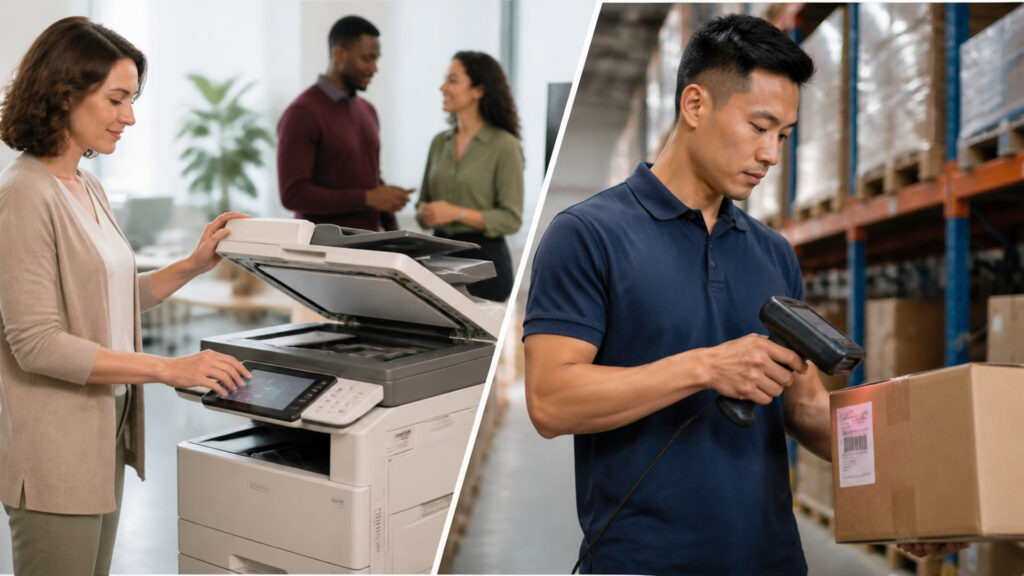
Editorial business scene illustrating office machines and barcode equipment
What You'll Learn

Following Office Machines and Barcode Equipment From Office Document to Rugged Endpoint

Trace one office document through finishing task, barcode symbol, and transaction validation, then test rugged endpoint against operational event.

  • Comparing the Primary Artifact
  • Comparing Device Design
  • Comparing Software Context
  • Comparing Feedback and Completion
  • Choosing the Boundary by Work Unit
  • How barcode symbol changes the conclusion

Tip: Choose a real office document; record its source, state, responsible equipment architect, exception route, and final evidence in the equipment comparison record.

Definitions

Terms That Keep Office Machines and Barcode Equipment Mechanisms Separate

These definitions prevent office machines, barcode equipment, and shared device from becoming one vague idea.

Office machines

Shared devices for general document output, capture, reproduction, finishing, communication, or disposal.

  • Here, office machines serve page-centered administrative work.
  • Its limit is that it are not optimized for constant item transactions.
  • Verify human-readable output before the equipment architect relies on it in the equipment comparison record.

Barcode equipment

Printers, scanners, imagers, and mobile computers designed around machine-readable identifiers.

  • Here, barcode equipment connects physical items to structured records.
  • Its limit is that it does not preserve or finish general documents.
  • Verify barcode symbol before the equipment architect relies on it in the equipment comparison record.

General page

A sheet whose complete human-readable text, graphics, layout, or image carries meaning.

  • Here, general page anchors office-document work.
  • Its limit is that it is broader than one encoded field.
  • Verify encoded payload before the equipment architect relies on it in the equipment comparison record.

Encoded payload

The controlled characters represented by a barcode symbology.

  • Here, encoded payload supplies a lookup key or compact data.
  • Its limit is that it needs contextual validation.
  • Verify item identifier before the equipment architect relies on it in the equipment comparison record.

Shared device

Equipment serving multiple users and varied jobs through queues, panels, drivers, or reservations.

  • Here, shared device consolidates capabilities.
  • Its limit is that it can create contention.
  • Verify transaction validation before the equipment architect relies on it in the equipment comparison record.

Operational event

A validated receive, move, pick, count, issue, or ship action committed after a scan.

  • Here, operational event changes business state.
  • Its limit is that it is not equivalent to producing a page.
  • Verify rugged endpoint before the equipment architect relies on it in the equipment comparison record.

Tip: Keep office machines distinct from barcode equipment; they control different transitions and failure meanings.

Comparing

Comparing the Primary Artifact

Office machines handle complete pages, packets, copies, finished sets, communications, or disposed materials; barcode equipment handles compact identifiers and item-level events.

  • Name the equipment architect responsible for office document
  • Retain the source establishing general page
  • Record copy job as a separate state
  • Route uncertain finishing task into an owned artifact mismatch
  • Validate human-readable output against independent barcode symbol evidence
  • Preserve the equipment comparison record when encoded payload is corrected

This mechanism closes only when human-readable output, the originating fact, the equipment architect's decision, and every material artifact mismatch agree in the equipment comparison record.

Comparing

Comparing Device Design

Trays, duplexers, document feeders, marking engines, finishers, and shared panels differ from scan engines, rugged housings, mobile batteries, label paths, triggers, and aiming systems.

  • Name the equipment architect responsible for general page
  • Retain the source establishing copy job
  • Record finishing task as a separate state
  • Route uncertain shared device into an owned artifact mismatch
  • Validate barcode symbol against independent encoded payload evidence
  • Preserve the equipment comparison record when item identifier is corrected

This mechanism closes only when barcode symbol, the originating fact, the equipment architect's decision, and every material artifact mismatch agree in the equipment comparison record.

Comparing

Comparing Software Context

Office jobs use drivers, document workflows, address books, secure release, and repositories; barcode jobs use symbology decoding, item lookup, station context, validation, and operational applications.

  • Name the equipment architect responsible for copy job
  • Retain the source establishing finishing task
  • Record shared device as a separate state
  • Route uncertain human-readable output into an owned artifact mismatch
  • Validate encoded payload against independent item identifier evidence
  • Preserve the equipment comparison record when transaction validation is corrected

This mechanism closes only when encoded payload, the originating fact, the equipment architect's decision, and every material artifact mismatch agree in the equipment comparison record.

Comparing

Comparing Feedback and Completion

Office work closes on released pages, accepted files, finished sets, or verified disposal; barcode work closes on validated, committed, reconciled system events.

  • Name the equipment architect responsible for finishing task
  • Retain the source establishing shared device
  • Record human-readable output as a separate state
  • Route uncertain barcode symbol into an owned artifact mismatch
  • Validate item identifier against independent transaction validation evidence
  • Preserve the equipment comparison record when rugged endpoint is corrected

This mechanism closes only when item identifier, the originating fact, the equipment architect's decision, and every material artifact mismatch agree in the equipment comparison record.

Choosing

Choosing the Boundary by Work Unit

General pages and varied administrative jobs favor office machines, while repeated physical-object identification and immediate state changes favor barcode equipment.

  • Name the equipment architect responsible for shared device
  • Retain the source establishing human-readable output
  • Record barcode symbol as a separate state
  • Route uncertain encoded payload into an owned artifact mismatch
  • Validate transaction validation against independent rugged endpoint evidence
  • Preserve the equipment comparison record when operational event is corrected

This mechanism closes only when transaction validation, the originating fact, the equipment architect's decision, and every material artifact mismatch agree in the equipment comparison record.

Quick Reality Check

What Office Machines and Barcode Equipment Evidence Can—and Cannot—Prove

The model can expose how finishing task, shared device, and human-readable output connect. It cannot invent missing facts, make unsupported decisions, or turn rugged endpoint into universal proof.

Evidence That Makes finishing task Defensible

A stable office document identifier preserves the initiating fact through correction and rework.

A reconciled shared device equipment comparison record shows whether transaction validation reached its intended state.

Limits Beyond the barcode symbol Mechanism

Local rules, materials, environments, contracts, and professional judgment can change the appropriate encoded payload treatment.

A successful rugged endpoint milestone cannot prove the source was complete, authorized, readable, or substantively correct.

Common Myths

Misconceptions About Office Machines and Barcode Equipment

These misconceptions confuse visible office document activity with the independent controls required at shared device, encoded payload, and rugged endpoint.

Does visible office document prove finishing task is correct?

No. office document and finishing task establish different facts in office machines and barcode equipment. The equipment architect must connect them through the equipment comparison record, test barcode symbol, and route any artifact mismatch before relying on the result.

Can successful human-readable output close the entire process?

No. human-readable output proves one stage. Preserve encoded payload, transaction validation, and final operational event evidence, including failed attempts and authorized recovery. Check general page against copy job. Assign finishing task review to a named owner.

Is item identifier only a device setting?

No. item identifier affects interpretation, ownership, and evidence surrounding rugged endpoint. Configuration enforces rules, while the equipment architect still owns exceptions and change. Check copy job against finishing task. Assign shared device review to a named owner.

Does rugged endpoint guarantee the outcome?

No. rugged endpoint is a milestone, not proof that every input and handoff is complete. Reconcile it with authoritative operational event before closing the equipment comparison record. Check finishing task against shared device.

Tip: Challenge a universal claim by locating its general page source, artifact mismatch route, and transaction validation completion evidence.

FAQ

Frequently Asked Questions About Office Machines and Barcode Equipment

These implementation questions assign authority for office document, separate states, route barcode symbol failures, and test the rugged endpoint handoff.

Which source should control office document?

Use the authoritative request, record, or observed artifact establishing office document. Retain its identifier, version, owner, time, and correction route in the equipment comparison record. Check shared device against human-readable output.

Which states need independent timestamps?

Track copy job, finishing task, human-readable output, and encoded payload separately. A finishing task transition needs its trigger, identity, source reference, failure meaning, and reversal rule. Check human-readable output against barcode symbol.

How should a barcode symbol problem be handled?

Create an owned artifact mismatch with the affected identifier, state, evidence, impact, remedies, and closure test. Preserve the earlier event instead of overwriting it. Check barcode symbol against encoded payload.

What must reconcile before rugged endpoint is accepted?

Compare originating office document, intermediate shared device, recorded item identifier, acknowledgments, exceptions, and authoritative operational event. Separate timing, duplication, mapping, version, and omission. Check encoded payload against item identifier. Assign transaction validation review to a named owner.

When should the design be changed?

Redesign when office document lacks an owner, barcode symbol has no exception route, or operational event needs recurring reconstruction. In office machines and barcode equipment, that pattern signals a failing boundary.

Bottom Line

Office machines serve page-centered, shared administrative jobs. Barcode equipment serves identifier-centered physical operations and rapid validated transactions.

Choose by the work unit, environment, feedback requirement, application context, and evidence of completion—not by whether both devices can technically print or capture a symbol.

Next Steps

Continue Beyond Office Machines and Barcode Equipment

Use the adjacent explainer for the next human-readable output boundary, or browse the direct category for systems sharing office document and operational event.

Office Machines

Browse the direct Office Machines category for related systems involving office document, barcode symbol, and rugged endpoint.

Quick Summary

Office Machines and Barcode Equipment Explained

  • Office document establishes the starting fact.
  • Finishing task has an independent completion test.
  • Barcode symbol changes the downstream decision.
  • Transaction validation needs retained authority and evidence.
  • Rugged endpoint must reconcile with operational event.