What Makes Right-Angle Drills Different from Inline Drills

Right-angle drills solve a physical problem that conventional inline drills cannot always overcome: the tool body needs room behind the bit. By turning the drive axis 90 degrees to the grip, a right-angle drill can line up with fasteners and holes inside cabinets, between joists, around plumbing, and in other spaces where a straight drill is simply too long.

That change in shape affects more than access. It also changes how the gearbox fits, how the tool reacts under load, where the operator can brace it, and which compromises appear in speed, chuck capacity, comfort, and heavy-duty performance. Understanding those differences makes it easier to choose the right form factor instead of treating a right-angle model as a smaller version of an ordinary drill.

By: Review Streets Research Lab
Updated: June 15, 2026
Explainer · 8-12 min read
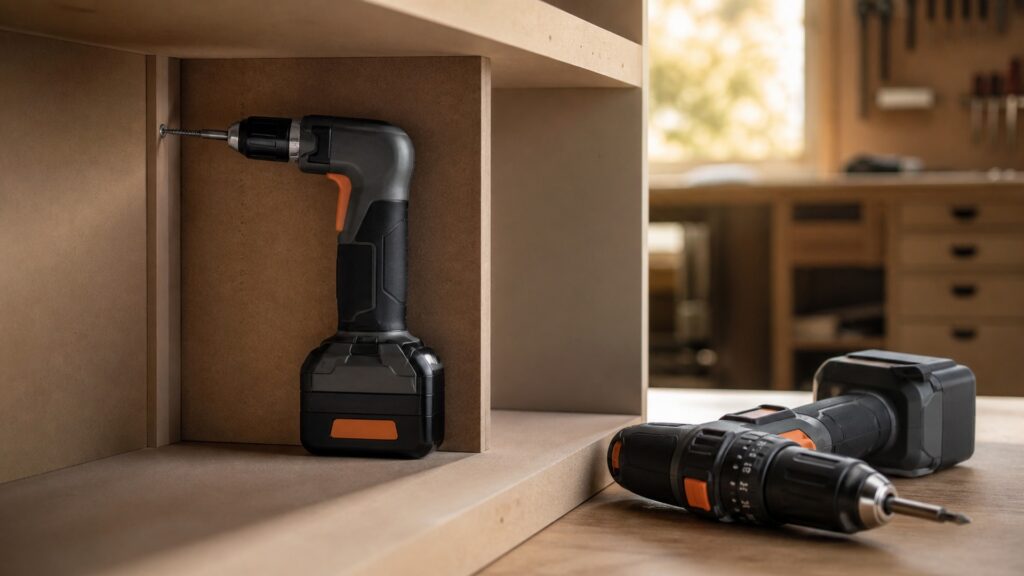
Right-angle drill reaching a cabinet fastener beside a conventional inline drill
What You'll Learn

How a 90-Degree Drive Changes the Tool

A practical comparison of head geometry, clearance, gearing, control, and workload between right-angle and conventional inline drills.

  • Why the bit axis sits across the grip instead of in line with it
  • How head height and body length determine access in tight spaces
  • Why compact access does not automatically mean higher power
  • How the internal gear train redirects motor rotation through 90 degrees
  • Why torque reaction can feel different when the tool is side-loaded
  • How keyed, keyless, and hex chucks affect overall clearance
  • When an inline drill remains faster, easier to brace, or more versatile

Tip: Read the concept as part of a system, then connect it back to the use case.

Definitions

Key Concepts That Define Right-Angle Drills

These definitions connect the main idea to the variables, limits, and practical signals readers need to compare options.

Right-Angle Drive

A drivetrain that turns the chuck or bit axis 90 degrees relative to the motor and grip.

  • Purpose: Places the working axis across the tool body
  • Benefit: Reduces the space needed behind the bit
  • Tradeoff: Requires additional gearing and a wider head

Inline Drill

A conventional drill-driver with the motor, gearbox, chuck, and bit arranged along a mostly straight front-to-back axis.

  • Strength: Natural forward pressure and two-handed bracing
  • Versatility: Common chuck sizes and broad accessory support
  • Limit: Needs clearance behind the chuck and body

Head Height

The distance from the bit axis to the outermost edge of the drill head, which determines whether the tool can work near a wall or inside a narrow bay.

  • Lower profile: Reaches closer to surrounding surfaces
  • Chuck effect: Short chucks can reduce the working envelope
  • Measurement: More useful than total tool length for side clearance

Bevel Gear Set

A pair of angled gears that redirects motor rotation through a corner inside many right-angle drill heads.

  • Function: Changes the direction of rotation
  • Load: Transfers torque through extra gear contact
  • Design effect: Adds complexity, width, and some mechanical loss

Chuck Format

The mechanism that holds the bit, commonly a three-jaw chuck or a compact quarter-inch hex holder.

  • Three-jaw chuck: Accepts round and hex shanks
  • Hex holder: Shorter and faster for compatible bits
  • Clearance: Chuck length can matter as much as head size

Torque Reaction

The force that tries to rotate the tool body opposite the bit when resistance rises or a bit binds.

  • Inline feel: Reaction is often centered around the grip
  • Right-angle feel: The offset head can create side leverage
  • Control: Bracing and auxiliary handles matter under heavy load

Tip: Keep the definitions connected; the strongest answer usually comes from the whole system, not one term.

How It Works

How Rotation Turns a Corner Inside a Right-Angle Drill

The motor still spins around its own shaft, but the chuck cannot sit directly in front of it. A compact gear stage redirects that rotation through 90 degrees before it reaches the bit.

  • The motor produces rotational speed along the tool body
  • Reduction gears adjust speed and multiply torque for the selected range
  • A bevel or similar right-angle gear pair changes the axis of rotation
  • The spindle and chuck deliver that rotation across the grip
  • Bearings and the head housing keep the redirected load aligned

The angled drivetrain creates access, but every extra gear interface must be engineered to handle load, heat, wear, and backlash.

Clearance

Why Shape Matters More Than Overall Size

An inline drill may be compact from chuck to battery, yet it still needs nearly its full body length behind the bit. A right-angle drill shifts most of that mass below or beside the working axis, so the critical dimension becomes head height rather than rear clearance.

  • Cabinet interiors often block a straight drill before the bit reaches the screw
  • Joist and stud bays leave side room but little room behind the hole
  • A short hex holder can reach where a full three-jaw chuck cannot
  • Battery shape and grip length still affect access from below
  • Flexible or right-angle attachments can help occasionally but add length and play

For tight-space work, compare the complete working envelope with the intended bit installed, not just the tool's advertised length.

Gearing

How the Angled Gear Train Changes Speed and Capacity

Redirecting rotation adds components between the motor and chuck. Manufacturers balance those components for compactness, durability, speed, and torque, which is why right-angle drills vary widely from light installation drivers to large low-speed trade tools.

  • Compact models often prioritize access and controlled fastening
  • Heavy-duty versions may use lower speeds and stronger reduction gearing
  • Extra gear contact can introduce small efficiency losses and mechanical noise
  • Chuck size may be limited to keep the head compact
  • A right-angle shape alone does not reveal torque or drilling capacity

Rated speed, chuck capacity, clutch design, and manufacturer workload guidance tell more about capability than the 90-degree shape by itself.

Load and Heat

Why Tight Access Does Not Remove Workload Limits

A right-angle drill can reach a difficult hole, but the bit still demands the same cutting force. Large spade bits, hole saws, and binding fasteners can produce high current draw and heat while creating a strong reaction at the offset head.

  • Dull bits increase load and heat in both drill types
  • Long continuous cuts can warm the motor, battery, and gear case
  • Compact housings have limited room to spread and shed heat
  • Binding can twist the tool suddenly around the bit axis
  • Heavy boring calls for a model specifically rated for that work

Access and capacity are separate questions: first confirm the tool fits, then confirm it is designed for the diameter, material, and duty cycle.

Control Feel

How Grip Position Changes Bracing and Torque Reaction

With an inline drill, the hand sits behind the bit and naturally pushes along the drilling axis. A right-angle drill places the grip below or beside that axis, which helps it fit but can make alignment and reaction forces feel less intuitive.

  • Use a stable stance and keep the wrist out of the likely reaction path
  • Brace the housing or auxiliary handle when the design allows it
  • Start slowly so the bit establishes a straight path
  • Avoid forcing the tool when a bit begins to bind
  • Use the inline drill when open access makes straight pressure easier

Right-angle drills reward deliberate positioning; their advantage is access, while an inline drill usually offers the more natural general-purpose stance.

Quick Reality Check

Where Right-Angle Drills Shine and Where Inline Drills Stay Better

The two layouts overlap, but each is strongest when its geometry matches the space and workload.

What Right-Angle Drills Do Well

They reach fasteners and drilling points inside cabinets, framing bays, mechanical spaces, and close to adjacent surfaces where a straight tool cannot align.

Their low-profile working head can reduce the need for extensions, flexible shafts, or awkward hand-tool work during installation and repair.

Where Inline Drills Have the Advantage

In open space, inline drills usually make it easier to apply straight pressure, use two hands, see the bit, and switch among a wider range of chucks and accessories.

A compact right-angle model may offer less speed, chuck capacity, or sustained-load capability than a similarly priced general-purpose drill, so it should not be assumed to replace one.

Common Myths

Misconceptions About Right-Angle Drills

Common shortcuts and misunderstandings can make the topic seem simpler than it is.

A right-angle drill is simply an inline drill with a bent housing

The drive path is mechanically different. Internal gears redirect rotation, and the offset working axis changes clearance, load paths, balance, and torque reaction.

Right-angle drills are always less powerful

Some compact models are built for light fastening, but heavy-duty right-angle drills are designed for demanding boring. Power and capacity depend on the motor, gearing, battery, chuck, and duty rating, not shape alone.

A right-angle attachment is the same as a dedicated drill

An attachment can solve occasional access problems, but it adds length, joints, and possible play. A dedicated tool generally offers better integration, control, durability, and trigger placement for repeated tight-space work.

The smallest head is automatically the best choice

A lower-profile head improves access, but the smallest tool may sacrifice chuck versatility, speed range, leverage, or workload capacity. The best choice is the smallest design that still handles the intended work.

The right-angle shape prevents kickback

The bit can still bind, and the offset head may give the reaction force more leverage on the housing. Proper bracing and a tool rated for the task remain important.

Tip: Treat strong claims as starting points for comparison, not final answers.

FAQ

Frequently Asked Questions About Right-Angle Drills

Concise answers to common questions readers may have after the main explanation.

What is the main difference between a right-angle drill and an inline drill?

The chuck axis on a right-angle drill sits at 90 degrees to the grip and motor area, reducing the clearance needed behind the bit. An inline drill keeps the drivetrain arranged front to back.

Can a right-angle drill replace a regular drill?

It can handle many drilling and fastening jobs, but most users will find an inline drill more comfortable and versatile in open spaces. A right-angle drill is usually a specialist or complementary tool.

Are right-angle drills good for drilling through studs and joists?

They are useful where framing limits access, but the model must be rated for the bit diameter and material. Large holes may require a heavy-duty low-speed right-angle drill with strong bracing features.

Should I choose a three-jaw chuck or a quarter-inch hex holder?

Choose a three-jaw chuck for round-shank drill bits and broader versatility. Choose a hex holder when compactness, quick bit changes, and screwdriving with compatible bits matter most.

Is a right-angle adapter enough for occasional work?

Often, yes. An adapter is economical for infrequent light-duty access. Repeated work, higher loads, or very tight spaces usually favor a dedicated right-angle drill.

What dimensions should I compare before buying?

Compare head height, distance from the chuck face to the back of the head, chuck length, battery position, and the total envelope with the intended bit installed.

Bottom Line

Right-angle drills are different because they reorganize the drivetrain around access: the bit turns across the grip, letting the tool work where an inline body cannot fit.

That 90-degree layout also changes gearing, bracing, balance, chuck options, and workload tradeoffs. Choose it for constrained spaces, but keep an inline drill in the picture when open access, straight pressure, broad versatility, and general-purpose comfort matter more.

Next Steps

Go Deeper or Compare Your Options

Use these Review Streets paths to connect the explainer to related categories, comparisons, and next decisions.

Right Angle Drills

Explore the Right Angle Drills category for related explainers, comparisons, and buying context.

Drills

Compare drill types and learn which designs fit different fastening and drilling jobs.

Home & Living

Browse broader Home & Living reviews and practical product guidance.

Quick Summary

Right-Angle Drills Explained

  • The chuck axis turns 90 degrees relative to the grip.
  • Head height replaces rear body length as the key clearance measurement.
  • Angled gearing redirects rotation and adds design complexity.
  • The offset head changes leverage and torque reaction under load.
  • Compact access does not automatically indicate power or capacity.
  • Inline drills remain more natural for most open-space work.