
Accessory Role
Accessory role is the practical job a small piece of running gear performs during a run.
- Example: holding a phone, adding reflectivity, or blocking sun
- Check: name the problem the item solves
- Limit: not every accessory helps every run
Running accessories and running hydration gear overlap, but they are not the same category. Running accessories is the broader group: belts, lights, phone holders, hats, gloves, storage pieces, reflectors, and small support items. Running hydration gear is the narrower group focused on carrying and accessing fluids.
The difference matters because a runner may need storage, visibility, weather coverage, or comfort without needing a bottle, vest, or flask. Hydration gear becomes the better fit when fluid access is the main problem the run needs to solve.
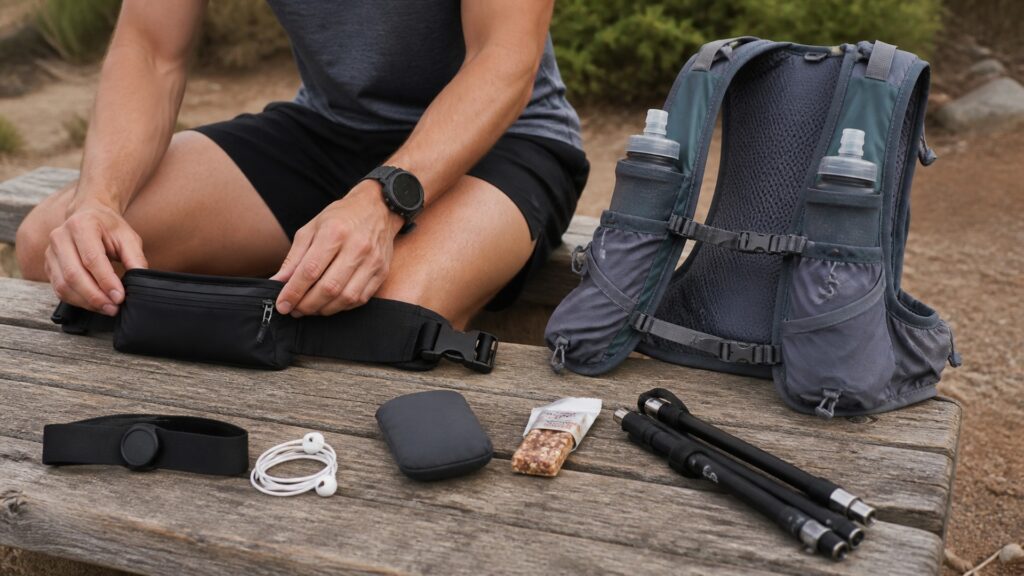
A practical comparison of broad running support items and fluid-carrying equipment.
Tip: Separate the run's support problem from the hydration problem before choosing gear.
These concepts clarify where the categories overlap and where they split.
Accessory role is the practical job a small piece of running gear performs during a run.
Hydration role is the job of carrying or accessing fluids during training.
Carry capacity is how much gear or fluid the setup can hold.
Access while moving is how easily the runner can reach an item without stopping.
Route dependence is how much the gear choice changes with distance, refill access, light, traffic, and weather.
Fit under load is how stable the item remains once it carries real weight.
Tip: Hydration gear is one kind of running support, but not every support problem is a hydration problem.
Running accessories can solve many small problems: storage, visibility, sun protection, cold-weather coverage, phone access, or comfort. Hydration may be one of those needs, but it is not the whole category.
The broader category is about practical support during the run.
Running hydration gear is more specific. Bottles, flasks, reservoirs, vests, and hydration belts exist because the runner needs fluid during the session.
Hydration gear earns its place when fluid access affects the run.
A running vest or belt may carry water, fuel, keys, and a phone. That makes it both an accessory and hydration gear when fluid carrying is part of the setup.
The same item can play different roles on different days.
If the run is limited by heat, distance, or lack of refill access, hydration gear may be the priority. If the issue is visibility, phone storage, weather, or comfort, a general accessory may solve it better.
The limiting factor should choose the category.
More gear can make running less comfortable. A short route with water access may need no hydration gear, while a dark route may need lighting more than fluid capacity.
Useful gear should reduce friction, not add it.
Hydration gear is a specific support tool inside the broader running accessory world.
The runner needs visibility, storage, weather coverage, comfort, or phone access.
The run does not require carrying much fluid.
Distance, heat, route, or workout duration make fluid access important.
The setup needs bottles, flasks, reservoirs, or a hydration vest.
The broader category and the hydration-specific category should not be treated as identical.
Many accessories handle visibility, storage, weather, or comfort without carrying fluid.
Heat, route access, and personal needs can make hydration useful before a run feels long.
Extra capacity can add bounce, heat, and weight when the run does not need it.
They can overlap, but capacity, access, bounce, and weather feel can differ a lot.
Tip: Choose hydration gear only when fluid access is part of the run's problem.
Short answers for choosing the right support setup.
Yes. They are running accessories, but they are more specifically hydration gear when fluid carrying is the main job.
Use hydration gear when distance, heat, route access, or workout duration makes drinking during the run important.
Yes, if the belt carries what you need and the run does not require much fluid.
Check bounce, access, load, weather, and whether the run actually needs fluid carrying.
Running accessories solve many support problems; hydration gear solves the fluid-access part of that wider category.
Running accessories differ from running hydration gear because accessories cover many support jobs while hydration gear focuses on carrying and accessing fluids.
The right choice depends on whether the run needs general support or a specific fluid-carrying setup.
Use these Review Streets paths to compare related categories and practical next decisions.
See how running gear solves practical training problems.
Explore the running accessories category.
Compare related running gear categories.
Choose a retailer
Prices checked regularly. We may earn a commission at no cost to you.