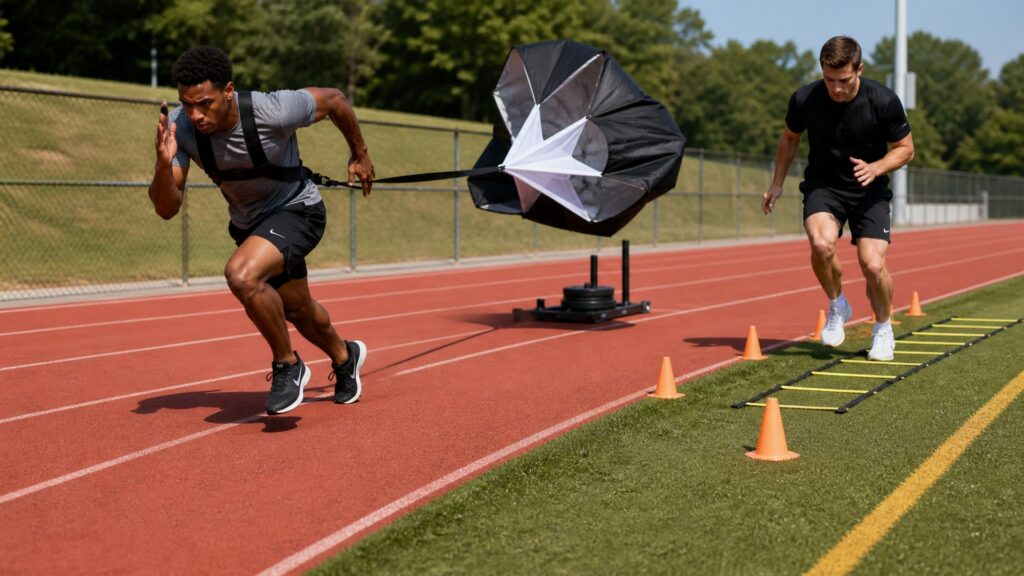
What Makes Speed Training Equipment Different from Agility Training Equipment

Speed training equipment is different from agility training equipment because it focuses more directly on acceleration, sprint mechanics, top-speed exposure, resisted sprinting, timing, and repeatable fast efforts. Agility training equipment focuses more on direction changes, foot placement, reaction paths, spacing, and movement decisions.

The categories often sit next to each other in athletic training, but they are not identical. Speed tools ask how fast the athlete can move with quality. Agility tools ask how well the athlete can change, organize, or respond to movement demands.

By: Review Streets Research Lab
Updated: October 5, 2026
Explainer · 8-12 min read
speed training equipment explainer hero image for Review Streets
What You'll Learn

Speed Gear Versus Agility Gear

A practical comparison of sprint-focused tools and direction-change tools.

  • How speed equipment supports acceleration and sprint mechanics
  • How agility equipment organizes footwork and change of direction
  • Where timing, spacing, and reaction overlap
  • Why resisted sprinting is not the same as agility work
  • When a program needs both categories

Tip: Compare the outcome first: faster output or better movement decisions.

Definitions

Key Concepts Behind Speed Training Equipment Different from Agility Training Equipment

These concepts clarify the practical signals readers should check before choosing equipment or planning workouts.

Speed Equipment

Speed equipment supports fast linear movement, acceleration, sprint mechanics, or timing feedback.

  • Example: sleds, timing gates, wickets, bands, and parachutes
  • Check: ask whether the tool improves sprint quality
  • Limit: speed tools may not train decision-making or cuts

Agility Equipment

Agility equipment organizes direction changes, foot placement, reaction, and spatial cues.

  • Example: cones, ladders, hurdles, and marker systems
  • Check: ask whether the tool improves movement decisions or paths
  • Limit: agility tools do not automatically improve sprint speed

Acceleration Focus

Acceleration focus trains how quickly the athlete reaches speed from a start.

  • Example: short sled sprints
  • Check: watch first-step power and body angle
  • Limit: acceleration is only one part of athletic movement

Change Of Direction

Change of direction is the ability to brake, turn, and reaccelerate.

  • Example: cone shuttle drills
  • Check: look at deceleration and body control
  • Limit: fast footwork is not always effective agility

Timing Feedback

Timing feedback measures speed over a set distance or drill.

  • Example: timing gates on a 20-yard sprint
  • Check: keep test conditions consistent
  • Limit: timing does not explain every technical issue

Reaction Path

A reaction path makes the athlete respond to a cue or changing direction.

  • Example: reactive cone callouts
  • Check: match the cue to the training goal
  • Limit: reaction drills can lose speed quality if overcomplicated

Tip: The best equipment choice is the one that matches the training job, available space, and user's current ability.

Main Difference

Speed Tools Prioritize Fast Output

Speed training equipment usually aims at faster starts, cleaner sprint mechanics, resisted acceleration, or better measurement. The work is often linear and repeatable so performance can be compared.

  • Use speed tools for acceleration and sprint quality.
  • Keep drills repeatable enough to measure.
  • Rest enough to preserve fast efforts.

Speed equipment is strongest when fast output is the central goal.

Agility Role

Agility Tools Organize Direction And Decisions

Agility equipment uses markers, hurdles, ladders, cones, and cues to shape where the athlete moves and how they change direction. The goal is not always maximum straight-line speed.

  • Use agility gear for foot placement and path changes.
  • Train braking and reacceleration deliberately.
  • Add reaction only when the athlete can move cleanly.

Agility tools make movement decisions visible.

Overlap

Some Drills Need Both Categories

A program may use speed equipment for acceleration and agility equipment for change of direction in the same session. The categories overlap when the athlete needs to move fast and respond to space.

  • Separate the goal of each drill.
  • Use timing when speed is the key measure.
  • Use markers when path or decision quality matters.

Overlap works best when each tool keeps a clear role.

Buying Choice

Buy For The Limitation You Need To Fix

If the athlete lacks acceleration or sprint feedback, speed equipment is the clearer first choice. If the athlete needs direction-change practice, spacing, or reaction cues, agility equipment may be more useful.

  • Identify the main limitation.
  • Choose tools that directly address it.
  • Avoid buying both categories just to look complete.

The limitation should decide the purchase.

Practical Check

Look At The Drill Outcome

The simplest distinction is the outcome being trained. Speed drills ask for faster, cleaner output over a set path. Agility drills ask for better movement decisions, transitions, or changes of direction.

  • Use speed tools when time and sprint quality are central.
  • Use agility tools when path and reaction are central.
  • Combine only when both outcomes are planned.

The outcome tells you which category is doing the work.

Quick Reality Check

Where Speed Gear Wins And Where Agility Gear Wins

The categories are complementary, not interchangeable.

Speed Gear Wins When

The goal is acceleration, sprint mechanics, resisted speed, or timing feedback.

The drill needs repeatable fast output over a known path.

Agility Gear Wins When

The goal is direction change, reaction, spacing, or foot placement.

The drill needs movement decisions rather than only straight-line speed.

Common Myths

Misconceptions About Speed And Agility Gear

Athletic-looking tools can still train different qualities.

Speed and agility equipment are the same thing

They overlap, but speed tools emphasize fast output while agility tools organize movement choices.

Agility ladders build sprint speed by themselves

They can support foot rhythm, but sprint speed needs force, mechanics, and recovery.

Timing gates are only for advanced athletes

Timing can help any level when the setup is consistent and the data is used carefully.

Every athlete needs both immediately

The first purchase should match the biggest training gap.

Tip: Treat strong claims as reasons to inspect the workout fit more closely.

FAQ

Frequently Asked Questions About Speed Versus Agility Equipment

Short answers for practical training and buying decisions.

What is the biggest difference?

Speed equipment focuses on sprint output and timing. Agility equipment focuses on direction, reaction, and footwork organization.

Can speed tools improve agility?

They can support acceleration and force qualities, but they do not replace direction-change practice.

Can agility tools improve speed?

They can improve coordination, but they do not replace sprint mechanics and speed-specific training.

Which should I buy first?

Buy the category that fixes the clearest limitation in the athlete's training.

What is the practical takeaway?

Use speed gear for fast output and measurement. Use agility gear for direction changes and movement decisions.

Bottom Line

Speed training equipment differs from agility training equipment by emphasizing sprint output, acceleration, mechanics, and timing.

Agility equipment is better for direction changes, spatial cues, reaction, and foot placement.

Next Steps

Go Deeper or Compare Your Options

Use these Review Streets paths to compare related categories and practical next decisions.