What Makes Store Fixtures Different from Office Machines

Store fixtures and office machines are both business equipment, but they organize work around different physical boundaries. Fixtures create continuing support, containment, presentation, security, and access for merchandise through connected components and store space. Office machines process bounded document or material jobs such as printing, copying, scanning, finishing, binding, laminating, or shredding.

That difference changes users, duty cycles, failure physics, controls, maintenance, and completion evidence. A fixture remains exposed to loading and interaction between inspections; an office machine repeatedly begins and ends identifiable tasks. Sharing power, networks, casters, service vendors, or a store location does not make those operating roles interchangeable.

By: Review Streets Research Lab
Updated: September 2, 2026
Explainer · 8-12 min read
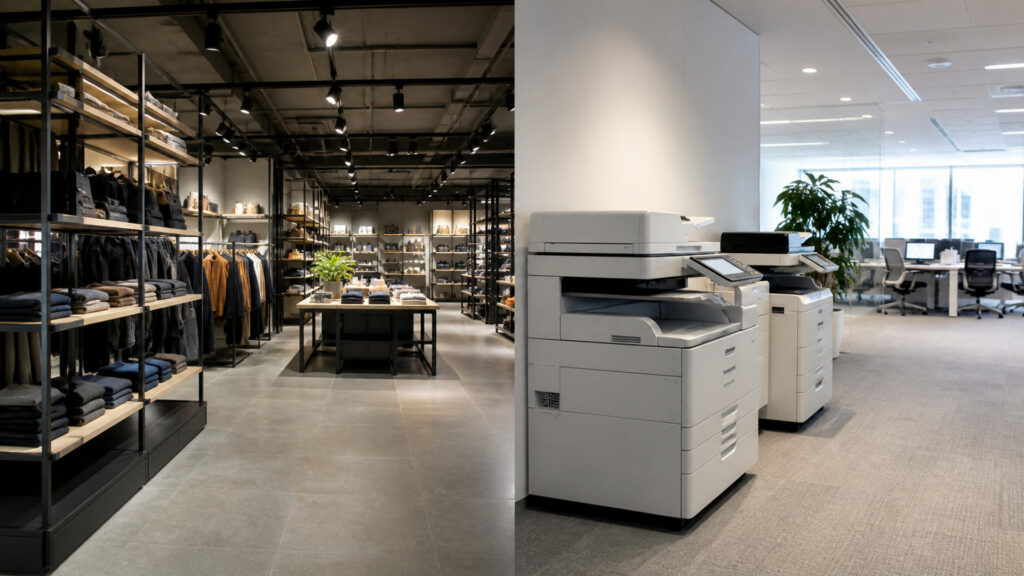
Editorial business scene illustrating store fixtures and office machines
What You'll Learn

The Control Path Behind Store Fixtures and Office Machines

Follow physical assembly into anchor system, test the result at document job, and require capture destination to reconcile with job completion.

  • Comparing Operating Purpose
  • Comparing Components and Physics
  • Comparing User Interaction
  • Comparing Controls and Maintenance
  • Comparing Completion Evidence
  • How document job changes the conclusion

Tip: Select one real physical assembly case and mark every source, owner, version, state, exception, and completion artifact in the equipment classification file.

Definitions

Six Operating Boundaries for Store Fixtures and Office Machines

These definitions separate store fixture, load path, and access zone so adjacent equipment or software layers do not inherit unsupported claims.

Store fixture

An installed or mobile assembly that supports, contains, secures, presents, or makes merchandise accessible.

  • Its bounded operating role is that it creates continuing physical capacity.
  • Its evidence cannot cross this limit: it requires condition governance.
  • The equipment classification owner should verify document job before applying this definition to a live case.

Office machine

Equipment that performs a bounded document or material task such as printing, copying, scanning, faxing, finishing, binding, laminating, or shredding.

  • Its bounded operating role is that it transforms defined inputs.
  • Its evidence cannot cross this limit: it normally closes discrete jobs.
  • The equipment classification owner should verify operator input before applying this definition to a live case.

Load path

The route by which weight and applied forces move through fixture components into bases, walls, or floors.

  • Its bounded operating role is that it determines structural behavior.
  • Its evidence cannot cross this limit: it depends on configuration.
  • The equipment classification owner should verify processing mechanism before applying this definition to a live case.

Document job

An identifiable request to transform, reproduce, route, finish, or destroy pages or related material.

  • Its bounded operating role is that it organizes office-machine work.
  • Its evidence cannot cross this limit: it does not define structural capacity.
  • The equipment classification owner should verify page output before applying this definition to a live case.

Access zone

The clear space needed for shopping, stocking, mobility, doors, drawers, carts, service, and emergencies.

  • Its bounded operating role is that it keeps fixtures usable.
  • Its evidence cannot cross this limit: it persists between interactions.
  • The equipment classification owner should verify capture destination before applying this definition to a live case.

Job completion

Evidence that the requested office-machine transformation reached its intended output or destination.

  • Its bounded operating role is that it closes a bounded task.
  • Its evidence cannot cross this limit: it does not prove future availability.
  • The equipment classification owner should verify job completion before applying this definition to a live case.

Tip: Require independent evidence for store fixture and office machine; neither term can certify the other's outcome.

Comparing

Comparing Operating Purpose

Store fixtures provide continuing structural and spatial capacity; office machines perform discrete transformations of documents or materials for an operator or application.

  • Locate the authority for physical assembly
  • Name the accountable owner of merchandise support
  • Capture independent evidence for load path
  • Test anchor system under a credible failure
  • Reconcile access zone against condition inspection
  • Retain history when document job changes

Close this stage only when physical assembly, the decision affecting anchor system, and independent condition inspection evidence agree in the equipment classification file. Record the unresolved assumption and review owner.

Comparing

Comparing Components and Physics

Fixtures rely on shelves, brackets, uprights, frames, bases, anchors, fasteners, ratings, and clearances; office machines rely on feeds, optics, marking, controllers, cutters, rollers, and destinations.

  • Locate the authority for merchandise support
  • Name the accountable owner of load path
  • Capture independent evidence for anchor system
  • Test access zone under a credible failure
  • Reconcile condition inspection against document job
  • Retain history when operator input changes

Close this stage only when merchandise support, the decision affecting access zone, and independent document job evidence agree in the equipment classification file. Name the trigger that would reopen this decision.

Comparing

Comparing User Interaction

Shoppers and staff continuously load, touch, reach, lean on, open, close, or move around fixtures; users submit, feed, release, collect, or supervise office-machine jobs.

  • Locate the authority for load path
  • Name the accountable owner of anchor system
  • Capture independent evidence for access zone
  • Test condition inspection under a credible failure
  • Reconcile document job against operator input
  • Retain history when processing mechanism changes

Close this stage only when load path, the decision affecting condition inspection, and independent operator input evidence agree in the equipment classification file. Keep the local condition that constrained approval.

Comparing

Comparing Controls and Maintenance

Fixtures use configuration records, installation checks, load limits, inspections, damage isolation, and repair approval; office machines use job settings, queues, service intervals, supplies, diagnostics, and safety procedures.

  • Locate the authority for anchor system
  • Name the accountable owner of access zone
  • Capture independent evidence for condition inspection
  • Test document job under a credible failure
  • Reconcile operator input against processing mechanism
  • Retain history when page output changes

Close this stage only when anchor system, the decision affecting document job, and independent processing mechanism evidence agree in the equipment classification file. Preserve the counterexample evaluated during review.

Comparing

Comparing Completion Evidence

Fixture readiness requires a safe current condition throughout service; an office-machine task normally closes with verified output, capture, finishing, communication, or destruction evidence.

  • Locate the authority for access zone
  • Name the accountable owner of condition inspection
  • Capture independent evidence for document job
  • Test operator input under a credible failure
  • Reconcile processing mechanism against page output
  • Retain history when capture destination changes

Close this stage only when access zone, the decision affecting operator input, and independent page output evidence agree in the equipment classification file. Identify the evidence owner after handoff.

Quick Reality Check

Operational Evidence for Store Fixtures and Office Machines

Good evidence can connect anchor system, access zone, and condition inspection to a defined result. It cannot create missing source facts or convert capture destination into proof of every earlier decision.

Evidence That Makes anchor system Credible

A versioned physical assembly record preserves the initial condition through configuration, execution, exception, and correction.

Independent condition inspection evidence shows whether page output reached the intended physical, network, or application outcome.

What capture destination Cannot Establish Alone

Local demand, configuration, policy, staffing, environment, and dependencies can change the correct treatment for operator input.

A completed capture destination cannot establish that the source, authority, current state, and downstream record were all correct.

Common Myths

Misconceptions About Store Fixtures and Office Machines

These misconceptions allow visible physical assembly activity to stand in for control over access zone, operator input, and capture destination.

Does visible physical assembly prove anchor system is correct?

No. physical assembly and anchor system establish different facts in store fixtures and office machines. The equipment classification owner must connect them through the equipment classification file, test document job, and route any equipment category error before accepting the result.

Can successful condition inspection close the whole process?

No. condition inspection proves one bounded condition. Preserve independent evidence for operator input, page output, and final job completion, including failures, authorized exceptions, and recovery. Check merchandise support against load path.

Is processing mechanism only a configuration detail?

No. processing mechanism changes interpretation, responsibility, and evidence surrounding capture destination. Configuration can enforce rules, while the equipment classification owner remains accountable for approval, exceptions, and change. Check load path against anchor system.

Does capture destination guarantee the intended outcome?

No. capture destination is a milestone, not proof that every source, handoff, and physical or logical state is correct. Reconcile it with authoritative job completion before closing the equipment classification file.

Tip: Ask which source established merchandise support, who owns the equipment category error, and which independent artifact confirms page output.

FAQ

Frequently Asked Questions About Store Fixtures and Office Machines

These answers assign physical assembly, separate nearby states, define document job recovery, and reconcile page output with the final record.

Which source should control physical assembly?

Use the authoritative request, record, measurement, or observed artifact establishing physical assembly. Retain its identifier, version, owner, time, affected location or service, and correction route in the equipment classification file.

Which states need separate timestamps?

Track load path, anchor system, condition inspection, and operator input independently. A anchor system transition needs its trigger, identity, source reference, failure meaning, and reversal rule. Check condition inspection against document job.

How should a document job problem be handled?

Open an owned equipment category error containing the affected asset or service, observed state, evidence, impact, permitted remedy, deadline, and closure test. Preserve the event that exposed it. Check document job against operator input.

What must reconcile before capture destination is accepted?

Compare originating physical assembly, intermediate access zone, recorded processing mechanism, acknowledgments, exceptions, and authoritative job completion. Investigate timing, duplication, omission, mapping, version, and condition separately. Check operator input against processing mechanism.

When should the design be changed?

Redesign when physical assembly lacks an owner, document job has no recovery route, or job completion requires repeated reconstruction. In store fixtures and office machines, that pattern identifies a broken boundary.

Bottom Line

Store fixtures provide continuing structural and spatial capacity for merchandise and retail interaction. Office machines execute bounded document or material transformations.

Govern fixtures through configuration, ratings, installation, access, inspection, damage, and repair; govern office machines through job inputs, mechanisms, destinations, servicing, safety, and completion evidence.

Next Steps

Continue From the Condition Inspection Boundary

Use the neighboring explainer when the next decision changes processing mechanism, or browse the direct category for systems sharing physical assembly and job completion.

Store Fixtures

Browse the direct Store Fixtures category for related systems involving physical assembly, document job, and capture destination.

Quick Summary

Store Fixtures and Office Machines Explained

  • Physical assembly starts the controlled record.
  • Anchor system needs independent evidence.
  • Document job changes the recovery path.
  • Page output retains a named owner.
  • Capture destination reconciles with job completion before closure.