What Makes Subscription Billing Platforms Different from Cloud Accounting Software

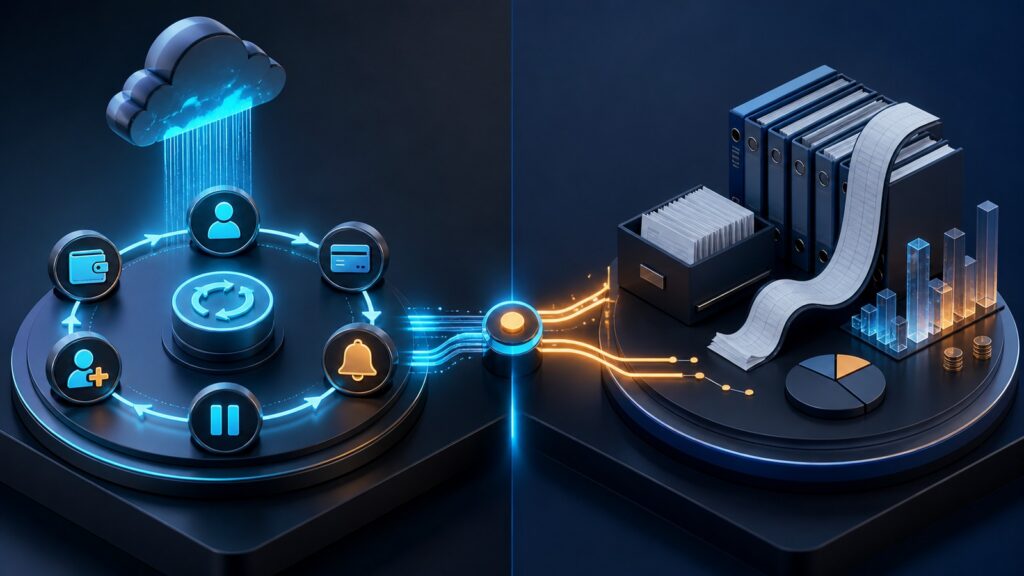
Subscription billing platforms determine what a recurring customer should be charged as plans, quantities, usage, and payment conditions change. Cloud accounting software organizes the business’s financial records, including customer balances, expenses, bank activity, and reporting. Both may create invoices and record payments, but those shared documents do not make the products equivalent.

The distinction is one of emphasis, not a universal feature boundary. Accounting products can support recurring invoices, automatic payments, and more advanced billing modules. Subscription platforms can provide financial reports and accounting connections. The useful comparison is whether the chosen product can manage the business’s changing customer agreements and still produce the complete financial records it needs.

By: Review Streets Research Lab
Updated: September 25, 2026
Explainer · 8-12 min read
Editorial business scene illustrating subscription billing platforms and cloud accounting software
What You'll Learn

Compare the Recurring Customer Agreement with the Financial Record

Look beyond the invoice screen to understand what each category manages before and after a charge.

  • Distinguish a subscription record from a ledger entry or customer balance.
  • Compare repeating a fixed invoice with calculating changing subscription charges.
  • Understand why renewal dates and accounting periods serve different purposes.
  • Separate payment recovery and product access from financial reporting.
  • Recognize overlapping capabilities in integrated accounting products.
  • Plan a handoff that avoids duplicate invoices and missing adjustments.

Tip:Choose a customer who changed plans during a period. Compare how each product explains the new charge, the payment result, and the resulting financial records.

Definitions

Six Concepts That Separate Billing from Accounting

Shared terms such as invoice and payment become clearer when the record’s purpose is explicit.

Subscription State

Subscription state records the current arrangement for an ongoing customer service.

  • Purpose: It helps determine future billing and relevant service changes.
  • Example: A customer has eight seats on a monthly plan with a scheduled downgrade.
  • Limit: A running subscription does not prove that every associated invoice has been paid.

Recurring Invoice

A recurring invoice is a bill produced repeatedly under a configured schedule.

  • Purpose: It reduces repeated entry for predictable charges.
  • Example: A business sends the same monthly service invoice until the arrangement changes.
  • Limit: A basic repeating bill may not handle complex usage or mid-period amendments without additional features.

Rating

Rating calculates a charge from applicable prices, quantities, usage, and other configured rules.

  • Purpose: It determines the amount that belongs on a bill.
  • Example: Measured usage above an included allowance produces an additional charge.
  • Limit: Calculation quality depends on correct source data and pricing rules.

Accounts Receivable

Accounts receivable records amounts customers owe the business and how those balances are settled or adjusted.

  • Purpose: It supports collection review and financial recordkeeping.
  • Example: An issued invoice remains outstanding until a payment or other valid adjustment is applied.
  • Limit: A balance alone may not explain the product configuration that created the charge.

General Ledger

The general ledger organizes financial transactions by account for accounting and reporting.

  • Purpose: It brings together activity from customers, suppliers, cash, and other parts of the business.
  • Example: Accounting records connect a customer payment with the relevant balances and bank activity.
  • Limit: A ledger is not, by itself, a detailed history of every subscription feature or usage event.

Entitlement

An entitlement defines the service features or access available to a customer.

  • Purpose: It lets the product respond to the agreed subscription arrangement.
  • Example: An upgrade enables a reporting feature from the approved effective date.
  • Limit: Product access and accounting treatment answer different questions and should not be inferred from one unexplained status.

Tip:Ask whether a record explains the customer agreement, the bill, the collection attempt, or the financial treatment. A single screen may combine several of these views.

Starting Point

Billing Starts with What the Customer Subscribed To

A subscription platform follows the ongoing agreement: product, price, quantity, renewal date, and planned changes. That information can explain the next charge before an invoice exists. Accounting follows financial activity across the business, including much more than subscription customers.

  • Identify the record that controls the next renewal.
  • Check where agreed changes and their effective dates are stored.
  • Separate subscription quantities from the resulting invoice amounts.
  • Confirm how the accounting product represents the broader business.

For a software customer adding three seats, billing needs to know when the seats start and whether a partial-period charge applies. Accounting needs the resulting financial records, but the ledger alone may not contain the operational detail needed to calculate the change.

Charge Calculation

Repeating a Bill Is Not Always Enough to Price a Subscription

A fixed recurring invoice can be an excellent fit for a stable service fee. More complex subscriptions may combine included usage, overage charges, discounts that expire, quantities that change, or upgrades partway through a period. The question is whether the product supports those rules reliably.

  • Test the actual pricing model instead of counting invoice features.
  • Review how usage is measured and assigned to a billing period.
  • Preview supported amendments and prorations.
  • Check what happens when a discount ends at renewal.

A business charging a constant monthly maintenance fee may be well served by recurring invoicing in accounting software. A service whose charges vary with customer consumption may need a billing engine, whether that engine is standalone or part of an accounting suite.

Time and Status

Renewal Dates and Accounting Periods Do Different Work

A customer’s subscription can renew on the anniversary of signup, while the business reviews financial results using its accounting periods. Billing also distinguishes draft invoices, issued invoices, and payment outcomes. Those statuses should not be collapsed into a single financial conclusion.

  • Retain the service period represented by each charge.
  • Distinguish an invoice being issued from money being collected.
  • Preserve the dates needed for the business’s accounting treatment.
  • Investigate timing differences instead of forcing unrelated totals to match.

An annual invoice may collect payment for service extending beyond the current reporting period. The invoice amount, cash received, and revenue reported can differ under the applicable accounting basis and policies. Billing records should support that treatment rather than substitute for it.

Daily Work

Billing Coordinates Renewal Behavior; Accounting Covers the Books

Subscription operations include payment-method updates, failed-renewal follow-up, plan changes, and customer access. Accounting also deals with costs, suppliers, bank reconciliation, and financial reports. A billing dashboard may be useful to the subscription team without being a complete picture of the business.

  • Check the recovery path for a failed renewal payment.
  • Define how the product receives access changes.
  • Include income and expenses outside the subscription service in accounting.
  • Give staff the information appropriate to their responsibilities.

A support agent may need to explain why a customer’s renewal is pending. A bookkeeper may need to explain a bank deposit containing many collected invoices and fees. Both views are valuable, but neither replaces the other’s job.

Working Together

Choose One Source for Each Record and Verify the Handoff

When two systems are used, decide which one creates the invoice, which one processes collection, and how the resulting records enter accounting. Unclear ownership can produce duplicate invoices, unmatched credits, or a payment recorded twice after a bank import.

  • Keep customer, invoice, payment, and adjustment references connected.
  • Test the transfer of credits and refunds as well as ordinary sales.
  • Confirm how grouped payouts and processing fees are represented.
  • Review exceptions where the receiving system rejects or changes a record.

The best arrangement may be a single integrated product or a connected pair. The result should be the same: one explainable bill, a traceable payment history, and complete financial records without repeated manual reconstruction.

Quick Reality Check

Different Responsibilities with Genuine Feature Overlap

Judge the actual product and configuration rather than assuming that category names define hard boundaries.

Subscription Billing Emphasis

Manage changing recurring agreements, calculate charges, and coordinate collection and relevant service events.

Keep the customer’s billing history understandable through renewals, amendments, and cancellations.

Cloud Accounting Emphasis

Maintain financial records across the business and support balances, bank reconciliation, and reporting.

Offer recurring invoicing or payment capabilities where available, sometimes through additional billing modules.

Common Myths

Misconceptions About Billing Platforms and Cloud Accounting

The most common mistakes come from treating shared features as proof that two products do the same job.

Cloud accounting cannot support subscriptions

Some products handle recurring invoices and payments, and some suites include substantial subscription features. Evaluate the required scenario and available module rather than excluding a category.

A subscription platform replaces all accounting work

Billing does not automatically cover supplier costs, every bank transaction, or the business’s full financial reporting needs. Check the complete scope before deciding what can be retired.

A paid invoice means all related records are complete

Payment may still need to be matched with fees, payouts, and accounting entries. Product access or a customer-service issue can also require a separate update.

A billing revenue chart is automatically the accounting revenue figure

Operational metrics can use different definitions and timing from financial reports. Understand the calculation and the business’s accounting treatment before comparing the numbers.

Tip:Compare outputs using a defined question. “What will this customer be billed?” and “What does the financial report show?” may correctly have different answers.

FAQ

Frequently Asked Questions About Subscription Billing and Cloud Accounting

Answers for businesses deciding whether one product or connected systems best fit their recurring revenue model.

When can recurring invoices in accounting software be enough?

They may be enough when charges and schedules are predictable, amendments are infrequent, and payment handling meets the business’s needs. Test exceptions as well as a normal renewal before relying on that arrangement.

What is the strongest reason to add a billing platform?

A recurring charge requires operational detail or repeated manual calculation that the current product does not handle well. Examples include measured usage, frequent quantity changes, or coordinated self-service upgrades. Confirm the gap in the actual software first.

Should both systems create customer invoices?

Usually the business should choose one source for each invoice and a defined method for representing it in the other system. Independent creation without matching references can cause duplicate documents and balances.

Can a subscription product provide accounting-related reports?

Yes. It may report invoices, payments, subscription metrics, or other financial information. The question is whether those reports cover the required accounting scope and use the appropriate definitions, not whether they contain monetary amounts.

What should an integration test include?

Trace a renewal, a plan change, a failed payment, a credit or refund, and the bank payout. Confirm that each record is linked, transferred once, and interpreted correctly by the receiving system.

Bottom Line

Subscription billing manages the changing agreement that creates recurring charges; cloud accounting manages the wider financial record.

Their capabilities overlap, so choose from real billing scenarios and reporting needs. If both are used, make record ownership and reconciliation explicit.

Next Steps

Compare One Renewal and One Mid-Period Change

Follow the agreement, calculation, invoice, payment, and accounting result in each candidate setup. Note which steps are automatic and which require manual interpretation.