
Plate Load
Plate load is the amount of removable weight added to a bar, machine, sled, or storage system.
- Example: adding two 10 lb plates to a barbell
- Check: confirm the total load includes both sides
- Limit: plates need compatible equipment
Weight plates differ from kettlebells because plates are removable loads for bars, machines, sleds, and storage systems, while kettlebells are self-contained hand-held weights. Plates are best at changing the load of compatible equipment; kettlebells are best at being the implement in the user's hands.
The difference affects exercise choice. Plates support barbell loading, machine loading, and heavy progression. Kettlebells support swings, carries, cleans, presses, and other grip-centered movements where the shape and handle matter.
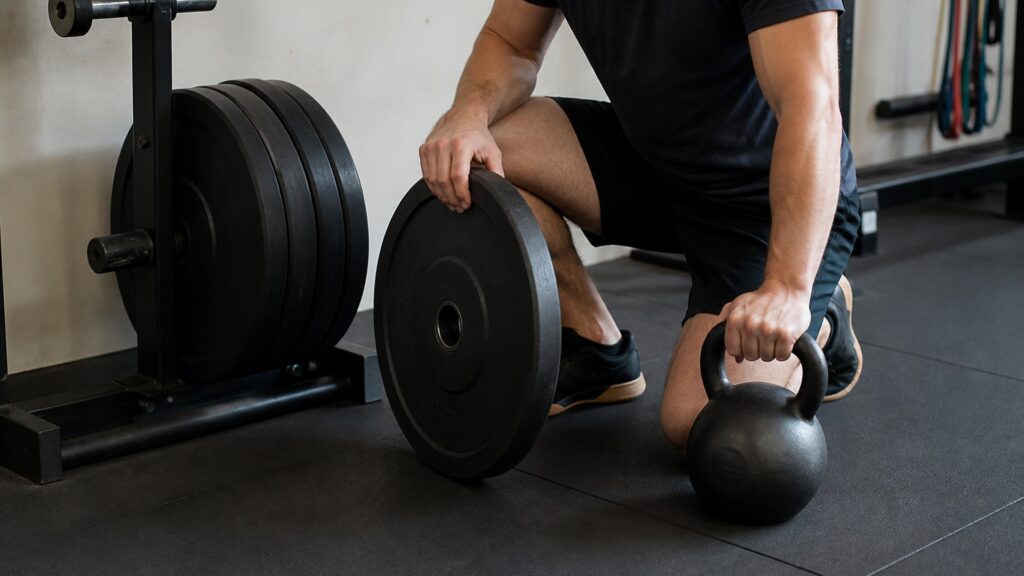
A practical comparison of equipment loading, hand-held movement, progression, storage, and workout role.
Tip: Choose plates to load equipment and kettlebells when the weight itself is the implement.
These concepts explain why plates and kettlebells feel and function differently.
Plate load is the amount of removable weight added to a bar, machine, sled, or storage system.
Sleeve diameter is the size of the bar or machine post the plate fits on.
Increment is the smallest useful weight change available.
Grip cutout is an opening or handle shape that makes a plate easier to carry.
Calibration is how closely a plate matches its labeled weight.
Storage fit is how well plate size, thickness, and quantity work in the room.
Tip: The right equipment choice depends on how resistance is created, adjusted, and repeated.
Plates are designed to add weight to bars, machines, sleds, and similar equipment. They are part of a larger loading system.
A plate is usually not the whole exercise tool.
A kettlebell has a handle and offset mass. That makes it useful for swings, carries, cleans, presses, and grip-focused training.
The kettlebell's shape is its advantage.
A plate set can build large loads on a bar or machine and can use small increments for gradual changes.
Plates are strong when load needs to scale.
For swings, rack positions, carries, and one-hand drills, a kettlebell is usually easier and safer to hold than a flat plate.
Shape matters during dynamic movement.
If the exercise loads a bar, machine, or sled, plates make sense. If the exercise is done with the weight in hand, kettlebells often fit better.
The exercise role decides the tool.
The tools are built for different jobs.
The user needs adjustable loading for bars, machines, sleds, or landmines.
The goal requires scalable heavy resistance.
The user needs a handle, offset mass, or dynamic hand-held movement.
The exercise is a swing, carry, clean, or rack-position drill.
The shapes are not interchangeable for most uses.
Some plate drills work, but the grip and shape are different.
Kettlebells are complete hand-held implements.
Plates can load machines, sleds, landmines, and other compatible tools.
The right tool is the one that matches the movement and load need.
Tip: Use plates for scalable equipment loading and kettlebells for hand-held movement.
Short answers for practical equipment and training decisions.
Plates are removable loads for equipment; kettlebells are self-contained hand-held weights.
Only for some simple drills. They usually do not handle as well for swings, cleans, and carries.
Use plates for barbells, machines, sleds, and scalable equipment loading.
Use kettlebells when the handle and offset mass are part of the exercise.
Choose plates for loading systems and kettlebells for hand-held movement patterns.
Weight plates differ from kettlebells because plates add load to equipment while kettlebells are the exercise implement.
Plates scale equipment loading; kettlebells handle dynamic hand-held movement better.
Use these Review Streets paths to compare related categories and practical next decisions.
Explore the weight plates category.
Review plate loading and setup basics.
Compare related strength-training equipment.
Choose a retailer
Prices checked regularly. We may earn a commission at no cost to you.