
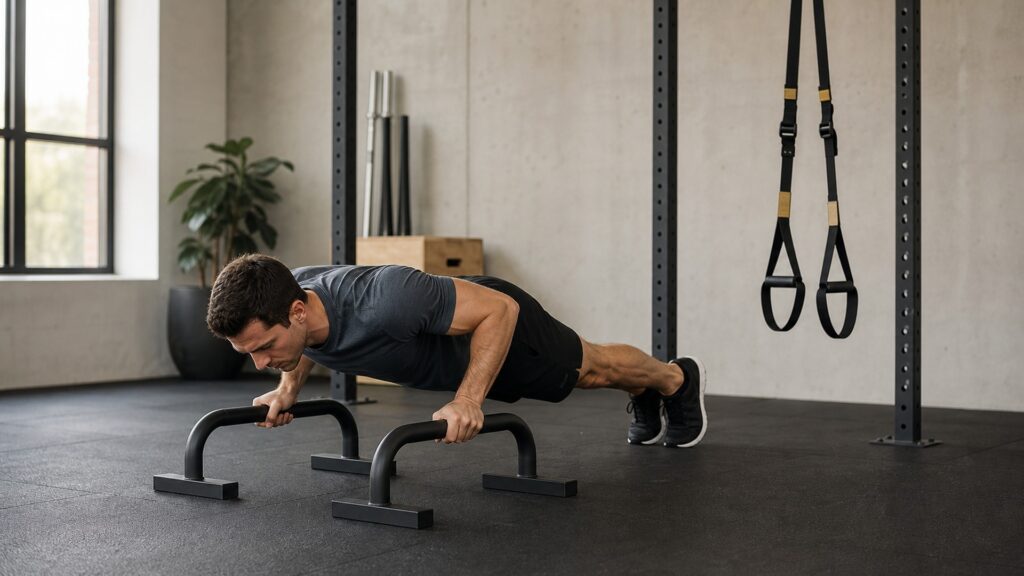
When to Use Bodyweight Training Equipment Instead of Functional Suspension Training

Use bodyweight training equipment instead of functional suspension training when the workout needs stable supports, fixed bars, floor-based tools, or simpler progression. A pull-up bar, push-up handle, dip station, parallettes, ab wheel, or slider can be easier to set up and repeat than straps or rings.

Functional suspension training is powerful when adjustable straps, handles, and body angle are the point. Bodyweight equipment is often better when the user wants less swinging, clearer support, a fixed station, or movements that do not depend on an anchor point.

By: Review Streets Research Lab
Updated: October 2, 2026
Explainer · 8-12 min read
bodyweight training equipment explainer hero image for Review Streets
What You'll Learn

When Stable Bodyweight Tools Are The Better Fit

A practical decision path for choosing bars, handles, stations, sliders, and wheels over suspension straps.

  • When fixed supports beat adjustable suspension straps
  • Why setup, anchor points, and stability change the choice
  • Where suspension training remains the better option
  • How beginners can use simpler bodyweight tools first
  • Which movements need bars, handles, wheels, or sliders
  • How to combine both categories without duplicating gear

Tip: Choose stable bodyweight tools when control and setup simplicity matter more than strap adjustability.

Definitions

Key Concepts Behind The Bodyweight-First Choice

These concepts explain why fixed bodyweight tools and suspension training are not the same setup.

Bodyweight Training Equipment

Bodyweight training equipment supports exercises where the user's body provides the main resistance.

  • Example: pull-up bars, parallettes, dip stations, sliders, or ab wheels
  • Check: see whether the tool gives stable support or a useful body position
  • Limit: some tools offer less angle adjustability than straps

Functional Suspension Training

Functional suspension training uses anchored straps or rings so the user can train against body angle and instability.

  • Example: suspension rows or strap-assisted squats
  • Check: confirm the anchor point is safe and the angle can be adjusted
  • Limit: instability can be too much for some movements

Fixed Support

Fixed support is a stable surface or bar that does not swing during the exercise.

  • Example: a pull-up bar during hanging knee raises
  • Check: test grip, height, and load rating
  • Limit: fixed support may offer fewer exercise angles

Anchor Dependence

Anchor dependence is the need for a secure door, ceiling, wall, beam, rack, or frame to hold straps or rings.

  • Example: mounting suspension straps over a sturdy door
  • Check: verify the anchor before loading it
  • Limit: not every home has a suitable anchor

Stability Demand

Stability demand is how much control the user needs to keep the body aligned.

  • Example: rings moving during a support hold
  • Check: match instability to current skill
  • Limit: too much movement can interfere with strength work

Progression Simplicity

Progression simplicity is how easily the user can understand the next harder or easier version.

  • Example: moving from incline push-ups to push-up handles
  • Check: look for clear steps without constant strap adjustment
  • Limit: simple steps may be less flexible

Tip: Suspension systems are adjustable, but stable bodyweight tools can be easier to control and repeat.

Control

Choose Bodyweight Tools For Stable Support

Fixed supports are often better when the user is learning a movement or trying to build strength without managing swinging straps.

  • Use bars for pulling and hanging.
  • Use parallettes for pressing and support positions.
  • Use dip stations when stable upper-body support is the goal.

Stability can make the target exercise easier to understand.

Setup

Avoid Suspension Training When Anchoring Is The Problem

Suspension training depends on a secure anchor. If the anchor is awkward, unavailable, or questionable, fixed bodyweight equipment may be the safer and simpler choice.

  • Check doors, beams, racks, or mounts before using straps.
  • Use freestanding or fixed tools when anchoring is uncertain.
  • Do not improvise anchors for loaded movements.

A simpler tool is better when setup confidence is low.

Exercise Fit

Some Movements Fit Fixed Tools Better

Pull-ups, dips, support holds, ab-wheel rollouts, slider hamstring curls, and parallette push-ups often work better with dedicated bodyweight tools than with straps.

  • Match the tool to the movement pattern.
  • Use suspension straps for adjustable rows and assisted patterns.
  • Use fixed tools for hanging, rolling, sliding, or support work.

The category should follow the exercise, not the label.

Suspension Advantage

Use Suspension Training When Angle Adjustment Matters

Suspension straps can be excellent when the user needs quick angle changes, scalable rows, assisted squats, anti-rotation work, or portable full-body options.

  • Straps adjust difficulty by foot position and body angle.
  • They pack smaller than most stations.
  • They add useful instability when the user is ready.

Suspension training wins when adjustability is the main need.

Decision

Pick The Setup You Will Repeat Safely

The better option is the one the user can set up correctly, perform with control, and progress over time. A stable tool used consistently beats a more flexible setup that feels awkward.

  • Prioritize safe setup over exercise variety.
  • Choose fixed supports for clean base strength.
  • Add straps when adjustability solves a real problem.

Consistency and control matter more than owning the most versatile system.

Quick Reality Check

Where Bodyweight Equipment Beats Suspension Training

The decision depends on stability, anchor setup, portability, and exercise type.

Bodyweight Equipment Wins When

The exercise needs a fixed bar, stable handles, floor sliders, or a dedicated support station.

The user wants simpler setup and less instability.

Suspension Training Wins When

The workout needs adjustable body angle, compact portability, and scalable strap-based movements.

A safe anchor is available and the user can control the instability.

Common Myths

Misconceptions About Bodyweight Tools And Suspension Training

Suspension straps are versatile, but they are not always the best bodyweight option.

Suspension training replaces all bodyweight equipment

It covers many movements, but fixed bars, stations, sliders, and wheels still serve different jobs.

Fixed tools are only for beginners

Advanced users can train difficult pull-ups, dips, support holds, rollouts, and range-based variations.

More instability always means better training

Instability is useful only when it supports the goal instead of disrupting the movement.

Any anchor point is fine

Suspension training requires a secure, appropriate anchor. Guessing is not safe.

Tip: Use suspension training for adjustability. Use fixed bodyweight tools for stable support and specific movements.

FAQ

Frequently Asked Questions About Bodyweight Gear And Suspension Training

Short answers for choosing between fixed tools and strap-based training.

When should I choose bodyweight equipment instead of suspension straps?

Choose bodyweight equipment when the movement needs a fixed bar, stable support, floor tool, or simpler setup.

When is suspension training better?

Suspension training is better when adjustable body angle, portability, and scalable strap movements are the main priorities.

Are suspension straps safe for beginners?

They can be, but beginners need a secure anchor, simple exercises, and enough control to avoid unstable positions.

Can I combine both?

Yes. Many routines use a pull-up bar or handles for stable work and straps for adjustable rows or assisted movements.

What is the practical takeaway?

Use bodyweight equipment for stable, specific support. Use suspension training for adjustable, anchor-based body-angle work.

Bottom Line

Bodyweight training equipment is the better choice when fixed support, simple setup, or a specific tool-based movement matters most.

Functional suspension training is better when safe anchoring and adjustable strap-based angles are central to the workout.

Next Steps

Go Deeper or Compare Your Options

Use these Review Streets paths to compare related categories and practical next decisions.