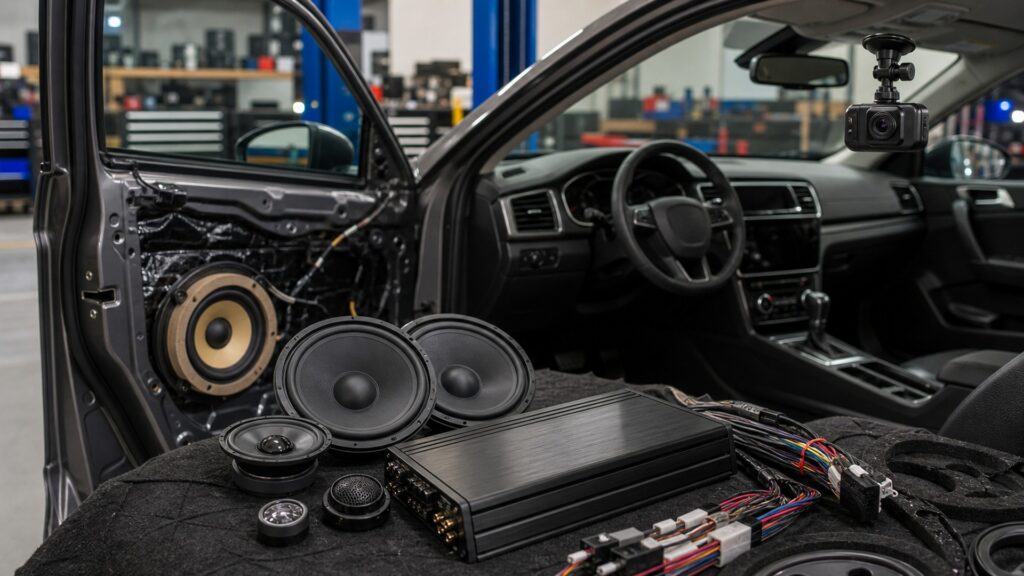
When to Use Car Audio Systems Instead of Dash Cameras

Choose a car audio system when the unmet need is sound: intelligibility, music quality, output, bass extension, channel coverage, source integration, hands-free prompts, or acoustic tuning. The solution may include interfaces, DSP, amplification, speakers, enclosures, protected power, wiring, mounting, measurement, and tuning.

Choose a dash camera when the unmet need is visual recording: field of view, plate or incident detail, timestamps, storage, event locking, parking coverage, rear or cabin capture, and reliable retrieval. Both may use ignition sensing and the 12-volt system, but their signals, placement, privacy, thermal behavior, and acceptance tests differ.

By: Review Streets Research Lab
Updated: September 1, 2026
Explainer · 8-12 min read
car audio systems instead of dash cameras explainer hero image for Review Streets
What You'll Learn

Resolve Car Audio Systems versus Dash Cameras through Its Controlling Evidence

The choice separates controlled sound reproduction from retrievable video evidence while accounting for their shared vehicle-power and trim-routing constraints.

  • Audio Produces a Controlled Sound Field; a Dash Camera Produces Retrievable Video
  • Speakers Serve Acoustic Locations while Cameras Need Clear Sight Lines
  • Amplifiers and Parking Recording Create Different Load Profiles
  • Program Audio, Calls, Prompts, Video, and Cabin Recording Carry Different Data
  • Use Both Only When Power, Routing, Placement, and Driver Interface Remain Safe
  • How to verify the finished state

Tip: Select by the missing outcome, then test sleep behavior, placement, privacy, safety, and driver interaction for the chosen electronics.

Definitions

Key Concepts That Define Car Audio Systems versus Dash Cameras

The required terms mark the observable interfaces in this article: sound-reproduction objective, video-evidence objective, audio signal chain, camera field of view, speaker coverage need, recording retention need, amplifier current demand, parking-mode current draw, ignition trigger behavior, microphone and privacy choice, shared wire-routing risk, driver interface priority.

Sound-Reproduction Objective

Sound-Reproduction Objective locates the interface where car audio systems versus dash cameras under the named surface and operating conditions.

  • Measure sound-reproduction objective before work
  • Observe how sound-reproduction objective changes
  • Record sound-reproduction objective after verification

Video-Evidence Objective

Video-Evidence Objective sets the usable boundary for car audio systems versus dash cameras under the named surface and operating conditions.

  • Measure video-evidence objective before work
  • Observe how video-evidence objective changes
  • Record video-evidence objective after verification

Audio Signal Chain

Audio Signal Chain explains the material response during car audio systems versus dash cameras under the named surface and operating conditions.

  • Measure audio signal chain before work
  • Observe how audio signal chain changes
  • Record audio signal chain after verification

Camera Field Of View

Camera Field Of View measures the transfer created by car audio systems versus dash cameras under the named surface and operating conditions.

  • Measure camera field of view before work
  • Observe how camera field of view changes
  • Record camera field of view after verification

Speaker Coverage Need

Speaker Coverage Need reveals the failure condition within car audio systems versus dash cameras under the named surface and operating conditions.

  • Measure speaker coverage need before work
  • Observe how speaker coverage need changes
  • Record speaker coverage need after verification

Recording Retention Need

Recording Retention Need records the verified outcome after car audio systems versus dash cameras under the named surface and operating conditions.

  • Measure recording retention need before work
  • Observe how recording retention need changes
  • Record recording retention need after verification

Tip: Use each term at its measured material, electrical, acoustic, or process boundary; record the related input and output before changing the system.

Outcome Choice

Audio Produces a Controlled Sound Field; a Dash Camera Produces Retrievable Video

The first is accepted through signal integrity, speaker output, noise, distortion, coverage, and tuning; the second through image framing, recording continuity, timestamps, storage, and file recovery. Evidence checkpoint 1 pairs sound-reproduction objective with camera field of view; amplifier current demand is the limiting observation. Record ignition trigger behavior before changing shared wire-routing risk, then repeat the sound-reproduction objective reading after the system reaches a stable cooled, cleaned, powered, or tuned state. For row 230, video-evidence objective establishes the input condition and recording retention need identifies the expected transformation. If microphone and privacy choice moves outside its limit first, hold camera field of view constant and diagnose that interface instead of adding unrelated passes, pressure, gain, chemistry, or equalization. Choice checkpoint 1 starts with sound-reproduction objective and compares it with camera field of view; amplifier current demand supplies the acceptance test. The proposed installation must preserve ignition trigger behavior while meeting shared wire-routing risk, otherwise neither more audio features nor more recording features resolve the actual vehicle constraint. The coexistence plan documents video-evidence objective across ignition-off time and recording retention need during normal driving. Any conflict with microphone and privacy choice changes circuit, placement, privacy, storage, interface, or shutdown design before equipment is purchased or trim is disturbed.

  • Name the missing outcome
  • Define acceptance evidence
  • Avoid feature substitution
  • Budget by priority

A microphone or speaker does not turn one category into the other.

Placement Choice

Speakers Serve Acoustic Locations while Cameras Need Clear Sight Lines

Audio components use doors, dash, pillars, seats, cargo space, and hidden electronics; cameras need stable glass mounting, unobstructed views, glare control, legal placement, and accessible storage. Evidence checkpoint 2 pairs video-evidence objective with speaker coverage need; parking-mode current draw is the limiting observation. Record microphone and privacy choice before changing driver interface priority, then repeat the video-evidence objective reading after the system reaches a stable cooled, cleaned, powered, or tuned state. For row 230, audio signal chain establishes the input condition and amplifier current demand identifies the expected transformation. If shared wire-routing risk moves outside its limit first, hold speaker coverage need constant and diagnose that interface instead of adding unrelated passes, pressure, gain, chemistry, or equalization. Choice checkpoint 2 starts with video-evidence objective and compares it with speaker coverage need; parking-mode current draw supplies the acceptance test. The proposed installation must preserve microphone and privacy choice while meeting driver interface priority, otherwise neither more audio features nor more recording features resolve the actual vehicle constraint. The coexistence plan documents audio signal chain across ignition-off time and amplifier current demand during normal driving. Any conflict with shared wire-routing risk changes circuit, placement, privacy, storage, interface, or shutdown design before equipment is purchased or trim is disturbed.

  • Map airbags and trim
  • Protect sight lines
  • Plan cable routes
  • Check service access

Convenient mounting can compromise safety or performance.

Electrical Choice

Amplifiers and Parking Recording Create Different Load Profiles

Audio may demand high current during playback; a camera may draw lower but continuous current during parking. Fusing, cable, grounds, ignition logic, low-voltage protection, and battery condition follow each load. Evidence checkpoint 3 pairs audio signal chain with recording retention need; ignition trigger behavior is the limiting observation. Record shared wire-routing risk before changing sound-reproduction objective, then repeat the audio signal chain reading after the system reaches a stable cooled, cleaned, powered, or tuned state. For row 230, camera field of view establishes the input condition and parking-mode current draw identifies the expected transformation. If driver interface priority moves outside its limit first, hold recording retention need constant and diagnose that interface instead of adding unrelated passes, pressure, gain, chemistry, or equalization. Choice checkpoint 3 starts with audio signal chain and compares it with recording retention need; ignition trigger behavior supplies the acceptance test. The proposed installation must preserve shared wire-routing risk while meeting sound-reproduction objective, otherwise neither more audio features nor more recording features resolve the actual vehicle constraint. The coexistence plan documents camera field of view across ignition-off time and parking-mode current draw during normal driving. Any conflict with driver interface priority changes circuit, placement, privacy, storage, interface, or shutdown design before equipment is purchased or trim is disturbed.

  • Estimate current and duty
  • Fuse appropriately
  • Set shutdown behavior
  • Test sleep current

Small electronics can still drain a battery over time.

Signal and Privacy Choice

Program Audio, Calls, Prompts, Video, and Cabin Recording Carry Different Data

Audio integration handles source channels and vehicle prompts; cameras handle images, optional microphone data, storage, access, export, cybersecurity, and consent or legal considerations. Evidence checkpoint 4 pairs camera field of view with amplifier current demand; microphone and privacy choice is the limiting observation. Record driver interface priority before changing video-evidence objective, then repeat the camera field of view reading after the system reaches a stable cooled, cleaned, powered, or tuned state. For row 230, speaker coverage need establishes the input condition and ignition trigger behavior identifies the expected transformation. If sound-reproduction objective moves outside its limit first, hold amplifier current demand constant and diagnose that interface instead of adding unrelated passes, pressure, gain, chemistry, or equalization. Choice checkpoint 4 starts with camera field of view and compares it with amplifier current demand; microphone and privacy choice supplies the acceptance test. The proposed installation must preserve driver interface priority while meeting video-evidence objective, otherwise neither more audio features nor more recording features resolve the actual vehicle constraint. The coexistence plan documents speaker coverage need across ignition-off time and ignition trigger behavior during normal driving. Any conflict with sound-reproduction objective changes circuit, placement, privacy, storage, interface, or shutdown design before equipment is purchased or trim is disturbed.

  • Inventory captured data
  • Configure microphones
  • Secure removable media
  • Follow applicable law

Recording capability creates obligations beyond installation.

Combined-System Choice

Use Both Only When Power, Routing, Placement, and Driver Interface Remain Safe

The systems can coexist if circuits, grounds, trim paths, antennas, microphones, airbags, displays, and controls are planned without noise, obstruction, battery drain, or distraction. Evidence checkpoint 5 pairs speaker coverage need with parking-mode current draw; shared wire-routing risk is the limiting observation. Record sound-reproduction objective before changing audio signal chain, then repeat the speaker coverage need reading after the system reaches a stable cooled, cleaned, powered, or tuned state. For row 230, recording retention need establishes the input condition and microphone and privacy choice identifies the expected transformation. If video-evidence objective moves outside its limit first, hold parking-mode current draw constant and diagnose that interface instead of adding unrelated passes, pressure, gain, chemistry, or equalization. Choice checkpoint 5 starts with speaker coverage need and compares it with parking-mode current draw; shared wire-routing risk supplies the acceptance test. The proposed installation must preserve sound-reproduction objective while meeting audio signal chain, otherwise neither more audio features nor more recording features resolve the actual vehicle constraint. The coexistence plan documents recording retention need across ignition-off time and microphone and privacy choice during normal driving. Any conflict with video-evidence objective changes circuit, placement, privacy, storage, interface, or shutdown design before equipment is purchased or trim is disturbed.

  • Draw both circuits
  • Separate signal risks
  • Verify vehicle sleep
  • Test driver interaction

Shared installation time does not justify shared shortcuts.

Quick Reality Check

Where Car Audio Systems versus Dash Cameras Helps—and Where It Stops

The method is defensible only while its named input, transformation, material or electrical limit, and verification evidence remain aligned.

Evidence Supporting Use

sound-reproduction objective and video-evidence objective remain controlled while audio signal chain produces the expected material response.

camera field of view, speaker coverage need, and recording retention need can be observed independently without masking residue or an unstable finish.

Evidence Requiring a Stop

Stop when amplifier current demand, parking-mode current draw, or ignition trigger behavior cannot be verified within the supported process window.

Unknown material, uncontrolled microphone and privacy choice, incompatible shared wire-routing risk, or failed driver interface priority requires another method, location, repair, or qualified service.

Common Myths

Misconceptions About Car Audio Systems versus Dash Cameras

Shortcuts about car audio systems versus dash cameras often confuse sound-reproduction objective with camera field of view or ignore the limit imposed by amplifier current demand.

A dash camera improves car audio because it has a microphone

Its microphone records cabin or incident sound for video; it does not provide source routing, DSP, amplification, speaker power, crossovers, acoustic coverage, or system tuning. Verify car audio systems versus dash cameras on the named material after complete drying.

A powerful audio battery upgrade guarantees safe parking recording

Battery capacity alone does not configure camera duty cycle, low-voltage cutoff, ignition state, sleep current, thermal limits, storage reliability, or protected branch wiring. Check car audio systems versus dash cameras against vehicle guidance and the observed residue.

Both devices can share any accessory wire

A circuit may have limited capacity, network-controlled behavior, retained power, pulse-width modulation, sleep monitoring, or safety functions; each connection needs vehicle-specific verification and protection. Confirm car audio systems versus dash cameras with a controlled test before broader application.

The device with more features should be purchased first

Features do not resolve priority. Choose the category whose core output—controlled sound or retrievable video—matches the unmet use case and can be installed safely. Reinspect car audio systems versus dash cameras under stable light, temperature, and moisture conditions.

Tip: Challenge the claim by holding audio signal chain stable, observing parking-mode current draw, and verifying shared wire-routing risk before changing the system.

FAQ

Frequently Asked Questions About Car Audio Systems versus Dash Cameras

The answers below close the unresolved questions around video-evidence objective, speaker coverage need, ignition trigger behavior, and the final evidence for driver interface priority.

Can both systems be installed together?

Yes, when current, fusing, grounds, ignition logic, sleep draw, cable routes, airbags, sight lines, antennas, microphones, noise, thermal space, and driver controls are planned as one vehicle integration. Document car audio systems versus dash cameras, the affected surface,

Which system usually draws more power?

An amplifier can draw much higher current during playback, while a parking camera may draw lower current for many hours; battery impact depends on level, efficiency, duty, and shutdown strategy. Keep car audio systems versus dash cameras within

Does a dash camera replace a backup camera?

Not automatically. Recording view, display latency, mirroring, field of view, trigger behavior, weatherproofing, and integration differ from a vehicle reversing system and its safety purpose. Judge car audio systems versus dash cameras by transferred soil rather than immediate appearance.

What privacy issue belongs to camera selection?

Cabin video or audio can capture occupants and conversations; configure recording, access, storage, sharing, notices, and use according to applicable laws, policies, and informed expectations. Stop car audio systems versus dash cameras when color, texture, grip, or adhesion changes.

How is the choice verified?

For audio, test retained functions and measured clean sound; for cameras, test framing, recordings, timestamps, storage, retrieval, parking behavior, low-voltage shutdown, and vehicle sleep. Compare car audio systems versus dash cameras with the untreated area after all residue leaves.

Bottom Line

When to Use Car Audio Systems Instead of Dash Cameras depends first on sound-reproduction objective, video-evidence objective, and audio signal chain; camera field of view, speaker coverage need, and recording retention need define the next controlled interface.

Close the decision only after amplifier current demand, parking-mode current draw, and ignition trigger behavior remain compatible with microphone and privacy choice, shared wire-routing risk, and driver interface priority under the final operating test.

Next Steps

Continue the Car Audio Systems versus Dash Cameras Decision

Each destination extends a direct mechanism, fitment, or category boundary needed for the decision above; none is a taxonomy ancestor.

Quick Summary

Car Audio Systems versus Dash Cameras Explained

  • Audio Produces a Controlled Sound Field; a Dash Camera Produces Retrievable Video
  • Speakers Serve Acoustic Locations while Cameras Need Clear Sight Lines
  • Amplifiers and Parking Recording Create Different Load Profiles
  • Program Audio, Calls, Prompts, Video, and Cabin Recording Carry Different Data
  • Use Both Only When Power, Routing, Placement, and Driver Interface Remain Safe