
Program Source
The tuner, phone, storage device, or other origin supplying audio content to the vehicle system.
- Selection determines which stream is active
- Connection quality can interrupt data
- Source level affects later headroom
A car audio system is useful only when each block performs a defined job. A source must deliver intact program material, an interface must preserve needed factory channels, a processor must route the right frequencies, an amplifier must drive the connected load, and speakers must convert that output into sound without wiring or placement undoing the result.
Operating function matters because a system can power on while failing at one of those handoffs. Naming the expected input, transformation, output, and limit at every stage turns vague complaints such as weak bass or harsh volume into testable questions. It also keeps an upgrade focused on the actual bottleneck instead of the most visible component.
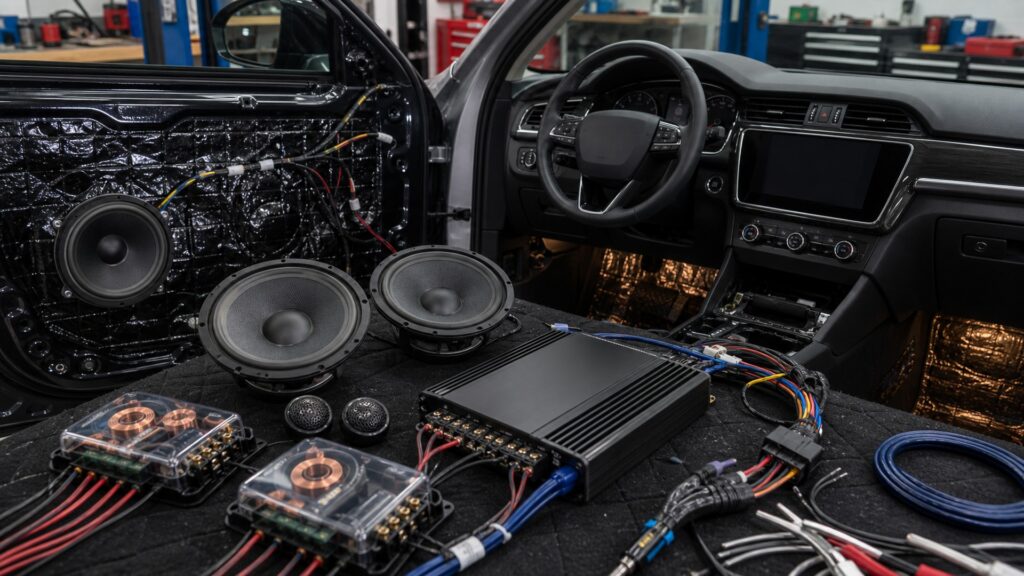
The article follows program information and vehicle power on separate paths, beginning with program source selection, then shows where they meet, how each handoff can fail, and what evidence identifies the responsible block.
Tip: Use a known recording and move downstream one connection at a time; the first point where the expected signal changes owns the next test.
These six terms identify the handoffs that must remain intact from selected program material to sound at the listener's seat.
The tuner, phone, storage device, or other origin supplying audio content to the vehicle system.
Preservation or reconstruction of channels, prompts, chimes, and control behavior supplied by the original vehicle electronics.
The distribution of signal level through source, processor, and amplifier stages before clipping or excessive noise appears.
A frequency range deliberately assigned to a driver so it handles content suited to its construction and placement.
The electrical demand presented by the connected speaker wiring and voice coils to an amplifier channel.
The pressure pattern produced after drivers, enclosures, mounting locations, polarity, and cabin reflections act on the electrical signal.
Tip: For every term, state what enters, what should leave, and which measurement or listening check can prove that change.
Playback begins with content selection, connection, decoding, and an output level that the next stage can accept. A phone that is paired but using the wrong audio profile, a tuner with poor reception, or a clipped source output creates faults no downstream amplifier can restore.
This section owns source integrity; later stages assume the program signal has already passed that test.
Modern vehicle audio may share paths with warning tones, phone microphones, steering-wheel commands, factory amplifiers, active-noise processing, or data-bus messages. An integration module translates or recreates those functions, and its vehicle-, trim-, and radio-specific programming determines what remains available.
Retention is a compatibility function, not proof that music channels are correctly routed.
A processor or equipped source assigns left and right content, front and rear balance, crossover bands, equalization, delay, and output level. These tools organize the signal; they cannot replace missing data, repair a damaged driver, or make an unsupported load safe.
Signal preparation succeeds when every output carries the intended band at a clean, documented level.
The amplifier uses vehicle electrical power to create the voltage and current needed by the speakers. Continuous capability depends on supply voltage, fuse and cable capacity, grounding, cooling, channel configuration, connected impedance, and the point where distortion or protection begins.
Power is useful only while the amplifier, conductors, and speakers stay within their documented operating envelopes.
Drivers turn channel current into motion, but the heard result also depends on polarity, mounting rigidity, door sealing, enclosure volume, aiming, seat location, and reflections from glass and trim. A correct electrical waveform can still produce cancellation, resonance, or uneven arrival at the listening position.
The final function is not cone movement; it is controlled acoustic output in the occupied cabin.
A block diagram can locate missing or corrupted behavior, while listening preference still determines the desired tonal balance and presentation.
Input-and-output checks separate source, interface, processing, amplification, wiring, and acoustic problems before equipment is condemned.
Defined limits reveal why more gain, equalization, or power can worsen clipping, noise, excursion, heat, or protection behavior.
Frequency balance, stage position, bass quantity, and listening level are preferences after basic function and safety are established.
Vehicle construction, factory processing, road noise, and seating geometry can constrain the result even when every component passes its individual test.
These shortcuts mistake visible activity or one specification for proof that the complete source-to-seat chain is working.
Power lights confirm only that some supply and control conditions exist. They do not prove correct source data, channel routing, crossover bands, unclipped amplification, speaker polarity, retained warnings, or usable acoustic output at the listening seat.
Gain matches an amplifier input to the upstream signal; it is not spare power. Raising it can expose noise or reach clipping sooner while leaving a low source level, cancellation, damaged driver, or poor enclosure unchanged.
Equalization changes level by frequency. It cannot recover discarded source information, reverse a wiring fault, seal an enclosure leak, remove a panel rattle, create amplifier headroom, or protect a driver receiving an unsuitable frequency band.
A subwoofer handles assigned low-frequency content within enclosure, excursion, and power limits. Vocals, imaging, prompts, tonal continuity, and retained vehicle sounds still depend on other channels and on the routing that joins them coherently.
Tip: When a claim skips an input, output, or limit, test that missing handoff before changing equipment or settings.
These questions show how to turn an operating complaint into a bounded test of one system function.
Use a known recording at a documented source setting, bypass optional processing when practical, and compare channels. Establishing repeatable input material prevents a streaming setting, damaged file, tuner reception problem, or phone connection from misleading every downstream check.
Verify supply voltage, ground drop, remote turn-on, input signal, channel configuration, connected impedance, and output before protection. An amplifier diagnosis requires clean input and supported load evidence, not merely heat, a warning light, or weak sound.
Speakers wired with opposing polarity can cancel shared low frequencies, while door leaks or an unsuitable enclosure can reduce acoustic loading. Confirm electrical polarity and mounting integrity before adding boost, changing crossovers, or assuming the amplifier lacks power.
They may. Many vehicles route prompts, warnings, calls, or active processing through factory audio hardware. The exact architecture decides whether an interface must retain, attenuate, reconstruct, or separately test those signals after a system change.
Keep the channel map, crossover points, polarity results, gain-setting method, interface firmware, equalization file, fuse sizes, speaker loads, and baseline measurements. Those records distinguish a new fault from an undocumented tuning or installation change.
Car audio operating function matters because every block must transform a known input into a defined output without crossing its limit.
Follow program information from source to listener and vehicle power from battery to load. Test the first failed handoff, preserve safety-related sounds and controls, and change equipment only after the responsible function is identified.
These verified explainers extend the operating model into the full signal chain, vehicle-specific fitment, and the maintenance evidence that keeps a tuned system diagnosable.
Trace audio information and electrical power through the complete source, processing, amplifier, speaker, and cabin sequence.
See how vehicle architecture, factory features, speakers, wiring, and mounting constrain whether those functions can work together.
Learn which inspections, saved settings, and baseline tests preserve function and shorten later troubleshooting.
Choose a retailer
Prices checked regularly. We may earn a commission at no cost to you.