
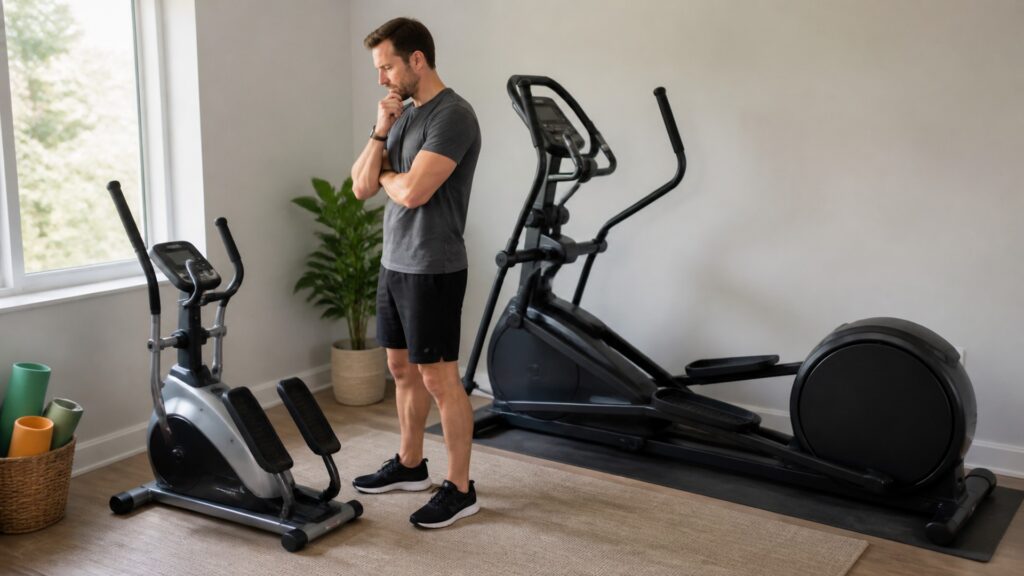
When to Use Compact Ellipticals Instead of Rear Drive Ellipticals

Use compact ellipticals instead of rear drive ellipticals when space, placement, storage, or easy access matters more than a long full-size stride. Compact machines are often the practical choice for apartments, multipurpose rooms, or users who need cardio equipment that can fit into daily life.

Rear drive ellipticals have the stronger case when the user has more room and wants a larger, smoother, more traditional elliptical feel. Compact ellipticals win when the workout has to fit the home before anything else can matter.

By: Review Streets Research Lab
Updated: October 6, 2026
Explainer · 8-12 min read
compact ellipticals explainer hero image for Review Streets
What You'll Learn

When Smaller Fit Beats Full-Size Stride

A practical decision path for choosing compact ellipticals over rear drive ellipticals in tight rooms, shared spaces, and moderate cardio routines.

  • Why compact ellipticals fit small homes more easily
  • When rear drive ellipticals offer a fuller stride feel
  • How storage and room clearance affect the decision
  • Where compact machines are enough for cardio consistency
  • Why taller users should test stride carefully
  • How to choose based on space and workout expectations

Tip: Judge a compact elliptical by the workout it can support in the space available, not by size alone.

Definitions

Key Concepts Behind Compact Ellipticals Instead of Rear Drive Ellipticals

These terms keep compact elliptical choices tied to stride, stability, resistance, footprint, and real home use.

Footprint

Footprint is the floor space the elliptical occupies during storage and use.

  • Example: a short-frame elliptical used in a small apartment
  • Check: measure the space around the machine, not only the frame
  • Limit: a small footprint can still feel cramped if stride clearance is poor

Stride Path

Stride path is the shape and length of the pedal motion.

  • Example: a shorter oval stride on a compact machine
  • Check: test whether the motion feels smooth at normal cadence
  • Limit: short strides may feel choppy for taller users

Resistance Range

Resistance range is how much effort the machine can add across settings.

  • Example: magnetic resistance levels for easy and moderate sessions
  • Check: try both low and higher settings
  • Limit: small machines may have less top-end challenge

Frame Stability

Frame stability is how steady the machine feels under stepping force.

  • Example: a compact frame that does not rock during faster cadence
  • Check: watch for wobble, flex, or shifting
  • Limit: lighter frames may move more on slick floors

Console Simplicity

Console simplicity is how easily the display and controls support a workout.

  • Example: quick resistance buttons and basic time tracking
  • Check: confirm controls are readable while moving
  • Limit: basic consoles may lack advanced programs

Storage Fit

Storage fit is how well the machine can be moved, parked, or kept ready between sessions.

  • Example: transport wheels for moving the elliptical after use
  • Check: test the actual move path and storage spot
  • Limit: portable does not always mean easy to lift

Tip: Compact design helps most when the stride, frame, and resistance still match the user's normal workout.

Space

Choose Compact When The Room Is The Limiting Factor

A compact elliptical can make sense when a full-size rear drive machine would dominate the room or block normal use of the space.

  • Measure floor space and clearance.
  • Check where the machine will stay between sessions.
  • Leave safe room to mount and step off.

The equipment has to fit before it can help.

Rear Drive Fit

Choose Rear Drive When Stride Feel Comes First

Rear drive ellipticals often appeal to users who want a larger machine with a more traditional elliptical path. That can matter for longer sessions or taller users.

  • Compare stride length and pedal feel.
  • Check whether the motion feels natural.
  • Make sure the room supports the larger frame.

Rear drive makes sense when space is not the main constraint.

Consistency

Compact Machines Can Improve Follow-Through

A smaller machine that stays accessible may support more consistent workouts than a larger machine that is hard to place or avoided because it takes over the room.

  • Choose a location that invites use.
  • Keep controls and pedals easy to access.
  • Avoid storage plans that make setup a chore.

Convenience can support the habit.

Intensity

Match The Machine To The Workout Demand

Compact ellipticals can work well for moderate cardio, warmups, and lower-impact movement. Users seeking hard, long, or very smooth sessions may prefer a larger frame.

  • Test resistance at the planned effort level.
  • Watch for frame movement at cadence.
  • Check comfort after more than a quick step.

The machine should handle the workout the user actually plans.

Decision

Choose The Machine That Removes The Main Barrier

If space is the barrier, compact has the stronger case. If stride feel and full-size stability are the barrier, rear drive may be worth the room.

  • Choose compact for small rooms.
  • Choose rear drive for larger-machine feel.
  • Test stride before committing.

The right elliptical solves the real constraint.

Quick Reality Check

Where Compact Wins And Where Rear Drive Wins

The decision is space practicality versus full-size stride feel.

Compact Ellipticals Win When

The user needs a smaller footprint, easier placement, or a more accessible setup.

Moderate low-impact cardio is enough.

Rear Drive Ellipticals Win When

The user has room for a larger frame.

Stride length, smoothness, and full-size stability matter more than storage.

Common Myths

Misconceptions About Compact Versus Rear Drive Ellipticals

The smaller machine can be the better choice when space controls the routine.

Rear drive is always better

It may feel better for some users, but it also needs more room.

Compact ellipticals are only emergency options

A stable compact model can support useful regular cardio.

Storage size is all that matters

Workout clearance and access matter too.

A longer stride helps everyone

Stride comfort depends on body size, cadence, and preference.

Tip: The best compact elliptical is the one that stays stable and usable enough to become part of the routine.

FAQ

Frequently Asked Questions About Compact Versus Rear Drive Ellipticals

Short answers for choosing compact ellipticals for real home workouts.

When should I choose a compact elliptical?

Choose compact when space, placement, and easy access are the main barriers.

When is a rear drive elliptical better?

Rear drive may be better when the user wants a larger stride feel and has enough room.

Can compact ellipticals support daily cardio?

Yes, if the frame, stride, and resistance are comfortable enough for the planned sessions.

Are compact ellipticals good for taller users?

Some may feel short or cramped, so taller users should test stride carefully.

What is the practical takeaway?

Use compact when the home setup matters most and rear drive when full-size motion matters most.

Bottom Line

Use compact ellipticals instead of rear drive ellipticals when space, placement, and access matter more than a full-size stride feel.

Rear drive models remain stronger when the user has room and wants a larger elliptical platform.

Next Steps

Go Deeper or Compare Your Options

Use these Review Streets paths to compare related categories and practical next decisions.