
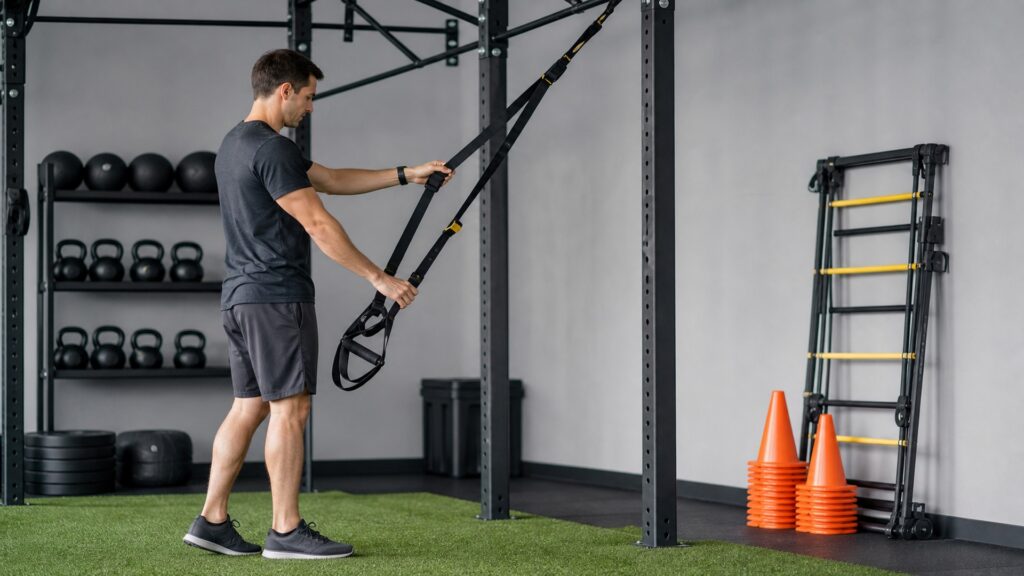
When to Use Functional Suspension Training Instead of Agility Training Equipment

Use functional suspension training instead of agility training equipment when the workout needs adjustable bodyweight resistance, support, and control rather than movement through space. Straps are better for rows, presses, assisted squats, lunges, planks, fallouts, and mobility support.

Agility equipment is better when the goal is quick footwork, acceleration, deceleration, reaction, spacing, and direction change. The decision is not which category is more athletic. It is whether the session needs anchored resistance or spatial movement drills.

By: Review Streets Research Lab
Updated: October 2, 2026
Explainer · 8-12 min read
functional suspension training explainer hero image for Review Streets
What You'll Learn

When Suspension Straps Are The Better Fit

A practical decision path for choosing strap-based bodyweight work over agility markers and drills.

  • When straps solve a problem agility tools do not
  • Why body angle and support matter for resistance training
  • Where agility equipment remains better
  • How space and anchor access affect the choice
  • When both categories can share a routine

Tip: Choose straps for anchored resistance and support. Choose agility tools for speed, footwork, and direction-change drills.

Definitions

Key Concepts Behind The Suspension-First Choice

These concepts separate strap-based resistance from agility drill equipment.

Functional Suspension Training

Functional suspension training uses anchored straps or rings to scale bodyweight exercises.

  • Example: rows, presses, lunges, and fallouts with adjustable body angle
  • Check: confirm anchor safety and repeatable setup
  • Limit: it does not organize footwork routes

Agility Training Equipment

Agility training equipment organizes quick movement, spacing, reaction, and direction changes.

  • Example: cones, ladders, hurdles, and marker discs
  • Check: use it when movement through space is the goal
  • Limit: it offers limited resistance training

Anchored Resistance

Anchored resistance is the challenge created by leaning against straps attached to a secure point.

  • Example: a suspension row using body angle
  • Check: adjust angle gradually
  • Limit: an unsafe anchor blocks the exercise

Assisted Control

Assisted control uses straps to help balance, range, or body position.

  • Example: strap-supported split squats
  • Check: use assistance to improve movement quality
  • Limit: too much assistance can reduce work

Spatial Movement

Spatial movement is quick travel through routes, markers, or direction changes.

  • Example: cone shuttles or ladder footwork
  • Check: use safe surfaces and stopping room
  • Limit: spatial drills are not strength progressions

Setup Constraint

Setup constraint is the practical limit created by anchors, space, flooring, or equipment placement.

  • Example: having a strong rack for straps but no open area for cone drills
  • Check: let the available safe setup guide the choice
  • Limit: convenience should not override safety

Tip: The better choice depends on whether the missing workout element is resistance control or movement-space practice.

Resistance

Choose Straps For Adjustable Bodyweight Work

Suspension training is the better option when the user needs scalable rows, presses, assisted lower-body patterns, or controlled core work.

  • Use angle changes to scale difficulty.
  • Use straps to assist balance or range.
  • Track setup so progress is repeatable.

Straps are strongest when bodyweight resistance is the goal.

Agility Advantage

Choose Agility Gear For Quick Movement Drills

Agility equipment is better when the session needs footwork, acceleration, deceleration, cutting, reaction, or route practice.

  • Use cones for routes.
  • Use ladders for foot placement.
  • Use cues for reaction work.

Agility gear is strongest when movement through space is the goal.

Space

The Setup Often Decides The Better Tool

Suspension training needs a safe anchor and leaning room. Agility training needs open floor or field space and good traction.

  • Use straps when anchor access is strong.
  • Use agility tools when open space is available.
  • Avoid high-speed drills in cramped areas.

Safe setup matters more than category preference.

Combination

The Categories Can Work Together

A session can use straps for strength and agility tools for movement skill, but each block should have a separate purpose.

  • Do strap strength before high fatigue when control matters.
  • Keep agility drills short and clear.
  • Avoid mixing too many demands at once.

The tools complement each other when roles stay clear.

Decision

Buy For The Problem You Actually Have

If the routine lacks pulling, pressing, assistance, or core control, straps may be the better buy. If it lacks speed, reaction, and direction change, agility tools are better.

  • List the missing movement job.
  • Check anchor and space limits.
  • Choose the tool that solves the repeated need.

The best purchase removes a real training constraint.

Quick Reality Check

Where Suspension Training Beats Agility Gear

The decision depends on anchored resistance versus spatial movement.

Use Suspension Training When

The workout needs rows, presses, assisted patterns, or core control.

A safe anchor is available and body angle can be scaled.

Use Agility Equipment When

The workout needs footwork, reaction, cutting, acceleration, or deceleration.

There is enough safe space for movement drills.

Common Myths

Misconceptions About Suspension Training Versus Agility Gear

The categories are not competing solutions for the same job.

Suspension training improves agility by itself

It can support strength and control, but agility still needs movement-specific practice.

Agility gear is better for all athletic goals

Strength, bracing, and control may be better served by straps.

Straps and cones train the same kind of control

Straps train control under anchored resistance, while cones organize movement through space.

One category should replace the other

Many routines use both for different blocks.

Tip: Choose the tool that matches the session's main demand.

FAQ

Frequently Asked Questions About Suspension Training And Agility Gear

Short answers for choosing between anchored resistance and movement drills.

When should I choose suspension training?

Choose it when adjustable bodyweight resistance, assistance, or core control is the main need.

When should I choose agility equipment?

Choose agility equipment when footwork, speed, reaction, and direction change are the main need.

Can I combine straps and agility tools?

Yes. Use straps for strength or support and agility tools for movement skill.

Which is better for small spaces?

Suspension training often fits smaller spaces if a safe anchor is available.

What is the practical takeaway?

Use suspension training for anchored bodyweight control and agility gear for quick movement through space.

Bottom Line

Functional suspension training is the better choice when the workout needs anchored bodyweight resistance.

Agility equipment is better when the session needs footwork, reaction, and direction-change drills in open space.

Next Steps

Go Deeper or Compare Your Options

Use these Review Streets paths to compare related categories and practical next decisions.