
Functional Suspension Training
Functional suspension training uses anchored straps or rings to scale bodyweight exercises.
- Example: adjustable suspension rows
- Check: confirm anchor safety and angle control
- Limit: straps can feel unstable
Use functional suspension training instead of fixed bodyweight training equipment when adjustable body angle and strap support are the main advantages. Straps can make rows, presses, squats, lunges, planks, and mobility drills easier to scale in small increments.
Fixed bodyweight tools are still better when the workout needs a stable bar, dip station, push-up handle, parallette, slider, or ab wheel. The choice comes down to whether adjustability and portability matter more than fixed support.
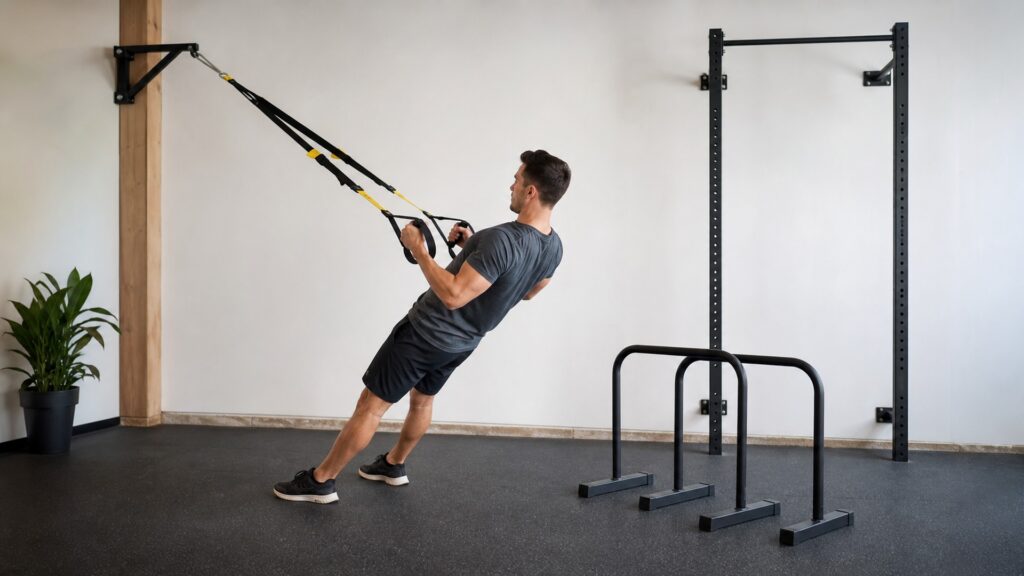
A practical decision path for choosing suspension straps over fixed bodyweight tools.
Tip: Start with the training job, then decide whether straps solve that job better than a fixed tool.
These concepts explain how strap setup, body angle, and movement control shape the training decision.
Functional suspension training uses anchored straps or rings to scale bodyweight exercises.
Bodyweight training equipment supports exercises where the body is the main resistance.
Angle adjustment changes difficulty by moving the body position relative to the anchor.
Fixed support is a stable surface, bar, handle, or station that does not swing.
Portability is how easily the tool moves between spaces.
Training fit is whether the tool solves the routine's specific problem.
Tip: Suspension training is useful when adjustability and control support the exercise rather than complicating it.
Suspension straps can make bodyweight exercises easier or harder with small changes in body angle. That helps users scale movements without needing multiple pieces of equipment.
Angle control is the main reason to choose straps.
Straps can help users practice squats, lunges, hinges, or mobility positions with support. That assistance can make the movement cleaner when used carefully.
Assistance should improve the movement, not hide the work.
A strap system can pack into a small bag, which makes it useful for travel or small spaces. The limitation is that every location still needs a safe anchor.
Portability helps only when setup remains safe.
Pull-up bars, dip stations, parallettes, and push-up handles are often better for stable support, hanging, dips, or pressing mechanics.
Fixed tools are better when the movement needs a stable base.
The better choice is the setup the user can repeat safely with clear progression. Straps win for angle-based scaling. Fixed tools win for stable, specific support.
Repeatability matters more than maximum versatility.
Suspension systems are strongest when adjustability and portability are central.
The user needs small angle-based progression steps.
A safe anchor and enough leaning space are available.
The exercise needs stable hanging, pressing, dipping, or rolling support.
The user does not have a reliable anchor.
Suspension straps are useful, but they are not always the better bodyweight option.
Fixed bars, stations, handles, and wheels still perform specific jobs better.
Portable straps still require a safe anchor.
Instability helps only when the user can control it.
Stable supports can be useful at every training level.
Tip: Judge the setup by the movement it improves, not by how many variations it promises.
Short answers for practical training and buying decisions.
Choose straps when adjustable body angle, compact storage, and scalable assistance matter most.
Choose fixed tools for stable hanging, dips, pressing support, ab wheels, sliders, or other specific movements.
They can be when the anchor is safe and the angle is easy enough to control.
Yes. Many routines use straps for rows and assistance, plus fixed tools for hanging or pressing.
Use suspension training when adjustability solves the problem; use fixed bodyweight tools when stability solves it.
Functional suspension training is better when adjustable body angle and strap support are the main needs.
Fixed bodyweight equipment is better when the exercise needs stable support or a dedicated tool.
Use these Review Streets paths to compare related categories and practical next decisions.
Explore strap-based functional training equipment.
Review anchors, body angle, and strap-based resistance.
Browse related fitness training equipment categories.
Choose a retailer
Prices checked regularly. We may earn a commission at no cost to you.