When to Use Luxury Sedans Instead of Electric Cars

A luxury sedan and an electric car are not opposing categories. Luxury describes the comfort, finish, and equipment of a vehicle; electric describes its power source. An electric car can also be a luxury sedan. The practical decision is whether a gasoline or non-plug-in hybrid luxury sedan suits your routine better than a battery-electric alternative.

A non-plug-in sedan deserves consideration when dependable charging is difficult to arrange or frequent journeys would require inconvenient charging stops. An electric luxury sedan may suit you better when charging fits naturally into home or work parking. Decide how you will replenish energy before comparing upholstery, screens, or acceleration.

By: Review Streets Research Lab
Updated: October 5, 2026
Explainer · 8-12 min read
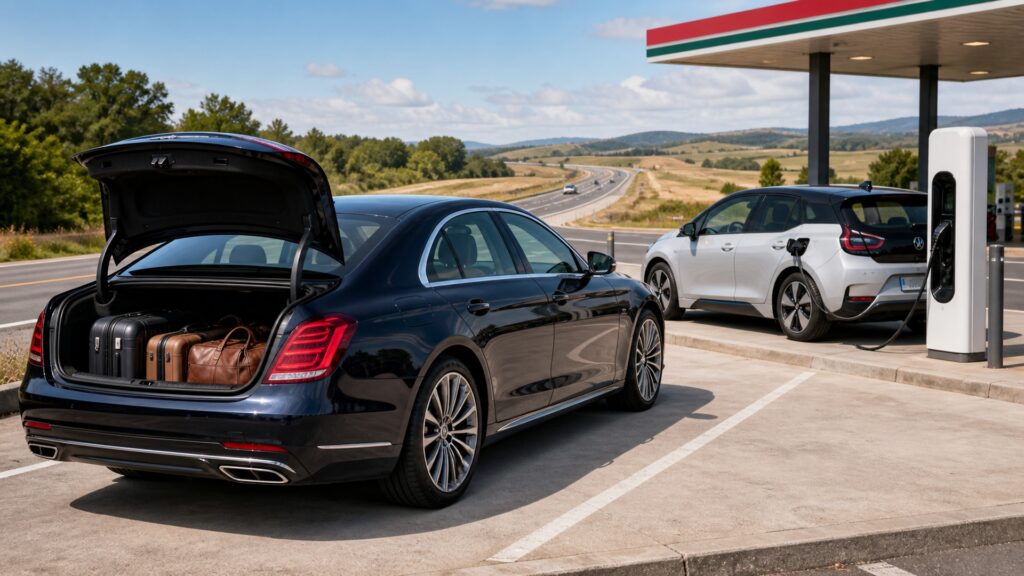
luxury sedans explainer hero image for Review Streets
What You'll Learn

Choose the Power Source That Fits Your Week

Separate comfort preferences from the practical work of charging or refueling.

  • Recognize that electric cars can also be luxury sedans.
  • Map dependable charging around ordinary parking.
  • Check demanding journeys as well as the daily commute.
  • Distinguish a non-plug-in hybrid from a plug-in hybrid.
  • Compare actual energy and ownership costs for specific cars.

Tip: Write down where the car will park overnight and how often it must make your longest regular trip.

Definitions

The Terms Behind the Powertrain Decision

Body style, comfort level, and propulsion answer different questions.

Luxury sedan

A luxury sedan combines a sedan body with an emphasis on comfort, refinement, and premium equipment.

  • Example: a four-door car with extensive seat adjustment
  • Check: the actual cabin and ride rather than the badge
  • Limit: the label does not specify an engine or battery

Battery-electric vehicle

A battery-electric vehicle uses stored electrical energy and electric motors for propulsion.

  • Example: a sedan recharged from an external power supply
  • Check: usable range and compatible charging options
  • Limit: charging time depends on the car, battery, and supply

Non-plug-in hybrid

A non-plug-in hybrid combines an engine with electric assistance without requiring external charging.

  • Example: a gasoline hybrid that recovers some braking energy
  • Check: fuel economy for the exact model
  • Limit: it still needs fuel and engine maintenance

Plug-in hybrid

A plug-in hybrid combines an engine with a battery that can be charged externally.

  • Example: electric local travel followed by engine-powered travel
  • Check: whether you can charge often enough to use its electric capability
  • Limit: it is not equivalent to a battery-electric car

Routine charging access

Routine charging access means a dependable opportunity to replenish energy during normal parking.

  • Example: a suitable charger at an assigned parking space
  • Check: permission, electrical suitability, access hours, and fees
  • Limit: a station nearby is not necessarily available when you need it

Trip charging plan

A trip charging plan identifies suitable stops and alternatives along a journey.

  • Example: a charging stop near a meal break with another site in reach
  • Check: connector compatibility and realistic stop duration
  • Limit: a charger map alone cannot guarantee availability

Tip: Compare specific vehicles with similar passenger space and comfort expectations, then evaluate their energy needs.

Daily Parking

Start With Where the Car Sleeps

An electric car is easiest to accommodate when its charging opportunity overlaps with time it would already spend parked. That could be at home or at a dependable workplace location. A public charger several blocks away may also work, but the walking, waiting, and return trip become part of ownership.

  • Confirm access rather than relying on a proposed installation.
  • Check charging compatibility for the actual vehicle.
  • Ask about parking restrictions and session fees.

If charging would regularly require a separate errand you dislike, a non-plug-in sedan may be more convenient. U.S. Department of Energy: charging equipment.

Long Journeys

Test the Difficult Trip Before the Easy Commute

A short commute tells only part of the story. Consider the trip to relatives, remote work site, or holiday destination that you repeat. An EV may handle it comfortably with a planned stop, or its useful charging locations may conflict with your schedule. Neither outcome can be inferred from the word electric.

  • Map the route and a backup charging location.
  • Allow for weather, speed, and cabin-heating demands.
  • Use realistic charging sessions rather than peak advertised charging power.

A gasoline or non-plug-in hybrid sedan can make sense when repeated routes offer poor charging coverage and stopping flexibility is limited. U.S. Department of Energy: electric range and driving conditions.

Comfort

Compare Luxury With Luxury

Electric propulsion can provide quiet low-speed travel without conventional engine shifts. It does not determine seat shape, tire noise, ride comfort, or rear-seat space. Likewise, a gasoline luxury sedan is not automatically the more comfortable choice. Take comparable cars over the same surfaces and sit in the seats you will actually use.

  • Separate road noise from engine noise.
  • Check passenger access and luggage openings.
  • Evaluate ordinary braking and low-speed response.

You can choose electric propulsion without giving up a sedan cabin or premium equipment.

Costs

Use Your Own Energy Prices

Avoid deciding from a general claim that one power source is always cheaper. Charging prices differ between home and public locations, and fuel costs depend on the vehicle and local prices. Insurance, tires, depreciation, service, and any charging installation also belong in the comparison.

  • Estimate annual miles for your household.
  • Use local tariffs, fees, and vehicle efficiency figures.
  • Obtain insurance and service estimates for each candidate.

A favorable energy estimate is useful, but it is only one part of the ownership cost.

Alternatives

Treat Hybrids as Separate Choices

A non-plug-in hybrid may suit someone who wants fuel economy improvements without arranging a charger. A plug-in hybrid is a different proposition: its electric capability is most useful when regular charging fits the routine. Its engine can support longer travel, but carrying both systems adds complexity and may affect packaging.

  • Check electric range and fuel use for the exact plug-in model.
  • Confirm luggage and passenger space in person.
  • Read the maintenance schedule for the complete powertrain.

Choose a hybrid because its actual use pattern works for you, not because it appears to split every difference.

Quick Reality Check

When Each Choice Has a Stronger Case

These are practical conditions to investigate, not universal rankings.

Consider a Non-Plug-In Sedan

Charging access is uncertain, or your repeated long trips have awkward charging gaps.

You value a refueling routine that already works for your schedule.

Consider an Electric Luxury Sedan

Dependable charging overlaps with parking you already do.

The car accommodates your regular journeys, passengers, and comfort needs.

Common Myths

Misconceptions About Luxury Sedans and Electric Cars

Avoid comparisons that mix a vehicle class with its source of power.

Electric cars are an alternative to luxury

Luxury and electric can describe the same vehicle. Compare comfort and propulsion separately.

No home charger means an EV is impossible

Dependable workplace or public charging may work. The question is whether its access, cost, and timing suit you.

A plug-in hybrid needs no charging consideration

It can use its engine, but regular charging is important if you expect to benefit from its electric driving capability.

Tip: Base the decision on a documented week of use and at least one demanding journey.

FAQ

Questions About Choosing a Sedan Powertrain

Answers for buyers deciding how charging fits into daily life.

Can I buy a luxury sedan that is fully electric?

Yes. Sedan body style and premium positioning do not require a combustion engine.

When is a gasoline sedan the more practical option?

It may be when reliable charging is difficult or frequent routes would create inconvenient charging stops. Compare a suitable non-plug-in hybrid as well.

Is a charger near my home enough?

Possibly. Check compatibility, access hours, availability, pricing, and how you will move the car when the session ends.

Should I choose solely by advertised range?

No. Evaluate your routes, conditions, charging opportunities, passenger needs, and the actual vehicle's comfort.

Bottom Line

Choose between specific powertrains, not between electric driving and luxury.

A non-plug-in sedan can suit difficult charging circumstances. An electric luxury sedan can fit equally well when replenishing energy is convenient and predictable.

Next Steps

Go Deeper or Compare Your Options

Use these Review Streets paths to compare related categories and practical next decisions.