When to Use Mixing Drills Instead of Standard Drills

Mixing drills and standard drills share similar forms, yet they are engineered for fundamentally different mechanical demands. Confusion arises because both tools rotate attachments, but the underlying motor design, torque delivery, gearing, and handle configuration are optimized for distinct load profiles. Standard drills are built primarily for axial drilling and fastening, where speed and compact control matter most. Mixing drills are designed to sustain high torque at lower speeds under continuous resistance from dense materials.

This explainer clarifies the mechanical differences that determine appropriate use. It outlines how torque curves, gear reduction, clutch systems, and duty cycles influence performance under load. By the end, readers will understand the structural and operational factors that distinguish mixing applications from conventional drilling tasks.

By: Review Streets Research Lab
Updated: April 20, 2026
Explainer · 8–12 min read
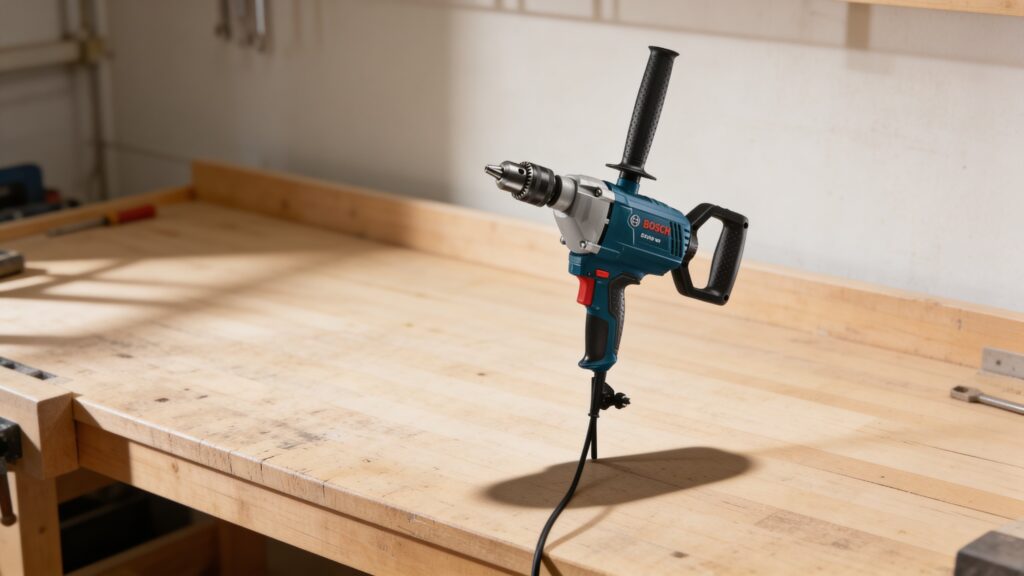
Heavy-duty mixing drill blending thick mortar in a bucket beside a standard handheld drill on a workshop floor
What You’ll Learn

Mixing Loads vs. Drilling Loads

A focused breakdown of how load type, torque demand, and duty cycle shape tool behavior during mixing and why standard drilling assumptions often fail.

  • How thick materials create constant resistance instead of intermittent cutting loads
  • Why low-speed, high-torque delivery depends on gearing and motor design
  • How torque curves affect stall behavior and control under sustained drag
  • What duty cycle means for heat buildup during continuous mixing work
  • How handle geometry counters rotational reaction forces from heavy paddles
  • Why chuck and spindle interfaces matter when torque spikes abruptly
  • How speed control changes shear rate and material movement in the bucket

Tip: Think in terms of load profile: drilling is brief resistance, mixing is sustained resistance.

Definitions

Key Parts That Determine Mixing Behavior

Mixing loads behave differently than drilling loads, so these definitions clarify how the power path and interfaces respond when resistance is continuous and uneven.

Power Source

The supply that provides electrical energy to the drive system. Under mixing-style loads, delivery stability matters because resistance remains high for long stretches.

  • Delivery: Maintains output when current demand stays elevated
  • Limits: Built-in constraints can reduce power as heat rises
  • Recovery: Output can rebound as temperature and load drop

Speed and Current Control

The control stage that translates trigger input into regulated motor power. It shapes ramp-up, sets current limits, and manages protective behavior during sustained drag.

  • Ramping: Smooths acceleration to avoid sudden torque shocks
  • Limiting: Caps current to control heat and protect components
  • Response: Adjusts output as resistance changes within each rotation

Motor and Heat Path

The rotating machine that converts electrical power into shaft torque. In mixing scenarios, the motor’s ability to shed heat governs how consistently it can sustain load.

  • Torque curve: Determines how force changes as speed drops under drag
  • Cooling: Airflow and housing design move heat away from windings
  • Saturation: Efficiency falls as temperature and current remain high

Gear Reduction

The gear train that trades speed for torque and sets the operating band for heavy resistance. It is the mechanical reason slow rotation can still produce high twisting force.

  • Reduction: Multiplies torque while lowering output speed
  • Stability: Helps the motor stay in a workable efficiency range
  • Shock loads: Transmits torque spikes when material clumps or binds

Tool Interface

The connection that transfers torque to the attachment. Under mixing loads, the interface must resist slipping because torque reversals and pulses occur as material circulates.

  • Grip: Clamping force determines whether the shaft creeps under torque
  • Alignment: Off-axis loading increases wobble and uneven stress
  • Wear: Repeated pulses can polish surfaces and reduce holding power

Sustained Torque

The continuous twisting force available at the output during steady resistance. Mixing emphasizes sustained torque because the load rarely relaxes the way a drilling cut does.

  • Continuity: Force must persist through long, uniform resistance
  • Stall point: Output drops sharply when torque demand exceeds capacity
  • Reaction: Higher torque increases rotational force felt at the handles

Tip: Treat the tool as a chain: supply → control → motor → gears → interface, where sustained resistance exposes the weakest link.

Power Path

How Power Delivery Changes Under Mixing Loads

Mixing turns rotation into continuous shear through dense material, which keeps resistance high and uneven. That load profile stresses every stage of the drive system at once.

  • Electrical supply must sustain high current instead of brief, intermittent peaks
  • Control electronics manage ramp-up to limit sudden torque shocks at startup
  • The motor spends more time at lower speed where torque demand is higher
  • Gear reduction sets whether the output can stay turning under steady drag
  • The interface transmits pulsing torque as material clumps and releases

When any link saturates—current limit, thermal limit, or mechanical grip—the output speed collapses under load.

Motors

How Motor Design Shapes Torque Delivery and Stability

Under sustained resistance, motors behave less like “spin sources” and more like torque regulators constrained by heat and current. Motor construction determines how smoothly torque is produced as speed drops.

  • Torque curve governs how output force changes as rotational speed declines
  • Thermal path determines how quickly heat escapes windings and housing
  • Current draw rises with load, accelerating temperature and limiting behavior
  • Control granularity affects how stable the shaft feels as resistance pulses

In mixing-style work, the motor’s heat handling and low-speed behavior set consistency more than free-speed ratings.

Gearing

Gear Reduction as the Torque Multiplier for Continuous Drag

Gearing determines the relationship between motor speed and output torque, which becomes critical when resistance rarely relaxes. Proper reduction keeps the motor operating in a controllable range.

  • Reduction increases torque at the output while lowering rotation speed
  • Lower output speed reduces sudden slinging and stabilizes material circulation
  • Gear train stiffness affects how torque pulses transmit through the tool body
  • Mechanical losses in gears convert part of input power directly into heat

When reduction is mismatched to the load, the motor is forced into inefficient, stall-prone operation.

Heat Management

Why Continuous Mixing Pushes Systems Into Thermal Limiting

Mixing creates long-duration electrical and mechanical stress, which turns into heat across cells, electronics, and the motor. As temperatures rise, protective limits reduce available current and torque.

  • Batteries warm under sustained current and may restrict output as temperature climbs
  • Controllers enforce current ceilings to prevent component damage under heavy draw
  • Motors lose efficiency as windings heat, requiring more current for the same torque
  • Gearboxes and bearings add frictional heat when torque stays high for minutes

Thermal limiting shows up as gradual speed loss and a narrower usable control range under the same load.

User Control

How Reaction Forces and Speed Control Affect Handling

Mixing produces strong reaction torque because the tool must oppose the material’s resistance to movement. Control depends on how speed is metered and how forces are managed through the grip.

  • Steady trigger response helps maintain a consistent shear rate as resistance varies
  • Handle geometry and stance counter rotation that increases with torque demand
  • Low-speed stability reduces sudden surges when material transitions from bound to fluid
  • Balanced mass distribution limits wrist leverage as the tool resists twisting

When control is stable, the tool’s behavior follows the load rather than amplifying it with abrupt speed changes.

Quick Reality Check

Where Standard Drills Fit — and Where Mixing Loads Change Things

A quick, mechanism-based balance between intermittent drilling loads and the sustained resistance patterns created by thick materials.

Standard drills under intermittent load

Standard drills are well matched to cutting and fastening cycles where resistance rises and falls, letting the motor recover speed between peaks.

When a bit advances, clears chips, and re-engages, the load pulses, keeping current draw and internal temperature from staying elevated continuously.

Mixing loads expose continuous limits

Mixing keeps resistance high and uneven for long periods, which pushes current, heat, and torque demand into a sustained operating state.

As material clumps and releases, torque spikes travel through gears and the interface, and protective limits can reduce output to manage temperature.

Common Myths

Misconceptions About Mixing Loads and Drill Behavior

Mixing looks like simple rotation, but continuous resistance changes how motors, gearing, heat, and reaction forces behave in real use.

Any drill can mix if it spins

Mixing creates sustained drag with uneven torque pulses as material circulates and clumps. That load profile stresses current delivery, heat dissipation, gearing, and the interface in ways intermittent drilling does not.

High speed makes mixing more effective

Mixing depends on torque and controlled shear, not free-spinning RPM. Higher speed under heavy resistance raises current draw and heat while reducing stability as the tool reacts to sudden changes in material viscosity.

Stalling means the tool lacks power

Stalls often occur when torque demand exceeds what the system can sustain at a given speed, triggering current limits or thermal protection. The result is a rapid drop in output even though the motor is still energized.

Torque ratings describe continuous mixing capability

Many torque figures reflect short-duration peaks under controlled conditions. Continuous mixing is governed by sustained torque, heat buildup, and how the drive system holds output as resistance remains high for minutes at a time.

Reaction force is mostly about user grip

Reaction torque is a direct consequence of the tool opposing the material’s resistance, so it rises with output torque and changes as the mix thickens. Handle geometry and speed stability determine how those forces transfer into the body.

Tip: Think in terms of load profile: mixing is continuous resistance with torque pulses, while drilling is intermittent cutting resistance.

FAQ

Frequently Asked Questions About When to Use Mixing Drills Instead of Standard Drills

Clear answers to the most common questions that come up when distinguishing sustained mixing loads from ordinary drilling and fastening work.

What makes mixing work harder on a drill?

Mixing creates continuous drag through thick material instead of short contact with a bit. That constant resistance keeps torque demand elevated for longer, which increases heat, strain, and control demands throughout the task.

Can a standard drill handle occasional mixing tasks?

It can in lighter materials and shorter sessions, but the limitation is sustained load rather than simple motion. As resistance rises or mixing time lengthens, the tool is more likely to heat up, bog down, or feel harder to control.

Why does torque matter more in mixing than speed?

Mixing thick compounds depends on keeping the paddle moving steadily through resistance, not just spinning quickly in open space. Torque is what maintains motion when the material pushes back and tries to stall the tool.

Why can mixing feel unstable with a standard drill?

Standard drills are often optimized for shorter drilling or driving actions, where resistance changes moment to moment. In mixing, resistance stays engaged, so reactive twisting forces build more consistently and make the tool feel less settled in the hands.

When does lower speed become more important?

Lower speed matters when material thickness, splash control, and steady blending are the priority. Slower rotation helps the paddle stay engaged more predictably, reduces unnecessary agitation, and gives the operator more control over how the mixture forms.

Does mixing put more heat into the tool?

Yes, because the motor stays under resistance for longer without much relief between load cycles. That sustained effort generates heat in the motor, electronics, and gearing, which is why mixing demands a different workload profile than ordinary drilling.

Why does paddle size affect drill behavior so much?

A larger paddle moves more material and creates more drag against the tool. As that drag rises, the drill must deliver steadier torque and maintain control under stronger reactive force, especially in thicker mixes.

What is the clearest sign a mixing drill makes sense?

The clearest sign is a task that combines thick material, sustained resistance, and extended mixing time. Once the load stops being brief and intermittent, the job starts to favor a tool designed for continuous torque delivery.

Tip: Diagnose the task by asking whether resistance is brief and intermittent or continuous and heavy, because that usually reveals whether it behaves like drilling or mixing.

Bottom Line

Mixing demands sustained torque through continuous resistance, not intermittent cutting loads. When resistance stays high, current draw and heat rise together, and the drive system’s limits show up as reduced speed and stability.

With this load-profile view, you can interpret tool behavior by tracing where torque is created, multiplied, and limited over time.

Next Steps

Go Deeper or Compare Your Options

If you’re deciding when a mixing drill makes more sense than a standard drill, these pages show where to go next for broader context.

Mixing Drill Roundups

A structured overview of mixing drill categories, use cases, and feature patterns to help you see which designs fit different materials and workloads.

Mixing Drill Comparisons

Focused side-by-side pages that clarify how drill types differ in handling, torque delivery, control, and comfort during repeated mixing tasks.

Mixing Drill Buying Guides

Practical guidance on choosing the right drill style, paddle setup, and performance range based on material thickness and frequency of use.

Quick Summary

Mixing vs Standard Drills

  • Mixing creates sustained resistance instead of intermittent cutting loads
  • Sustained torque matters more than short-duration peak ratings
  • Continuous drag raises current draw and internal heat buildup
  • Gear reduction determines stability at low rotational speeds
  • Reaction torque increases as material viscosity and load rise