
Workout Role
Workout role is the job the machine fills in a weekly routine.
- Example: steady cardio, warmups, or longer endurance sessions
- Check: name the sessions the user expects to repeat
- Limit: a vague role makes features harder to judge
Use a rear drive elliptical instead of a compact elliptical when stride comfort, frame stability, and longer-session feel matter more than saving the most floor space. Compact ellipticals solve placement problems, but they may shorten or simplify the workout experience.
Rear drive makes sense when the user has enough room and wants a smoother, more open motion for regular cardio. Compact makes sense when space is the real barrier and the smaller machine still feels comfortable enough to use.
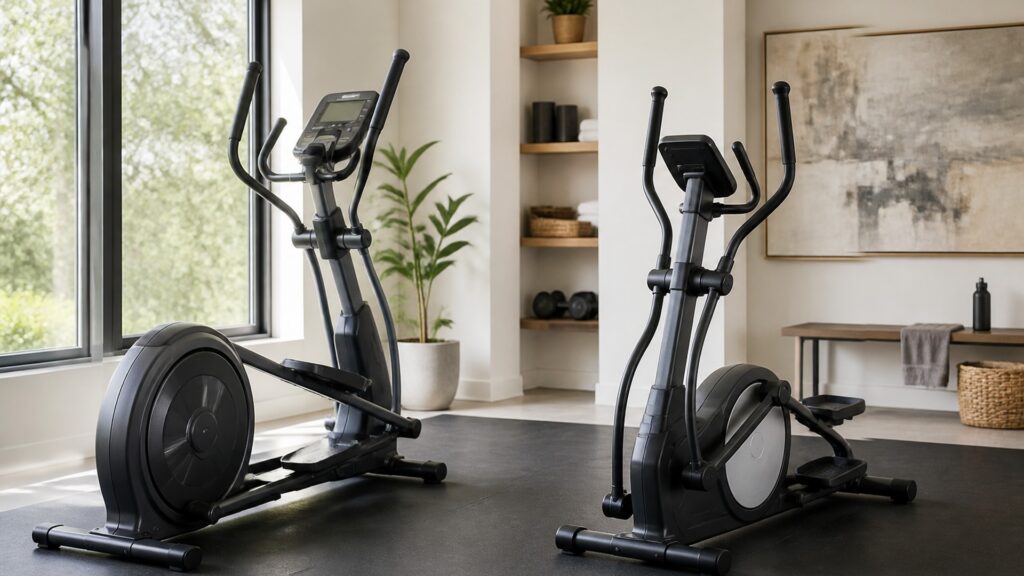
A practical decision path for choosing stride comfort over maximum compactness.
Tip: Match the machine to the workout the user will repeat, then test comfort at real pace.
These concepts connect the equipment design to comfort, setup, and repeated workout use.
Workout role is the job the machine fills in a weekly routine.
A rear drive layout places the main drive housing behind the user.
Stride comfort is how natural the pedal motion feels over time.
Resistance range is how much the machine can vary workout effort.
Room fit is whether the frame, clearance, and access space work at home.
Consistency fit is how easy the machine is to use as part of a normal routine.
Tip: A useful cardio machine is the one whose motion, controls, and setup fit the user.
A rear drive elliptical can provide a longer, more open stride. That advantage matters when the user plans frequent or longer cardio sessions.
Stride quality is the main reason to choose the larger design.
Rear drive ellipticals often need more floor length than compact models. The machine should fit without making the room awkward or unsafe.
Extra space is worthwhile only when it is available.
A compact elliptical may be the better choice when the room cannot support a longer frame. The key is making sure the smaller design still feels stable and usable.
Compact wins when space is the true constraint.
A fuller rear drive machine may feel more stable during steady cardio. That can matter when the machine is expected to handle many sessions each week.
Stability supports confidence and consistency.
If the friction is uncomfortable motion, rear drive may solve it. If the friction is lack of space, compact may solve it better.
The right choice solves the problem the user actually has.
The decision is a tradeoff between motion comfort and placement flexibility.
The user has room and wants a smoother, longer stride.
The machine will be used often enough for comfort to matter.
The room cannot support a longer frame.
Storage and smaller footprint matter more than stride feel.
Bigger and smaller machines solve different problems.
It is an upgrade only if the room and user fit work.
They can be useful when space is the main constraint.
Mounting space, pedal travel, and ceiling height also matter.
The right stride depends on user comfort and routine.
Tip: Use broad claims as a reason to test the actual machine more carefully.
Short answers for practical cardio equipment decisions.
Choose rear drive when comfort and longer stride feel matter more than footprint.
Choose compact when room space or storage is the real barrier.
Measure floor length, side clearance, ceiling height, and mounting space.
Some can, if the stride and stability are comfortable enough.
Use rear drive when the room allows it and the better motion will support repeated workouts.
Use a rear drive elliptical instead of a compact elliptical when the fuller stride and stability are worth the extra space.
Choose compact when placement is the main constraint and the smaller motion still works.
Use these Review Streets paths to compare related categories and practical next decisions.
Review the rear drive layout and stride system.
Connect the design to workout use.
Explore the broader elliptical category.
Choose a retailer
Prices checked regularly. We may earn a commission at no cost to you.