When to Use Right-Angle Drills Instead of Standard Drills

Right-angle drills are frequently associated with specialty trades or confined job sites, yet their mechanical purpose is broader than many assume. Unlike standard inline drills that drive force directly behind the bit, right-angle models redirect torque through a 90-degree gear assembly. This configuration changes the drill’s physical footprint and leverage characteristics, altering how power is delivered in restricted or obstructed environments.

This explainer outlines the structural differences between right-angle and standard drills, focusing on torque transfer, clearance geometry, and access constraints. It clarifies how head design, body length, and handle orientation affect drilling mechanics in framing cavities, cabinetry, and mechanical installations. By the end, readers will understand the operational principles that determine when a right-angle configuration becomes mechanically necessary rather than optional.

By: Review Streets Research Lab
Updated: April 20, 2026
Explainer · 8–12 min read
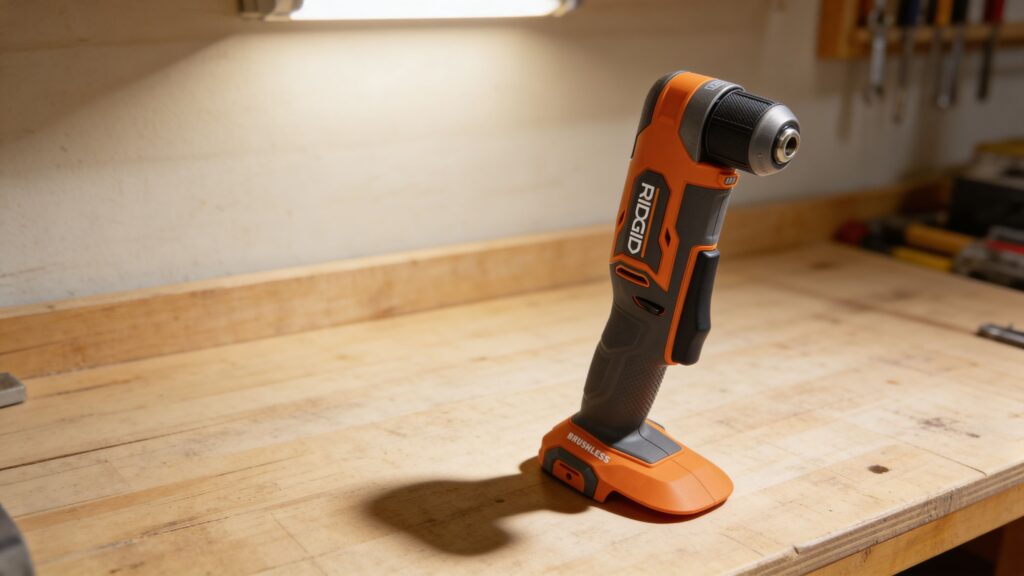
Contractor using a right-angle drill in a tight cabinet space compared to a standard drill on a workbench
What You’ll Learn

Right-Angle Drill Mechanics Explained

A focused breakdown of how right-angle drills redirect torque, alter tool geometry, and change force application in confined or obstructed drilling environments.

  • How 90-degree gear assemblies redirect motor torque output
  • Why head geometry determines access between studs and joists
  • How tool length affects leverage and drilling stability
  • What clearance constraints require perpendicular drive orientation
  • How side-handle positioning changes applied rotational control
  • Why torque reaction differs in compact drilling configurations
  • How bit alignment influences pressure distribution in tight cavities

Tip: Visualize the torque path shifting sideways; once space blocks inline force, perpendicular drive becomes mechanically necessary.

Definitions

Core Components in Right-Angle Drill Systems

Understanding how torque is redirected and controlled begins with the internal components that reshape force, alignment, and spatial access.

Right-Angle Gear Assembly

This gear set redirects rotational force 90 degrees from the motor shaft to the output spindle. It changes how torque travels through the tool and how space is occupied during drilling.

  • Bevel gears: Transfer rotation across intersecting shafts
  • Load path: Alters how force moves through housing
  • Clearance impact: Reduces front-to-back tool length

Head Profile

The compact housing that contains the angled gearing determines how closely the tool can approach surrounding surfaces. Its dimensions directly affect access within framing or cabinetry.

  • Thickness: Governs fit between structural members
  • Offset distance: Controls bit reach from handle axis
  • Material strength: Supports internal torque loads

Motor Alignment

In a right-angle configuration, the motor sits parallel to the handle rather than directly behind the bit. This orientation reshapes balance and torque reaction during operation.

  • Inline motor: Drives gears from perpendicular position
  • Balance shift: Moves mass away from drilling axis
  • Heat flow: Redirects ventilation through side housing

Handle Orientation

The handle’s position relative to the output spindle determines how force is braced against rotation. This geometry influences control when drilling in confined cavities.

  • Side leverage: Counters rotational kickback forces
  • Grip axis: Changes wrist loading direction
  • Body clearance: Allows operation near adjacent surfaces

Output Spindle

The spindle transfers redirected torque from the gear assembly to the bit. Its alignment determines how drilling pressure meets the material surface.

  • Perpendicular drive: Enables drilling between obstacles
  • Bit retention: Maintains stability under angled load
  • Runout control: Affects hole precision in tight spaces

Torque Reaction

When resistance increases, the redirected force produces rotational feedback through the handle. The direction of that reaction differs from inline drills.

  • Side torque: Pushes laterally against grip hand
  • Constraint limits: Reduced swing room in framing bays
  • Control dynamics: Depends on bracing against surfaces

Tip: In a right-angle drill, torque does not move straight through the body; it turns a corner, and every component must manage that redirected force.

Torque Path

How Right-Angle Drills Redirect Rotational Force

Unlike inline drills that send rotation straight through the body, right-angle drills reroute torque through a perpendicular gear assembly. This change reshapes both the tool’s footprint and how force reaches the bit.

  • The motor spins a drive shaft aligned with the handle
  • Bevel gears transfer rotation across intersecting shafts at 90 degrees
  • The redirected spindle delivers torque sideways relative to the grip
  • Housing design absorbs and distributes lateral load forces

By turning the torque path sideways, the drill fits where inline force cannot physically align.

Spatial Constraints

Why Clearance Determines Drill Configuration

Tool selection often depends less on power and more on available space. Stud bays, cabinet interiors, and mechanical cavities limit how a drill can be positioned behind the bit.

  • Long drill bodies require straight-line clearance behind the chuck
  • Framing members restrict swing room for full-length tools
  • Obstructions such as pipes and ducts block inline access
  • Compact head profiles allow rotation within narrow gaps

When space prevents straight alignment, perpendicular drive geometry becomes structurally necessary.

Force Control

How Leverage and Reaction Forces Change at 90 Degrees

Redirecting torque alters how rotational reaction travels through the handle and into the user’s grip. The change in axis affects stability and bracing during drilling.

  • Sideways torque pushes laterally against the wrist
  • Handle orientation determines how force is countered
  • Shorter front-to-back length reduces bending leverage
  • Compact heads shift balance closer to the drilling surface

The altered leverage profile explains why confined drilling feels mechanically different from open-space drilling.

Application Context

When Material and Location Demand an Angled Drive

Certain construction and installation tasks inherently limit access behind the drilling surface. In these cases, geometry, not motor strength, defines tool compatibility.

  • Drilling between closely spaced studs restricts rear clearance
  • Cabinet interiors prevent straight tool alignment
  • Plumbing and wiring runs create physical barriers
  • Structural members limit repositioning once partially drilled

In constrained assemblies, the drill must adapt to the structure rather than the structure adapting to the drill.

Operational Mechanics

How Orientation Influences Stability and Precision

Bit alignment relative to surrounding surfaces affects how pressure is applied during drilling. A perpendicular drive can stabilize the tool when direct rearward pressure is impossible.

  • Side-mounted motors shift weight away from the spindle axis
  • Compact heads allow closer contact with drilling surfaces
  • Perpendicular orientation maintains bit contact in tight cavities
  • Reduced overall length minimizes unintended flex under load

The orientation of the drill body directly shapes how force is transmitted into confined materials.

Quick Reality Check

Where Right-Angle Drills Help — and Where They Don’t

A grounded look at how angled drive geometry solves clearance problems, while also introducing trade-offs in leverage and torque handling.

Access in Tight Clearances

Right-angle drills redirect torque ninety degrees, allowing the motor housing to sit beside the drilling axis instead of directly behind it.

This configuration makes it possible to bore holes between studs, inside cabinets, or around piping where a full-length drill body cannot physically align.

Leverage and Torque Tradeoffs

Because torque is transferred through angled gears, force reactions move laterally through the handle rather than straight back into the wrist.

In open areas with ample rear clearance, a standard inline drill can provide more direct leverage and stability under higher sustained loads.

Common Myths

Misconceptions About Right-Angle Drill Use

Right-angle drills are often misunderstood as niche tools, when their purpose is defined by torque direction, clearance limits, and reaction forces.

Right-angle drills are only for professionals

The defining feature is mechanical geometry, not a user category. A 90-degree gear path simply allows the bit to align when the drill body cannot sit behind it due to obstructions.

They are inherently weaker than standard drills

Perceived strength often changes because torque reaction is lateral and leverage differs with the shorter head. Output depends on the full system, but the angled drive primarily changes alignment and force direction.

Angle heads exist mainly for comfort

The design solves clearance and alignment constraints by moving the motor beside the spindle. Any change in comfort is a side effect of altered handle position and reaction forces during drilling.

Any tight space requires a right-angle drill

Tightness matters only when it blocks straight-line access behind the chuck. If the tool can align inline with the bit and still brace against reaction torque, angled gearing provides no structural advantage.

If it binds, the drill is underpowered

Binding is typically a result of bit geometry, misalignment, or material grab that increases resistance abruptly. In confined setups, limited bracing and lateral torque reaction can amplify that effect even at normal loads.

Tip: Think in terms of geometry first: if the drill body cannot sit behind the bit, the torque path must turn a corner.

FAQ

Frequently Asked Questions About Right-Angle vs Standard Drill Use

Clear answers to common points of confusion about angled drive geometry, clearance limits, and how torque reaction changes in confined drilling.

What actually determines when a right-angle drill is necessary?

Necessity is defined by geometry: if the drill body cannot sit behind the bit in a straight line, inline torque delivery becomes impossible. A right-angle head relocates the motor beside the drilling axis so the bit can align within the available clearance.

Does the 90-degree head change how torque is delivered?

Yes. Torque is transmitted through a perpendicular gear set, which redirects the force path to the output spindle. That redirection also changes where reaction forces are felt, shifting the load laterally through the handle rather than directly back along the tool body.

Why can drilling feel less stable in tight cavities?

Stability depends on how the tool can brace against torque reaction while keeping the bit aligned. Confined spaces reduce bracing options and limit hand positioning, so lateral reaction forces and small alignment errors can translate into bit wander, binding, or uneven pressure at the cutting edges.

What causes binding to happen more often with angled access?

Binding usually comes from the bit grabbing as resistance rises, often made worse by misalignment or uneven feed pressure. When the drill cannot stay centered behind the bit due to obstructions, side loading increases and the cutting geometry is more likely to catch and stall the rotation.

When does a standard drill remain mechanically appropriate?

If there is sufficient rear clearance to align the drill inline with the bit, the force path stays direct and bracing is typically simpler. That straight geometry reduces lateral reaction forces and can make it easier to keep steady pressure and alignment through longer, continuous drilling.

How do clearance and head size relate to real access?

Access is determined by the minimum envelope needed around the bit to rotate and apply feed pressure. A right-angle head reduces the front-to-back length behind the chuck, but its head thickness and offset still set the practical limit for fitting between studs, joists, or adjacent hardware.

Why does the drill sometimes “kick” sideways under load?

The sideways kick is torque reaction expressed through the redirected drive axis. As resistance increases at the bit, equal and opposite force pushes back through the gear assembly into the housing, which transmits that reaction laterally through the handle and the user’s grip.

What matters more in confined drilling: power or alignment?

Alignment often governs results because it controls how cutting edges engage and how friction builds at the hole wall. In tight spaces, limited positioning can create side load and uneven pressure, increasing heat and resistance even when the motor has sufficient torque available.

Tip: Diagnose the situation by tracing a straight line behind the bit—if that line is blocked, the problem is geometry, not power.

Bottom Line

Drill choice is governed by geometry before raw torque. When clearance blocks straight-line alignment behind the bit, redirecting the torque path through a 90-degree head becomes mechanically necessary for proper force delivery.

Understanding how space, alignment, and reaction forces interact clarifies why some drilling challenges stem from access constraints rather than insufficient motor output.

Next Steps

Explore Lists, Comparisons, and Guides

With the mechanics and geometry clarified, these pages expand the discussion into structured overviews, direct comparisons, and deeper decision frameworks.

Right-Angle Drill Lists

Curated roundups that organize right-angle drills by application type, size class, and design focus to highlight how different configurations address specific access constraints.

Right-Angle Drill Comparisons

Structured comparisons examining head geometry, torque handling, and form factor differences to clarify how design variations affect stability and confined-space performance.

Right-Angle Drill Buying Guides

In-depth guides that explain specifications, clearance measurements, and torque considerations so readers can interpret tool design in relation to real structural constraints.

Quick Summary

When Right-Angle Drills Make Sense

  • Right-angle drills redirect torque through a 90-degree gear path
  • Geometry, not motor strength, often determines tool suitability
  • Clearance behind the bit governs inline drill feasibility
  • Lateral torque reaction changes leverage and bracing dynamics
  • Compact head design enables drilling within structural constraints