
Session Fit
Session fit is how well running accessories matches the purpose of a specific run.
- Example: choosing less gear for a short easy route
- Check: match gear to distance, route, weather, and pace
- Limit: one setup will not fit every run
Use running accessories instead of running hydration gear when the run needs support other than carrying fluids. A runner may need visibility, phone storage, key security, sun protection, warmth, weather coverage, or comfort without needing a bottle, flask, reservoir, or hydration vest.
Hydration gear is the better choice when drinking during the run is the main problem. General running accessories are the better choice when the run's limiting factor is storage, safety, weather, or comfort.
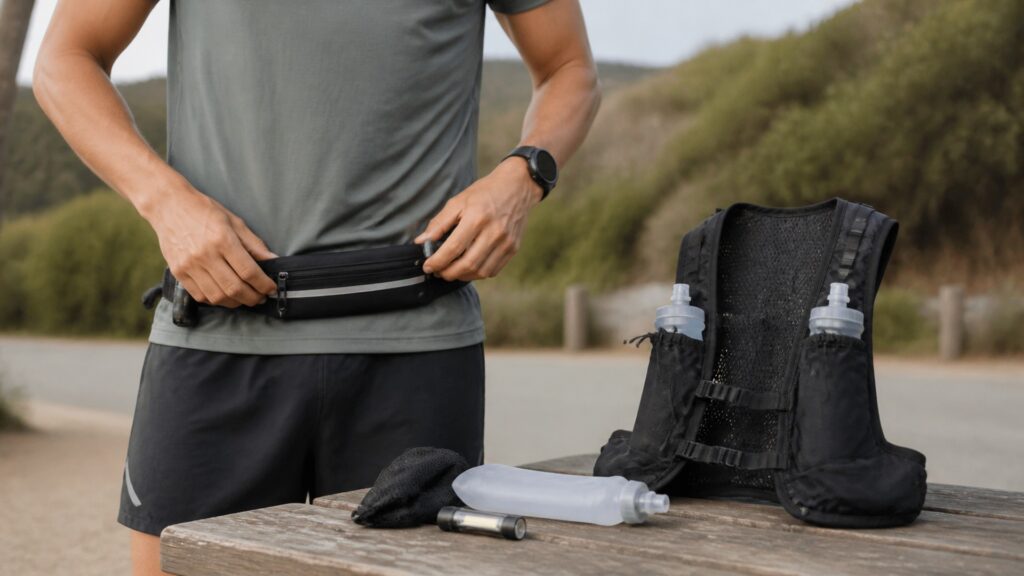
A decision path for choosing general running accessories over hydration-specific gear.
Tip: Choose hydration gear for fluid access. Choose other accessories for the other problems a run creates.
These concepts help decide when fluid-carrying gear is not the main need.
Session fit is how well running accessories matches the purpose of a specific run.
Carry stability is how well gear stays close to the body without bouncing or shifting.
Access while moving is how easily the runner can use gear without stopping.
Weather and route demand are the outside conditions that change what gear is useful.
Comfort cost is the rubbing, heat, weight, or distraction created by carrying gear.
Training role is the job the gear performs within the workout.
Tip: If the run does not need carried fluid, hydration gear may be solving the wrong problem.
Keys, ID, phone, or a gel may not require hydration gear. A small belt, pocket, or holder can solve the carry problem with less bulk.
Small carry needs usually deserve small gear.
Dark routes, traffic, and low-light weather call for lights or reflectors. A hydration vest may have reflective details, but fluid capacity is not the main answer.
Visibility is its own gear job.
Sun, cold, wind, and rain can make hats, gloves, sleeves, shells, or sunglasses more useful than bottles. Hydration still matters in heat, but it is not always the only issue.
Weather support should solve the condition at hand.
A short route, cool day, nearby fountain, or supported event may reduce the need to carry fluid. In those cases, hydration gear can add weight and bounce without much benefit.
Hydration gear is useful when the run actually needs fluid access.
The best choice may be a light, belt, hat, gloves, phone holder, or no accessory at all. Hydration gear should enter the setup when drinking during the run is important.
The lighter setup often wins when fluid carrying is not needed.
The choice depends on whether the run needs fluid access or another kind of support.
The main need is visibility, storage, weather coverage, comfort, or phone access.
The route already solves fluid access or the run is short enough not to need carried fluid.
Heat, distance, duration, or route access make drinking during the run important.
The runner needs bottles, flasks, reservoirs, or a hydration vest.
Hydration gear is useful, but it is not the answer to every running support problem.
It can carry items, but it may be too warm or bulky when fluid is not needed.
Short runs may still need visibility, keys, phone access, or weather support.
Storage and hydration are separate needs.
Prepared means carrying the right items for the route, not the most items.
Tip: Use the item that solves the actual limitation.
Short answers for deciding whether fluid-carrying gear is necessary.
Skip it when distance, heat, and refill access make carried fluid unnecessary.
Use the accessory that solves the run's actual need, such as a light, belt, hat, gloves, or phone holder.
It can when the run needs small storage but not much fluid capacity.
Use hydration gear when drinking during the run is important and other access is limited.
Choose running accessories when the problem is support, storage, safety, or weather rather than fluid carrying.
Use running accessories instead of hydration gear when the run needs support other than carried fluid.
Hydration gear is best when drinking access is the main training need.
Use these Review Streets paths to compare related categories and practical next decisions.
Compare the broader accessory category with hydration-specific gear.
Match accessories to the run type.
Explore running accessories.
Choose a retailer
Prices checked regularly. We may earn a commission at no cost to you.