When to Use Single Axle Utility Trailers Instead of ATV Utility Trailers

Use a general-purpose single-axle utility trailer when its deck, load limits, coupling, and intended operating conditions suit the job better than an ATV-towed work trailer. For example, moving bulky equipment behind a suitable road vehicle calls for a different assessment from moving garden material around a property behind an ATV. One axle alone does not establish road suitability or adequate capacity.

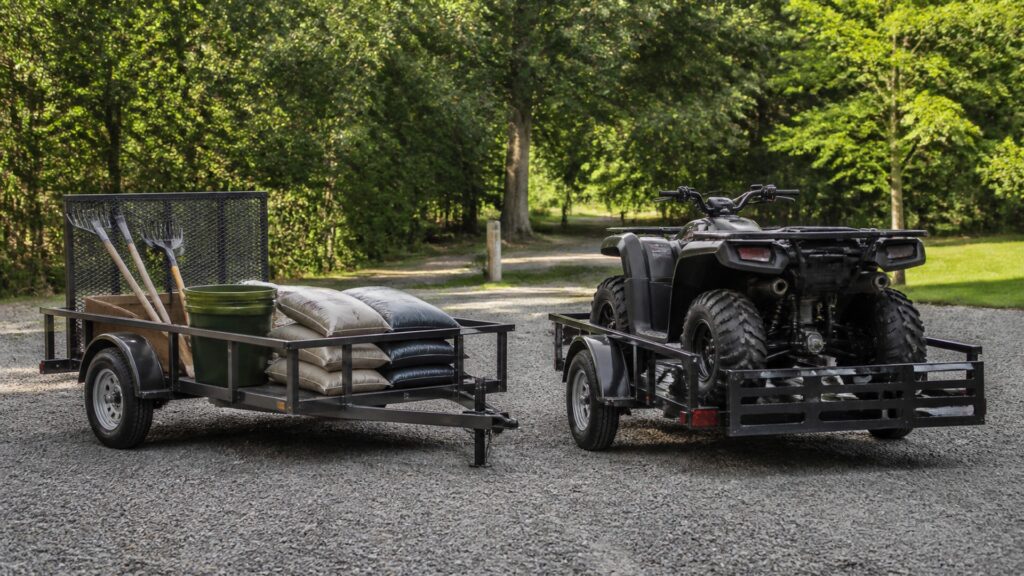
The names overlap: an ATV-towed trailer can also have a single axle. “ATV trailer” can also mean a trailer that carries an ATV, rather than one pulled by it. Here, the comparison concerns an ATV-towed work trailer. If the ATV is the cargo, evaluate its transport using the trailer’s deck, ramp, restraint provisions, and load limits.

By: Review Streets Research Lab
Updated: October 7, 2026
Explainer · 8-12 min read
single axle utility trailers explainer hero image for Review Streets
What You'll Learn

Choose for the Tow Vehicle, Load, and Route

Resolve the intended use before comparing trailer shapes.

  • Why axle count and ATV use are different descriptions
  • When a road-oriented utility trailer may fit the job
  • How towing limits and coupling compatibility interact
  • Why load handling and terrain matter
  • How a mixed road-and-property route changes the choice

Tip: Write down what is towing, what is being carried, and where the combination will travel.

Definitions

Six Terms That Clarify Trailer Choice

Avoid confusing running-gear layout with intended use.

Single axle

Single axle identifies a trailer with one axle assembly supporting its wheels.

  • Example: a utility trailer with one axle beneath the deck
  • Check: the exact trailer ratings and design
  • Limit: axle count alone does not establish highway suitability

ATV-towed trailer

An ATV-towed trailer is intended to be pulled by a compatible ATV under specified conditions.

  • Example: a work trailer carrying material around a property
  • Check: tow-vehicle limits and the trailer’s permitted use
  • Limit: the label does not authorize every terrain or public-road use

ATV transport trailer

An ATV transport trailer carries the ATV as its load.

  • Example: an ATV secured on a utility-trailer deck
  • Check: combined cargo mass, deck, ramp, and restraint suitability
  • Limit: carrying an ATV is different from being towed by one

Loaded trailer mass

Loaded trailer mass includes the trailer itself and everything carried on it.

  • Example: the empty trailer plus tools and equipment
  • Check: trailer and tow-vehicle limits
  • Limit: cargo capacity is not the same as total loaded mass

Coupling compatibility

Coupling compatibility means the connection components match in type, size, rating, and intended application.

  • Example: a specified ball and coupler combination
  • Check: both manufacturers’ instructions and component markings
  • Limit: physical contact alone does not establish a safe connection

Intended operating conditions

Intended operating conditions define where and how the particular trailer is designed to be used.

  • Example: a manufacturer specifying off-road hauling only
  • Check: surface, speed restrictions, terrain, and permitted use
  • Limit: a rugged appearance is not an operating approval

Tip: A trailer can satisfy one description while remaining unsuitable for the actual trip.

Meaning

First Identify What the ATV Is Doing

An ATV pulling a small work trailer and an ATV riding on a transport trailer create different requirements. In the first case, the ATV is the tow vehicle and its towing instructions govern the combination. In the second, its mass and dimensions are part of the cargo assessment. Either trailer might have one axle, so axle count cannot separate the two jobs.

  • Name the towing vehicle explicitly.
  • List the complete load.
  • Confirm whether ATV refers to towing or transport.

This distinction prevents a common selection mistake: choosing a trailer associated with ATVs without establishing whether it was built to carry one or be pulled by one.

Route

Choose a Road-Suitable Trailer When the Trip Requires It

If the assignment includes public roads, verify that the exact trailer and towing combination are suitable and meet the requirements for that location. Do not infer this from a single axle, a ball coupler, or added lights. Some ATV work trailers are expressly limited to off-road use. Clam’s Polar Trailer FAQ, for example, identifies its trailers as off-road hauling products rather than highway trailers.

  • Check the manufacturer’s intended-use statement.
  • Assess the entire route, including short connecting sections.
  • Confirm applicable local requirements before road use.

A general utility trailer intended and equipped for road towing may be the appropriate candidate for a supply trip. A property trailer should not be taken onto the road merely because the distance is short.

Reference: Polar Trailer intended-use FAQ.

Combination

Match the Loaded Trailer to the Tow Vehicle

Assess the trailer’s own limits alongside the towing vehicle, hitch, and coupling limits. Include empty trailer mass, added equipment, and cargo. Check the specified tongue load and load placement requirements rather than applying a single percentage to every trailer type. The tow vehicle must support the actual loaded combination and its operating conditions.

  • Use the exact vehicle and trailer instructions.
  • Match coupling type, size, and rating.
  • Check loaded mass and tongue-load requirements.

A trailer with enough cargo capacity can still be unsuitable for a particular ATV or road vehicle. Carry-On’s utility-trailer manual emphasizes compatible towing and connection equipment; its instructions apply to the relevant trailer configuration.

Reference: Carry-On utility-trailer manual.

Handling

Compare the Deck and Terrain with the Actual Work

A flat utility deck may suit awkward equipment or loads needing a ramp, while a suitable ATV work trailer may offer a tub or tipping arrangement useful for property tasks. These are equipment choices, not promises attached to a category name. Consider gate width, turning room, ground clearance, loading height, and the intended surface within the manufacturers’ limits.

  • Check how the load enters and leaves the trailer.
  • Verify ramp and restraint suitability where needed.
  • Account for access restrictions along the route.

For instance, a bulky machine may fit a utility deck but need a ramp with a suitable rating and geometry. Conversely, a wide deck may be impractical at a narrow property entrance even when its capacity is adequate.

Decision

Select for the Whole Assignment

Choose the general utility trailer when its supported towing arrangement, deck, and route suitability solve the job. Choose an ATV-towed work trailer when the compatible ATV, permitted terrain, and material-handling arrangement fit the task. If neither satisfies the complete route and load, change the transport plan instead of stretching a label into permission.

  • Include the return journey and any changed load.
  • Plan securement appropriate to the cargo.
  • Check that unloading can occur at the destination.

A supply run followed by property distribution may need separate road and property arrangements. Making that separation explicit is better than assuming one trailer can serve both merely because each trip carries the same material.

Reference: NHTSA load-security guidance.

Quick Reality Check

Which Arrangement Fits the Assignment?

These are conditional examples, not universal capabilities.

General utility trailer may fit

An appropriate road-towing combination moving bulky equipment.

A load requiring a suitable deck, ramp, and restraint layout.

ATV-towed work trailer may fit

Property hauling within the ATV and trailer instructions.

Material handling supported by the particular tub or tipping design.

Common Myths

Misconceptions About Trailer Categories

Names do not replace compatibility checks.

Single axle means suitable for highway travel

Intended use and the complete towing arrangement determine suitability.

An ATV trailer always carries an ATV

The phrase may describe a trailer pulled by an ATV or one used to transport it.

Enough trailer capacity means any vehicle can tow it

The tow vehicle and every connection component have their own limits.

A short road section is acceptable for an off-road trailer

Short distance does not override the manufacturer’s use restrictions or applicable requirements.

Tip: Compare exact products and documented uses rather than broad category names.

FAQ

Questions About Choosing a Single-Axle Utility Trailer

Answers for road trips, property work, and ATV transport.

Can an ATV utility trailer also have one axle?

Yes. The descriptions can overlap; one identifies axle layout and the other an intended use.

When should a general utility trailer be considered?

When its load handling, ratings, towing compatibility, and permitted use fit the complete assignment.

Can I carry an ATV on one?

Only if the exact trailer, ramp where used, restraint arrangement, and towing combination are suitable for that ATV and all other cargo.

Does adding lights make a property trailer road-suitable?

No. That does not establish its design suitability or compliance with all applicable requirements.

What if part of the job is on a narrow trail?

Assess the trailer and tow vehicle against that route and their operating restrictions. A different or separate transport arrangement may be needed.

Bottom Line

Choose a single-axle utility trailer when the actual towing combination and deck suit the entire job better than an ATV-towed work trailer.

Axle count is only a description. Verify intended use, load limits, coupling, handling, and route suitability.

Next Steps

Go Deeper or Compare Your Options

Use these Review Streets paths to compare related categories and practical next decisions.