
Clear Space
Clear space is the room needed to move, stop, and recover without hitting people or objects.
- Example: an open lane for a shuttle drill
- Check: check side and stopping room
- Limit: tight spaces make reaction drills risky
Safety factors matter in agility training equipment because the drills often involve speed, stopping, cutting, jumping, reacting, and shared space. A cone, ladder, hurdle, band, or reaction light can be useful, but the setup can also increase trip risk, poor landings, collisions, or overreaching if it is too advanced.
Safer agility training starts with clear space, appropriate spacing, stable surfaces, low obstacles, controlled speed, and drills that match the athlete's current movement ability.
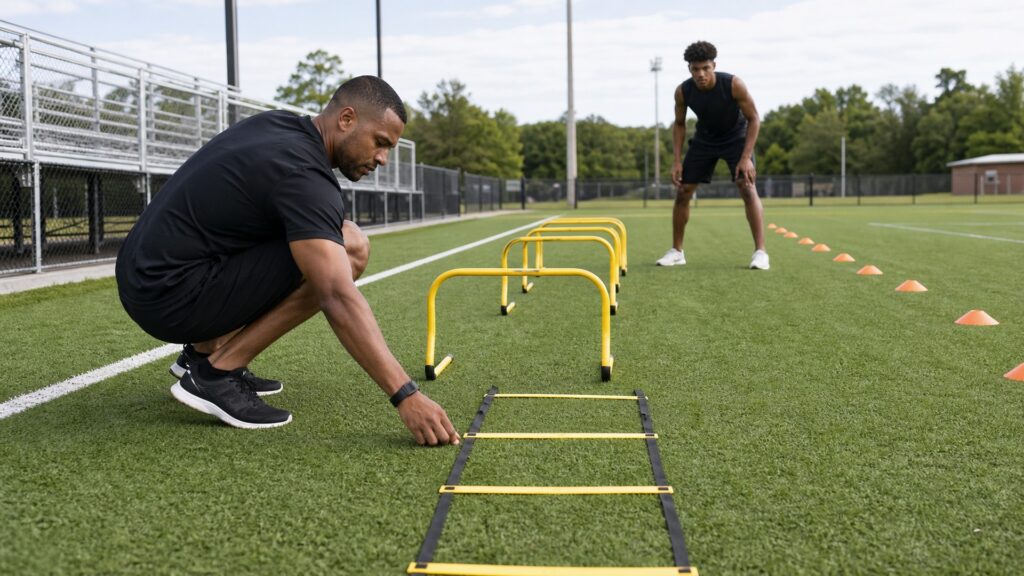
A practical look at space, surface, obstacle height, progression, reaction cues, and fatigue.
Tip: Start with the swimming situation, then choose the gear detail that solves that specific problem.
These concepts keep the decision tied to fit, water conditions, training purpose, and realistic limits.
Clear space is the room needed to move, stop, and recover without hitting people or objects.
Surface grip is how reliably the floor or turf supports starts, stops, and cuts.
Obstacle height is how tall a hurdle, cone, or marker is relative to the athlete and drill.
Progression speed is how quickly the drill advances from slow control to faster reps.
Reaction safety is adding unpredictable cues only after the athlete can move under control.
Fatigue stop is the point where the drill should end because control is fading.
Tip: The useful feature is the one that makes the swim clearer, safer, or easier to repeat.
Agility drills need enough room for movement and stopping. The faster or more reactive the drill, the more escape space the athlete needs.
Space is a safety feature, not just a convenience.
Starts, stops, and cuts depend on the surface. Wet floors, loose turf, uneven ground, or shoes with poor grip can make a safe drill unsafe.
The surface should support the movement before intensity rises.
Hurdles, cones, and ladders should guide movement without forcing awkward reaching or jumping. Lower setups often teach better control.
The obstacle should shape the drill, not surprise the athlete.
A drill can start planned, then become faster or more reactive as control improves. Adding all variables at once makes it harder to see what went wrong.
Progression keeps challenge from turning into chaos.
Agility work can deteriorate quickly when athletes get tired. Sloppy foot placement, upright cutting, stumbling, or delayed braking are signs to pause or simplify.
Quality reps are safer and more useful than extra messy reps.
Safety checks make agility drills easier to scale and repeat.
They reduce trip, slip, collision, and poor-landing risk.
They keep drill difficulty matched to the athlete.
They cannot replace supervision for young or inexperienced athletes.
They do not guarantee safety on poor surfaces or with inappropriate drills.
A simple tool can still create risk when the setup is wrong.
Cones are safer when spacing, speed, and traffic are controlled.
Reaction drills should come after basic mechanics are safe.
Higher obstacles may change mechanics and increase trip risk.
Fatigue can turn a useful drill into poor movement practice.
Tip: Strong claims still need to match the swimmer, pool, and session.
Short answers for practical swimming decisions.
Check space, surface, shoes, obstacle height, athlete readiness, and stopping room.
They can be, when flat, simple, and used at controlled speed.
Add them after the athlete can stop, cut, and move through the basic pattern safely.
Use the lowest height that supports the drill purpose and clean movement.
Scale agility equipment so movement stays controlled before speed, reaction, or complexity increases.
Agility training equipment safety factors matter because speed, cutting, obstacles, reaction, surface, and fatigue can all change risk.
The safest setup gives athletes enough room, grip, progression, and control to practice clean movement.
Use these Review Streets paths to compare related categories and practical next decisions.
Explore tools for footwork, change of direction, and reaction drills.
See how cones, ladders, hurdles, cues, and timers shape practice.
Browse related fitness training equipment categories.
Choose a retailer
Prices checked regularly. We may earn a commission at no cost to you.