
State Table
The firewall's active record of observed connections and their protocol, endpoints, direction, timing, and handling state.
- Creation: follows a permitted start
- Return: matches related packets
- Expiry: removes idle or closed state
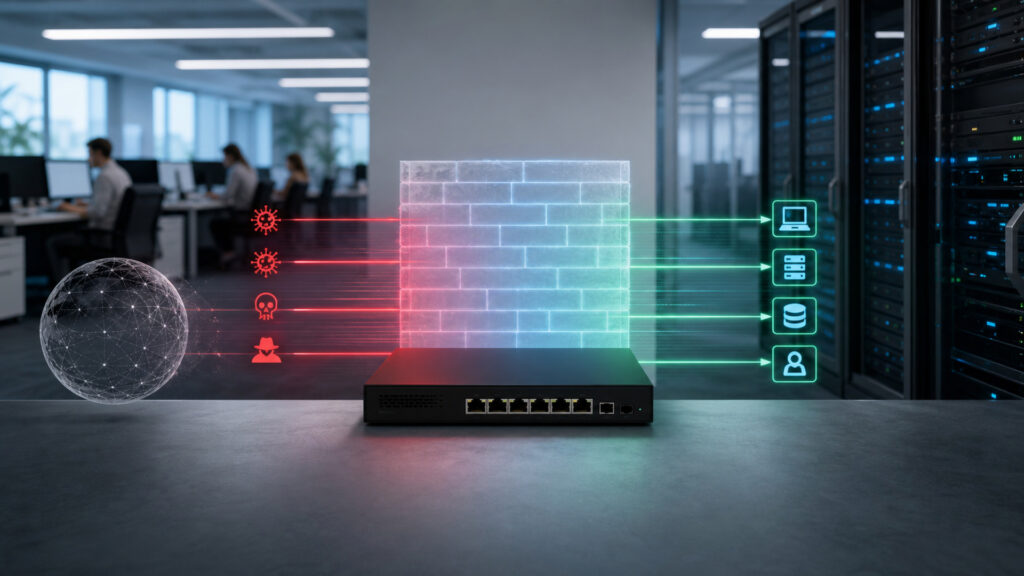
Business firewalls matter because network reachability is otherwise determined mainly by addressing and routing: if a path exists, a device can attempt a connection. A firewall inserts an enforcement point where the organization can decide which sources, destinations, services, users, devices, and applications may communicate—and record what was attempted.
Modern firewalls track connection state, apply ordered policy among security zones, translate addresses, terminate encrypted tunnels, identify some applications, inspect selected content, and generate evidence. Those mechanisms reduce exposed services, constrain lateral and outbound paths, and support containment. They also create a critical dependency. Poor rules, bypass routes, overloaded inspection, asymmetric traffic, weak administration, or failed redundancy can disrupt legitimate business service while leaving unwanted paths open.
Follow packet classification, ordered rules, connection state, inspection, translation, performance, resilience, logging, and rule governance.
Tip: Choose one permitted application and trace its source zone, identity, device, destination, name resolution, route, port, protocol, application signature, inspection action, translation, return path, log, owner, and expiration condition.
These terms describe the classification, state, transformation, inspection, and performance mechanisms a firewall applies to traffic.
The firewall's active record of observed connections and their protocol, endpoints, direction, timing, and handling state.
A logical grouping of interfaces or networks used to express policy between trust or function boundaries.
An ordered condition-and-action statement controlling traffic that matches defined attributes.
Classification that uses traffic behavior, signatures, protocol decoding, and sometimes decryption beyond a simple port number.
A controlled process that decrypts eligible encrypted sessions for policy inspection and re-encrypts permitted traffic.
Inspection that compares traffic or decoded content with exploit, malware, anomaly, reputation, or protocol rules.
Tip: A rule base should describe required business flows, not merely accumulated exceptions. Every broad source, destination, service, application, or any-any condition expands reachable attack paths and complicates later review.
The firewall receives a packet, identifies ingress interface and zone, parses the five-tuple, consults routing and policy, then uses connection tracking to create state for a permitted flow. Related return packets can match that state rather than open an independent inbound path.
Stateful inspection matters because the policy can govern who initiates communication while recognizing the valid return path of an approved exchange.
Rules commonly match source and destination zones, networks, identities, devices, applications, services, schedules, or tags. Evaluation order and implicit defaults determine which action actually applies, not the administrator's informal intention.
A firewall constrains movement only when its zones correspond to meaningful boundaries and its effective rule order permits no unexplained alternate match.
Port-based policy cannot reliably identify every modern application. Protocol decoding, intrusion prevention, DNS and reputation context, and selective decryption can add visibility. Egress filtering restricts destinations and channels available after compromise.
Inspection improves policy context but also adds privacy, trust, compute, compatibility, and false-positive costs that must be governed rather than enabled indiscriminately.
Published firewall throughput varies with packet size, encryption, threat profiles, logging, concurrent sessions, tunnels, network address translation, and enabled features. High-availability pairs need synchronized state, independent paths, correct routing, and sufficient capacity after failure.
A firewall protects the business only while it can process peak and degraded traffic predictably; saturation or failed convergence can resemble an application outage.
Traffic decisions, threats, administrator changes, configuration versions, system health, and authentication events create an audit trail. Recertification ties each rule to an active owner, valid purpose, necessary scope, and reviewed risk.
Firewall value compounds when evidence supports investigation and stale reachability is removed; without governance, rules gradually become an undocumented parallel network architecture.
It can enforce and observe selected paths while legitimate applications, identities, endpoints, and bypass routes remain separate risk surfaces.
It reduces exposed services, controls initiation and egress, segments important zones, adds application context, records decisions, and offers selective containment points.
It also centralizes encrypted remote access and selected threat inspection.
Applications must authorize actions, endpoints must resist compromise, identities must be protected, data must be governed, and alternate cloud or local paths must be controlled.
Permitted encrypted sessions can carry harmful activity beyond firewall visibility.
These claims overstate appliances, encryption inspection, and default configurations while ignoring placement, policy, state, and operations.
An appliance changes nothing until traffic crosses it and well-designed policy is enforced. Bypass paths, broad rules, weak administration, unpatched software, stolen identities, permitted applications, and unmanaged endpoints can still enable compromise.
Compromised internal systems can connect outward, use permitted cloud services, resolve malicious domains, or move laterally. Egress controls, internal segmentation, identity, endpoint security, application authorization, telemetry, and response address paths beyond unsolicited inbound traffic.
Inspection covers only eligible traffic that passes through configured decryption. Certificate pinning, unsupported protocols, privacy exclusions, unmanaged devices, alternate paths, application-layer encryption, and performance constraints can preserve blind spots or break sessions.
A redundant peer helps only when state synchronization, links, routing, power, configuration, software, licensing, and capacity survive the initiating fault. Shared mistakes or upstream failures can disable both units or prevent usable convergence.
Tip: For each firewall claim, identify the enforcement path, effective rule, observed fields, encrypted visibility, state behavior, failure mode, log destination, policy owner, and controls operating beyond the firewall.
These questions explain firewall placement, rule design, encrypted inspection, sizing, redundancy, and evidence in operational terms.
Place enforcement at boundaries where required flows and trust differ: internet edges, data centers, cloud networks, remote access, guest networks, sensitive servers, management, or operational environments. Avoid designs that invite uncontrolled bypass paths.
A router selects paths among networks. A stateful firewall also evaluates connection context and security policy, often adding application inspection, threat controls, translation, tunnels, identity, and logging. Many appliances perform both functions.
Review continuously through ownership and expiry metadata, with periodic risk-based recertification and after application, network, threat, or organizational change. Prioritize broad, unused, shadowed, temporary, internet-facing, administrative, and sensitive-zone access first.
No universal answer fits. Base decryption on risk, legal and privacy duties, workforce notice, data sensitivity, technical compatibility, key protection, performance, and alternative controls. Document exclusions and monitor the resulting visibility gaps.
Use realistic packet sizes, concurrent sessions, new connections, encrypted traffic, VPNs, enabled inspection profiles, logging, routing, and failure-state load. Vendor headline throughput measured with lighter features may not represent production behavior.
Retain policy decisions, threats, application identity, translations, remote access, authentication, administrator changes, configuration versions, health, failover, and resource saturation with synchronized time and enough source, destination, rule, zone, and session context.
Business firewalls matter because they convert routable paths into stateful, observable policy among zones. They govern connection initiation, return state, segmentation, egress, selected application behavior, encryption, translation, and containment.
Their value depends on correct placement, narrow effective rules, sufficient inspected capacity, resilient routing, protected administration, useful logs, and continuing rule ownership. A firewall is a critical enforcement layer, never the whole security system.
These explainers place firewall enforcement inside the wider trust system, packet-delivery path, and availability design that determine whether policy works safely.
Place firewall policy inside identity, device trust, segmentation, management protection, telemetry, containment, and recovery.
Trace switching, addressing, DNS, routing, NAT, VPNs, and return paths around firewall decisions.
Learn how failure domains, diversity, convergence, degraded capacity, evidence, and recovery preserve service.
Choose a retailer
Prices checked regularly. We may earn a commission at no cost to you.