
Connection Resistance
Unwanted opposition at a terminal, splice, fuse holder, or ground joint that can create voltage loss and heat under current.
- Appearance may remain normal
- Load reveals the voltage drop
- Heat or discoloration requires attention
Car audio systems live with vibration, temperature swings, dust, moisture, cargo movement, battery service, phone updates, and repeated control use. Those conditions can raise connection resistance, loosen mounts, block cooling, damage speaker suspensions, corrupt a saved configuration, or create a rattle that masquerades as an electrical fault.
Maintenance matters because a tuned system has a known starting condition worth preserving. Periodic inspection and records reveal whether performance changed at a terminal, fuse holder, driver, enclosure, software interface, or calibration setting. That evidence prevents routine aging from turning into random gain changes, repeated part swaps, or unsafe attempts to restore loudness.
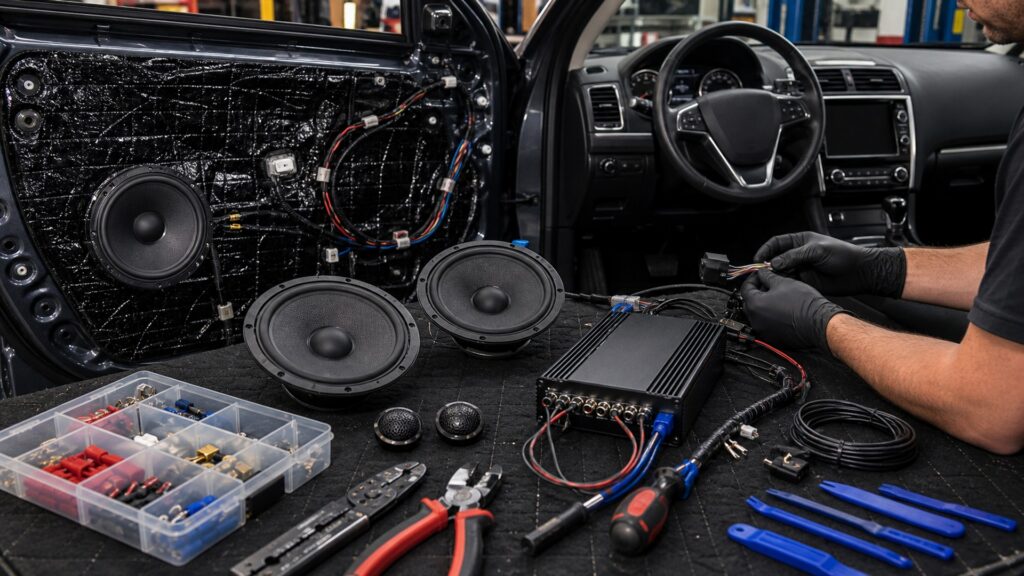
The maintenance role is to preserve known electrical, mechanical, thermal, environmental, and configuration conditions so new symptoms, including ground voltage drop, can be compared with reliable evidence.
Tip: Before changing equalization or gain, compare the same source, settings, vehicle state, and listening position with the documented baseline.
The key terms describe slow changes that can alter output even when the installed component list remains identical.
Unwanted opposition at a terminal, splice, fuse holder, or ground joint that can create voltage loss and heat under current.
The documented state of fasteners, brackets, grilles, panels, cones, surrounds, and enclosure seals when the system operates correctly.
The clearance and airflow that allow an amplifier or processor to release heat during operation.
Moisture entering doors, trunks, floors, connectors, or equipment locations through leaks, drains, seals, or spills.
A saved copy of interface programming, crossover, level, delay, equalization, and related settings for restoration or comparison.
A repeatable source, track, volume, vehicle state, seat, and test method used to compare system behavior over time.
Tip: Record the before-and-after condition; maintenance without a baseline can accidentally erase the evidence needed to find the fault.
Vibration, oxidation, thermal cycling, and service work can change terminals or fuse holders. Under load, added resistance reduces voltage and creates heat. A visual check is useful, but voltage-drop testing under the documented operating condition provides stronger evidence.
Restored continuity returns the circuit to baseline; it does not justify a larger fuse or more gain.
Cone surrounds flex, adhesive joints experience heat, grilles collect debris, enclosure seals compress, and panels can loosen. Buzzing or reduced bass may therefore arise after the amplifier output, where electrical replacement cannot repair an air leak or vibrating trim clip.
Mechanical maintenance protects the acoustic boundary without rewriting the tune.
Door and trunk locations can receive water from failed membranes, blocked drains, damaged seals, spills, or condensation. Amplifiers can overheat when vents are covered or dust traps heat. Both problems may be intermittent before corrosion or repeated thermal protection becomes obvious.
Cleaning equipment is secondary to correcting the environmental cause.
Phones, receivers, integration modules, and processors may receive separate updates. A compatibility change can affect wireless connection, steering controls, cameras, prompts, or stored tuning. Maintenance records should identify versions and preserve supported configuration files before a sanctioned update.
Firmware maintenance is controlled change, not a reflexive factory reset.
Use the same reference source, track, settings, seat, and vehicle state to compare channel balance, noise, bass integrity, rattles, temperature, and protection behavior. Trends across dates are more useful than an isolated memory of how the system once sounded.
Maintenance closes with a verified return to known function or a clearly bounded repair finding.
Inspection, cleaning, records, and controlled updates can prevent or reveal drift, but failed materials and unsafe circuits require repair.
Keeping terminals protected, cooling clear, mounts secure, drains functional, and settings backed up reduces avoidable faults.
A repeatable listening and measurement baseline makes subtle channel, noise, rattle, and shutdown changes easier to locate.
Melted insulation, repeated fuse opening, water-damaged electronics, burnt odor, unstable charging voltage, or damaged speaker structures require root-cause repair.
Retightening, resetting, or retuning cannot restore a conductor, connector, voice coil, adhesive joint, or module that has physically failed.
These myths turn maintenance into cleaning, habitual adjustment, or automatic replacement instead of evidence-based preservation.
Sealed electronics may have no routine internal service, but the installed system still faces vibration, heat, moisture, blocked airflow, connector stress, speaker motion, software changes, and cargo contact. Periodic external inspection can reveal those changing conditions early.
Equalization or gain can hide a symptom while increasing stress elsewhere. Compare source settings, voltage, connections, polarity, speaker condition, enclosure sealing, rattles, and software state first; retune only after the physical and electrical baseline passes.
A fuse element may be intact while its holder or terminal has resistance, looseness, corrosion, or heat damage. Inspect safely and evaluate voltage drop under load; never bypass protection to determine whether output returns.
A reset can erase channel routing, crossovers, delay, equalization, camera settings, integration programming, or paired-device behavior. Use it for a documented reason, preserve compatible backups, and plan a complete post-reset functional check.
Tip: Do not erase the baseline with a reset or tune change until power, wiring, mechanics, environment, and software state have been recorded.
These questions focus on maintenance intervals, safe inspection, baselines, updates, and symptoms that should not be managed with settings alone.
Use the equipment and installer guidance, then inspect after relevant events such as battery service, water leaks, trim removal, cargo impact, repeated thermal protection, or a new noise. Fixed intervals alone cannot predict vehicle-specific exposure.
Only with the circuit made safe according to vehicle and equipment instructions, the correct tool and torque guidance, and confidence in the connection design. Damaged, overheated, corroded, or unfamiliar high-current wiring should be handled by qualified service.
Phone, receiver, and integration firmware evolve independently. Record versions, confirm supported connection requirements, remove stale pairings only when instructed, and retest microphones, calls, audio routing, controls, and other retained functions after the update.
Protection can respond to temperature, supply voltage, shorted wiring, or an unsupported load. Clear ventilation and reproduce the condition safely, then test power, ground, speaker circuits, impedance configuration, and temperature instead of repeatedly restarting the amplifier.
Keep wiring and channel maps, fuse ratings, speaker loads, interface and firmware versions, tune files, baseline measurements, installation photos, water or battery service history, and dated symptoms. Together they preserve context that a component list cannot.
Car audio maintenance matters because electrical, mechanical, environmental, and software conditions can drift while the equipment list stays unchanged.
Protect the original baseline with safe inspections, configuration backups, repeatable tests, and event-based checks. Repair physical or electrical causes before retuning, and treat heat, water, damaged wiring, or repeated protection as diagnostic findings.
These related explainers show the operating chain, the vehicle-specific fitment constraints, and the safety controls that maintenance is meant to preserve.
Use defined inputs, outputs, and limits to place a newly discovered maintenance fault in the correct system block.
Review the vehicle, integration, wiring, speaker, enclosure, and mounting constraints that establish the system's original baseline.
Recheck fusing, conductor condition, secure mounting, retained alerts, display behavior, and listening use when maintenance reveals change.
Choose a retailer
Prices checked regularly. We may earn a commission at no cost to you.