
Battery-Side Fuse
An overcurrent device intended to interrupt a fault before an unfused power cable can overheat along its vehicle route.
- Placement limits unprotected cable length
- Rating must suit the conductor
- A fuse does not regulate normal gain
Car audio safety begins where electrical energy leaves the battery, but it does not end at the amplifier. A protected power cable, supported speaker load, secure enclosure, guarded wire route, and ventilated mounting location all prevent an entertainment upgrade from creating heat, abrasion, movement, or crash hazards inside the vehicle.
The system also participates in how people operate the car. Warning tones may pass through factory audio hardware, screens can invite long glances, and high listening levels can mask outside cues or add hearing exposure. Safety factors matter because excellent playback cannot compensate for a compromised restraint zone, disabled alert, unstable power connection, or distracting interface.
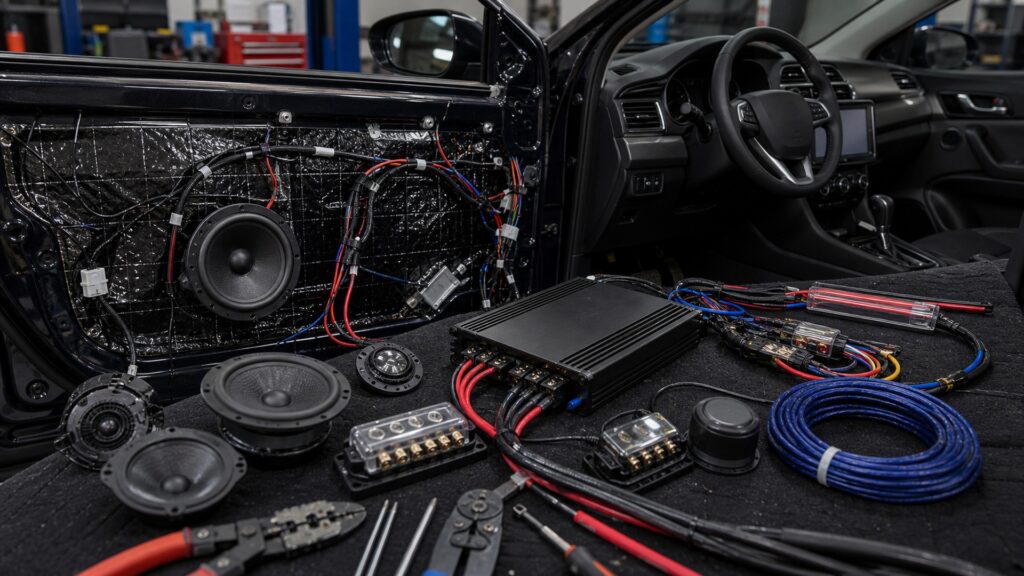
Cable current capacity, the chassis ground path, amplifier thermal protection, and secured component mounting are distinct from retained vehicle functions, driver interaction, and listening exposure; each boundary requires its own evidence.
Tip: Close the installation only after checking both vehicle states and human use: key off, cranking, driving functions, alerts, visibility, control reach, and realistic listening level.
The safety vocabulary separates cable protection, electrical loading, physical placement, retained alerts, visual interaction, and cumulative sound exposure.
An overcurrent device intended to interrupt a fault before an unfused power cable can overheat along its vehicle route.
The connection carrying amplifier current back through approved conductors and vehicle structure to the charging system.
The frequency-dependent electrical load an amplifier encounters through the connected speakers and wiring configuration.
The space an airbag, trim panel, seat mechanism, or restraint component needs to move as designed during a crash.
A warning chime, prompt, parking tone, or other safety-relevant sound that the vehicle may deliver through audio electronics.
The visual attention required to locate, read, and operate a control while the primary task remains driving.
Tip: Do not combine these terms into one vague 'professional installation' claim; each boundary needs a product- and vehicle-specific check.
A battery-connected lead can deliver damaging current if insulation is crushed, cut, or shorted to vehicle structure. A correctly selected fuse near the source limits the length of conductor that remains unprotected, while grommets, loom, clearance, and secure routing reduce the chance of a fault beginning.
The fuse is a cable-fire control; it is not an audio filter or a cure for weak voltage.
Amplifier demand changes with supply voltage, program content, output level, channel mode, and connected speaker impedance. Excess resistance in power or ground wiring wastes voltage as heat, while an unsupported load can increase current and trigger distortion, shutdown, or component damage.
Electrical safety depends on the complete circuit, not the advertised wattage printed on one device.
An amplifier, processor, capacitor, or subwoofer enclosure becomes part of the vehicle interior. Fasteners, brackets, cable strain relief, ventilation, cargo access, seat travel, water exposure, and restraint deployment paths determine whether it remains safe during braking, a collision, or ordinary service.
A component that sounds stable while parked may still be an unsecured mass when the vehicle changes speed.
Factory amplifiers and receivers may reproduce warning chimes, navigation prompts, calls, parking tones, or other information. Replacement interfaces and programming must preserve required behavior. Video and configuration functions intended only for a stopped vehicle should retain their designed lockouts rather than be bypassed.
Entertainment functionality is incomplete when the vehicle loses a sound, display behavior, or control it uses to inform the driver.
A touchscreen task can draw eyes and a loud system can dominate hearing even when the installation is electrically correct. Interface layout, physical controls, voice operation, notification behavior, playback level, exposure duration, and the need to hear surrounding cues all shape real-world risk.
No universal knob position defines safety; the relevant evidence is how the system affects attention, communication, outside awareness, and hearing over time.
A documented installation can address foreseeable electrical, physical, and interaction hazards without replacing the vehicle maker's procedures or a qualified inspection.
Source-side fusing, guarded routing, supported loads, secure mounts, retained alerts, and post-install tests address identifiable failure paths.
Configuration records and measured voltage, polarity, impedance, and function results make later changes easier to evaluate safely.
Unknown airbag zones, high-current modifications, damaged vehicle wiring, water intrusion, unstable charging voltage, or unexplained heating call for vehicle-specific expertise.
Compliance with one component manual cannot establish that the whole installation meets every applicable vehicle, electrical, occupational, insurance, or local legal requirement.
These myths confuse normal operation, a powered indicator, or a tidy appearance with evidence that every safety boundary has been controlled.
A larger fuse can leave the installed cable insufficiently protected and allow more fault energy before opening. Repeated fuse operation calls for diagnosis of current demand, conductor condition, connections, load, and equipment faults—not a higher rating.
Battery power cables and amplifier outputs can carry substantial current. Pinched insulation, unfused conductors, loose terminals, undersized wire, or unstable speaker loads can create heat, arcing, shutdown, or fire risk even in a nominally low-voltage vehicle.
Some vehicles generate or route chimes, calls, parking tones, and prompts through the original receiver or amplifier. Retention depends on the exact architecture, compatible interface, programming, connections, and a deliberate test of each function.
Audible distortion is not a reliable exposure meter. Hearing risk depends on sound level, duration, frequency content, repeated sessions, and individual factors. Reduced outside awareness or post-listening ringing warrants lower level and shorter exposure.
Tip: Treat heat, odor, repeated fuse opening, lost warnings, screen lockout changes, loose hardware, ringing ears, or hidden wiring damage as stop signals.
These answers identify when an audio safety question can be checked directly and when vehicle or product instructions must control the decision.
Follow the amplifier, fuse-holder, cable, and vehicle instructions. The protective device is normally placed close to the battery connection so little cable remains unfused, but exact routing, rating, terminal protection, and service procedure are application-specific.
The connected load influences amplifier current and heat. Parallel speakers or bridged wiring can present a lower load than expected. Confirm nominal configuration and manufacturer limits, then investigate protection events rather than repeatedly restarting an overheated or overloaded channel.
Follow current vehicle and equipment procedures. Disconnecting may be required before wiring work, yet some vehicles need special shutdown, memory, high-voltage, security, or relearn steps. Never assume one generic sequence covers every electrical architecture.
Use suitable vehicle structure, rated hardware, and a design that accounts for enclosure mass, braking and crash forces, cargo movement, access, water, ventilation, and seat travel. Hook-and-loop alone may not restrain a heavy enclosure during severe deceleration.
Check starting and charging behavior, parasitic shutdown, alerts, steering controls, microphones, cameras, lighting, HVAC access, seat and restraint movement, amplifier temperature, speaker operation, cable security, and clear driver sightlines under the states the installation can affect.
Car audio safety factors matter because the system joins battery energy, occupant space, vehicle warnings, driver attention, and sound exposure.
Protect the feed, support the connected load, secure every component, preserve the vehicle's alerts and lockouts, and test realistic use. A clean-sounding result passes only after those independent boundaries also pass.
The next explainers show where the system meets the exact vehicle, how signal and power move through it, and which recurring checks catch degradation after installation.
Map vehicle data, factory amplifiers, airbags, openings, speakers, and routing before deciding whether an installation can retain every required function.
Trace the ordinary signal and power paths so protection devices, amplifier loads, interfaces, and outputs can be checked in operating order.
Use periodic connection, cooling, speaker, software, and baseline checks to detect changes before they become heat, shutdown, or lost-function problems.
Choose a retailer
Prices checked regularly. We may earn a commission at no cost to you.