
Build quality
Build quality is how well materials, design, and assembly hold up under repeated training use.
- It affects stability and durability.
- It includes details that are not obvious in photos.
- High price does not guarantee it.
Exercise equipment quality matters because training equipment is repeatedly loaded, adjusted, gripped, sweated on, and trusted during awkward positions. Small construction details can affect stability, adjustment, durability, and the user's confidence under load.
Quality is not just a premium label. Welds, hardware, steel thickness, bearing or bushing feel, padding density, weight accuracy, finish durability, and tolerance all change how equipment behaves after months of real use.
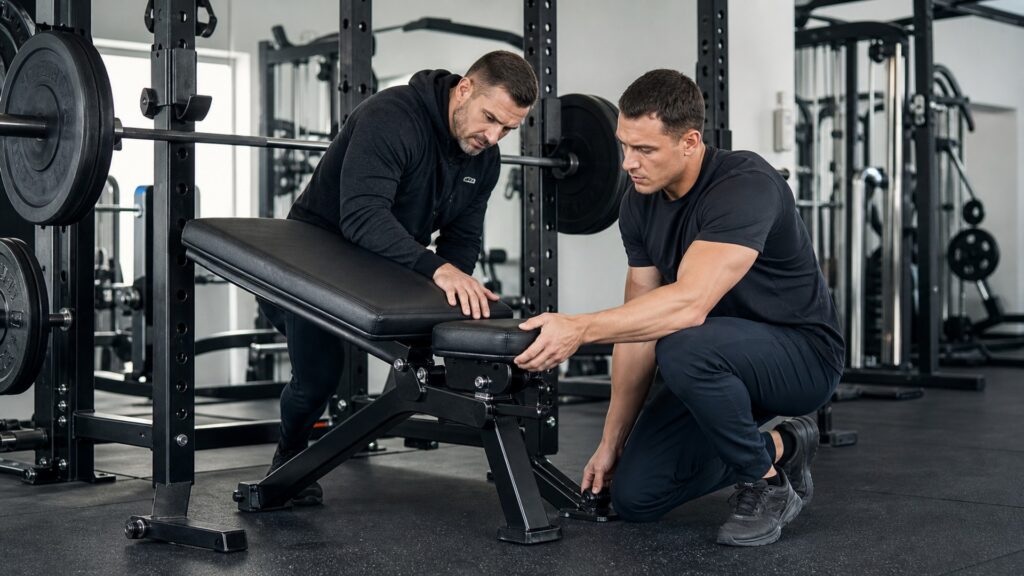
Exercise equipment quality matters when materials, tolerances, hardware, stability, surface finish, padding, and weight accuracy affect repeated training.
Tip: Judge the equipment by the training job it changes, then compare features.
Build quality is how well materials, design, and assembly hold up under repeated training use. The remaining concepts define the variables that change actual use.
Build quality is how well materials, design, and assembly hold up under repeated training use.
Tolerance is how precisely parts fit together.
Steel gauge describes the thickness of steel tubing or parts.
Bearings and bushings allow rotating parts such as bar sleeves or pulleys to move.
Padding density is how firm or supportive upholstery feels under load.
Weight accuracy is how close plates, dumbbells, or stacks are to their labeled weight.
Tip: Tolerance is how precisely parts fit together.
A rack, bench, bar, dumbbell, or cable station may look fine unloaded but reveal flex, wobble, or rough movement during training.
Quality matters when load exposes weakness.
Strength equipment is adjusted constantly. Pins, hooks, sleeves, knobs, and pop-pins need to move smoothly and lock predictably.
Quality changes daily usability.
Knurling, handles, upholstery, foot plates, and grips determine how secure the user feels during hard sets.
Contact quality affects confidence.
Finish, hardware, bushings, upholstery, and moving parts show quality over time.
Durability is part of training value.
Not every user needs commercial-grade everything. The key is spending where failure, wobble, or inaccuracy would affect training most.
Quality matters most where the equipment carries trust.
The useful answer follows the actual mechanism, setup, and training condition rather than a generic upgrade claim.
It explains what exercise equipment quality changes in real training.
It gives readers practical comparison criteria without overstating outcomes.
It cannot guarantee performance, recovery, injury prevention, safety, or health outcomes.
Build-quality guidance cannot diagnose equipment misuse, pain, or facility safety concerns that require expert inspection or professional care.
Common shortcuts and misunderstandings can make the topic seem simpler than it is.
The useful choice depends on body size, skill, setup, environment, goal, and tolerance.
Extra features help only when they solve a specific movement, setup, or feedback problem.
Gear can support training decisions, but it cannot control technique, fatigue, progression, recovery, or risk.
A tool can feel good while still being poorly matched to the goal.
Complex lifts, stroke changes, pain, and symptoms need more context than a product page can provide.
Tip: For exercise equipment quality, follow the mechanism before accepting broad gear claims.
Concise answers to common questions readers may have after the main explanation.
Start with the physical job: load support, resistance path, grip, stability, vision, buoyancy, propulsion, or stroke feedback.
No. It can support better training decisions, but it cannot guarantee performance, safety, recovery, or injury prevention.
Compare the mechanism, fit, setup, adjustment range, durability, and training context before brand claims.
Test the setup during ordinary training before using it for heavy attempts, races, long sessions, or technical work.
Qualified coaching or medical guidance matters for complex technique, pain, symptoms, injury concerns, or individualized programming.
Exercise Equipment Quality matters when it changes a specific movement, setup, feedback, or progression problem.
The best decision matches mechanism, fit, training context, and evidence limits instead of treating equipment as a shortcut.
Use these related explainers to continue the Review Streets fitness decision path around exercise equipment quality.
Use it to place this strength-equipment topic inside the broader equipment system.
Read it when load increments, exercise setup, and progression are central to the choice.
Use it for the free-weight side of strength-equipment comparisons.
Choose a retailer
Prices checked regularly. We may earn a commission at no cost to you.